
The Timeline of a Dog’s Chronic Illness: What to Expect

Updated: May 20
By the time a chronic disease is diagnosed, it has usually been quietly developing for months or years. In human medicine, about 40% of obese adults develop at least one chronic illness within five years – and nearly 30% of those go on to develop multiple chronic conditions within ten years.[1]
The point isn’t the human statistic itself. It’s what it reveals: chronic disease is rarely a single moment. It’s a timeline – a long, uneven road with patterns that science can describe, but not predict with precision.
When your dog is suddenly labeled “chronic” – kidney disease, diabetes, heart failure, cancer, autoimmune disease, epilepsy – it can feel like the future has turned into a blank page of dread.

This article is about sketching in that page: not with exact dates or guarantees, but with shapes, phases, and realistic expectations you can carry into conversations with your vet, and into your own thinking.
Chronic illness as a trajectory, not a straight line
Medicine uses the term illness trajectory to describe how a disease tends to unfold over time.[5]
That trajectory includes:
Changes in symptoms and body function
Shifts in treatment goals
Emotional ups and downs for both patient and caregiver
Practical workload: appointments, medications, monitoring, decision-making
For dogs, as in humans, chronic disease usually doesn’t move in a smooth downhill curve. Instead, it tends to move through phases.

A widely used framework in chronic care describes phases like:[7]
Pre-trajectory – disease is developing silently, no obvious signs
Trajectory onset – first symptoms, tests, and diagnosis
Stable phase – condition controlled, life feels relatively “normal”
Unstable / exacerbations – flare-ups, medication changes, new symptoms
Acute episodes / crises – hospitalization-level events, emergencies
Comeback – partial recovery of stability after a crisis
Downward phase – more frequent or severe problems, reduced function
Dying phase – final decline and end-of-life period
Not every dog goes through every phase, and not in a neat sequence. But this map is useful because it tells you:
What you’re feeling now is part of a known pattern
Your dog’s needs – medical and emotional – will change over time
Your needs as a caregiver will change too
Key terms you’ll hear (and how to think about them)
You may hear your vet use language that sounds very clinical when your brain is busy trying not to fall apart. These concepts can actually be grounding once you translate them.

1. Disease staging
Disease staging means classifying how advanced a condition is. For example, chronic kidney disease (CKD) is often staged from 1 to 5 based on kidney function tests (like estimated glomerular filtration rate, or eGFR, in humans).[3][14]
What staging does:
Helps estimate risk and likely pace of progression
Guides treatment intensity (diet, medications, monitoring)
Gives a shared language between you and your vet (“we’re still in early stage,” “we’re moving into a later stage”)
What staging does not do:
It does not give an exact timeline
It does not tell you exactly how your dog feels day-to-day
It does not remove uncertainty
Two dogs in the same stage can have very different experiences and speeds of decline.
2. Multimorbidity
Multimorbidity means having two or more chronic conditions at the same time.[1]
In people, research shows patterns like:
Chronic diseases often appear sequentially – one increases the risk of another
From the first metabolic disease (like diabetes), some people progress to three chronic conditions in about four years on average[1]
In dogs, we see similar patterns: a dog with long-term obesity might later develop arthritis, diabetes, or heart issues. Kidney disease may coexist with high blood pressure or heart disease.
The takeaway isn’t “disaster is coming.” It’s:
Once one chronic disease appears, the vet team often monitors more broadly
You may see new diagnoses over the years – not because anyone failed, but because this is how biology often behaves
3. Illness trajectory vs. prognosis
Illness trajectory = pattern over time (ups, downs, plateaus)
Prognosis = best estimate of likely course and outcome
Both are probabilistic, not guaranteed. Your vet is balancing:
What’s known from studies and guidelines
Your dog’s specific test results
How your dog actually behaves and feels at home
Your goals and limits as a caregiver

Common trajectory patterns in chronic disease
Different diseases often follow different shapes of decline.[5][11] Understanding the pattern doesn’t change the outcome, but it can change how prepared you feel.

1. “Mostly stable, then steep decline” (often seen in cancers)
Pattern:
Longish period where your dog seems relatively okay
Symptoms may be controlled with treatment
Then, over weeks to a few months, a more rapid decline
What this can feel like:
“We were fine… and then suddenly we weren’t.”
Shock at how quickly things changed near the end
Second-guessing earlier decisions, even if they were reasonable at the time
2. “Slow, gradual decline” (often organ failure, some heart disease)
Pattern:
Subtle changes over months or years: energy, appetite, stamina
Periodic medication adjustments
Increasing limitations (shorter walks, more rest, diet changes)
Eventually, daily life shrinks around the disease
What this can feel like:
Long-term vigilance and fatigue
Grief in slow motion: losing little bits of the dog you knew
A constant sense of “Is this still okay? Is this still fair to them?”
3. “Up and down in bursts” (some autoimmune diseases, epilepsy, asthma-like conditions)
Pattern:
Periods of relative stability
Sudden flares, crises, or seizures
Recovery to “almost normal,” but never quite the old baseline
What this can feel like:
Living on edge, waiting for the next episode
Difficulty planning anything – trips, work, social life
Guilt if a crisis happens on a day you let your guard down
Most chronic illnesses in dogs are some mix of these patterns. Over time, you and your vet start to recognize your dog’s specific trajectory.
The emotional timeline: not linear, but very real
Medical timelines get charts. Emotional timelines mostly get silence.

Yet research is clear: chronic illness has a profound psychological impact on patients and caregivers.[2][4][8][10]In humans with chronic disease, rates of depression are about 2–3 times higher than in the general population.[4][8] The same emotional themes show up in owners of chronically ill dogs.
You may move in and out of:
Shock / disbelief – “This can’t be happening. He’s only six.”
Denial – avoiding reading about the disease, hoping it’s a mistake
Anger – at the vet, at yourself, at the universe, at the breeder, at past you who fed the wrong food
Bargaining – “If this treatment works, I’ll do everything perfectly from now on”
Sadness / depression – heavy, persistent grief even while your dog is still here
Acceptance (with flare-ups of everything above) – understanding the reality, making thoughtful decisions, still having moments of anger or despair
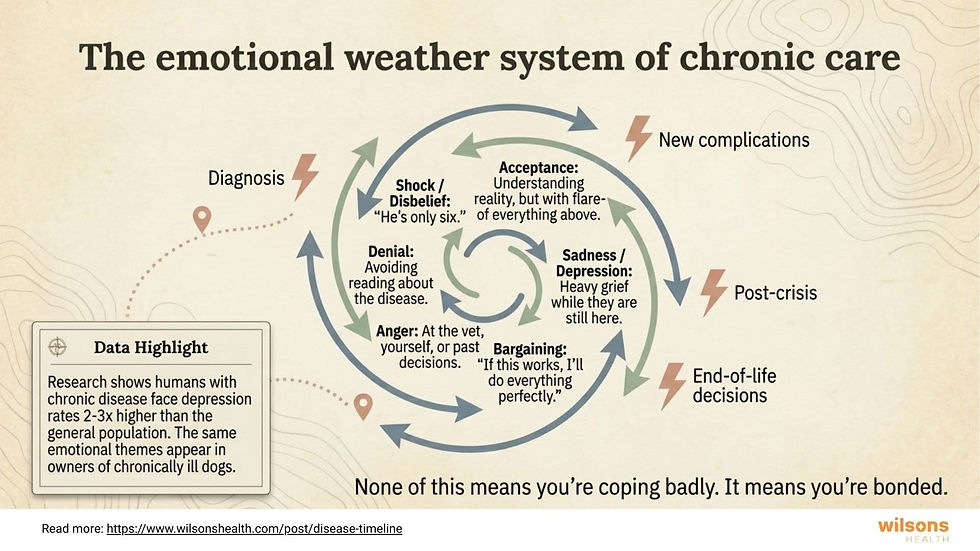
These stages are often described in grief models, but they are not a straight staircase you climb once.[6][13][15] They’re more like weather systems that circle back, especially:
At diagnosis
When there’s a new complication
After a crisis or hospitalization
When euthanasia or end-of-life decisions come into view
None of this means you’re coping badly. It means you’re bonded.
How your dog’s phases and your emotions tend to interact
It can help to see the medical and emotional timelines side by side.
Disease Phase (typical) | What often happens medically | What owners often feel |
Pre-trajectory | Subtle early changes, often unnoticed | “Looking back, I wonder if that was the first sign.” Guilt, hindsight regret |
Onset / diagnosis | Tests, new language, treatment decisions | Shock, information overload, fear, intense hope |
Early stable phase | Treatment routine established | Slight relief, “We can do this,” followed by fatigue as the work continues |
Unstable / exacerbations | New symptoms, medication changes, more vet visits | Anxiety, dread before appointments, irritability, financial stress |
Acute crises | Emergency care, hospitalization, life-or-death decisions | Panic, helplessness, trauma-like memories afterward |
Comeback | Partial recovery | Gratitude, cautious optimism, fear of jinxing it |
Downward phase | More limitations, less response to treatment | Anticipatory grief, constant “Is it time?” questioning |
Dying / end-of-life | Palliative focus, euthanasia decisions | Deep sorrow, relief and guilt often coexisting, second-guessing |
Knowing this doesn’t make it easy. But it can make it less confusing. You’re not “overreacting.” You’re responding to a genuine, sustained stressor.[2][4][10]

The invisible patient: you, the caregiver
In human chronic illness research, caregiver stress is so common it has its own vocabulary: caregiver burden, compassion fatigue, burnout.[2][4][10][12]

With a chronically ill dog, your role may quietly expand to include:
Medication management (timing, refills, side-effect watching)
Diet preparation and monitoring
Symptom tracking and journaling
Transport to repeated appointments
Night-time vigilance (“Are they breathing okay?”)
Financial planning around ongoing care
Over time, this can lead to:
Irritability and emotional numbness
Difficulty concentrating
Withdrawal from social life (“No one gets it”)
Physical symptoms – headaches, stomach issues, fatigue
Again: this is not a character flaw. It’s a predictable response to a long-term, emotionally loaded workload.
Research in chronic illness care shows that support for the caregiver improves outcomes for the patient too.[10] When you are better supported, you’re better able to sustain the routines and decisions your dog needs.
Support might look like:
A vet who makes space to ask, “How are you doing with all this?”
A counselor or therapist, especially one familiar with grief or chronic illness
Online or local support groups for pet loss or chronic illness caregivers
Practical help from friends or family with transport, pet sitting, or finances
Talking with your vet about the road ahead
Veterinary teams sit in a complicated place: they treat the disease, see your dog as a patient, and also witness your emotional life around it.[10] They’re balancing:
Limited appointment time
Medical uncertainty
Your hopes and fears
Their own emotional load

You can make these conversations more useful (and less overwhelming) by asking specific, trajectory-focused questions, such as:
“If we zoom out, what kind of illness trajectory does this disease usually follow?”
“Are we more likely looking at a slow decline, ups and downs, or a long stable period with a sharper decline later?”
“What does stable look like for this condition? How will we know if we’re there?”
“What are the typical ‘turning points’ we should watch for over the next year or two?”
“What might change our goals from ‘treating to control the disease’ to ‘treating for comfort’?”
“How often should we expect to adjust medications or come in for rechecks at this stage?”
You can also be honest about your own limits:
“I’m worried about managing this many medications long-term.”
“I can afford X, but not Y. Can we talk about options within that?”
“I’m starting to feel burned out. Are there ways to simplify the plan without compromising her comfort?”
Good vets understand that quality of life includes your ability to keep going, not just your dog’s lab values.
Planning in layers, not in certainties
Because chronic disease timelines are probabilistic rather than exact, planning works best in layers:
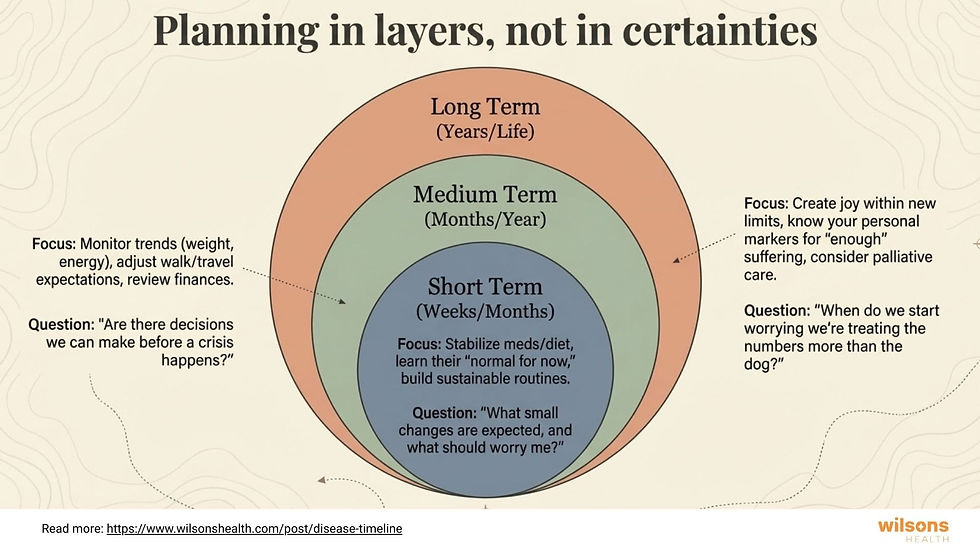
1. Short term (weeks to a few months)
Focus on:
Getting stable on medications or diet
Learning to recognize your dog’s “normal for now”
Building routines that are sustainable for you
Writing down questions between visits
Useful questions for your vet:
“What are the red flag signs that mean I should call or come in urgently?”
“What small changes are expected and okay, and what would worry you?”
2. Medium term (months to a year)
Focus on:
Monitoring trends: weight, energy, appetite, lab results
Adjusting expectations: walk length, activities, travel
Considering insurance, savings, or credit options if finances are tight
Thinking quietly about your values around end-of-life, without needing to decide yet
Useful questions:
“If things follow a typical pattern, what might the next 6–12 months look like?”
“Are there decisions we can make before a crisis that would help us later?”
3. Long term (years, or the rest of their life)
Focus on:
Accepting that chronic illness is now part of your dog’s story
Creating joy within new limits (sniff walks, gentle games, cuddle rituals)
Knowing your personal markers for “enough” in terms of suffering and interventions
Considering palliative care or hospice-style support when appropriate
Useful questions:
“At what point would you, as a vet, start to worry that we’re treating the numbers more than the dog?”
“How do we recognize when it’s time to shift from trying to control the disease to focusing on comfort and goodbye planning?”
Quality of life vs. length of life: the quiet tension
Chronic care always carries a tension between controlling disease and protecting quality of life.[10]

Some examples:
A medication improves lab values but makes your dog nauseated and withdrawn
A strict diet might be ideal for the disease but removes one of your dog’s few remaining pleasures
Frequent monitoring catches problems earlier but means more stressful clinic visits
There is no universal right answer here. Ethical veterinary care involves:
Clear information about benefits and burdens of each option
Respect for your values and your dog’s personality
Willingness to revisit decisions as the trajectory changes
It’s okay to say:
“If this drug makes him miserable, I may prefer slightly worse numbers and a happier dog.”
“I don’t want to put her through another hospitalization. Can we talk about comfort-focused options instead?”
These are not “giving up” conversations. They are adaptive conversations, matching care to the current phase of the illness trajectory.
When the timeline shortens: downward and dying phases
At some point, for many chronic diseases, the pattern shifts more clearly into a downward phase:
Flares become more frequent or severe
Treatments work less well or for shorter periods
Your dog’s world shrinks: less interest in play, more sleep, more help needed

This phase often brings:
Intensified anticipatory grief – grieving before the loss actually happens
Constant internal debates about euthanasia timing
Fear of “too soon” and “too late” at the same time
The dying phase in dogs is usually shorter than in humans, partly because euthanasia allows us to choose a gentler endpoint. But that choice carries its own emotional weight.
What can help:
Discussing quality-of-life tools with your vet (daily scoring, “good day / bad day” calendars)
Asking, “What signs would tell you that you would consider it time, if this were your dog?”
Naming your own red lines (e.g., unmanageable pain, persistent severe breathing distress, total loss of interest in connection)
Research on chronic illness emphasizes that honest, timely conversations about prognosis and end-of-life reduce regret and complicated grief later.[5][10] They don’t make the loss less sad – but they can make it less chaotic and less lonely.
What we know, and what we honestly don’t
From chronic disease research in humans and animals, some things are solid:[1][3][5][8][10]
Chronic diseases often have recognizable phases and patterns
Many progress over years, not weeks, though some have more abrupt terminal declines
Emotional and psychological impacts are not side notes – they strongly affect how well care can be maintained
Depression, anxiety, and burnout are common in long-term illness contexts
And some things remain uncertain or under-studied, especially in dogs:
Exact timelines for specific diseases in individual animals
The best ways to systematically support owners’ mental health in veterinary settings
How caregiver coping styles change over the full arc of a dog’s chronic illness
So if you find yourself asking, “Why can’t anyone just tell me how long?” – it’s not because they’re holding out on you. It’s because biology doesn’t work like a train timetable. It’s more like weather forecasting: patterns, probabilities, and surprises.
A different way to think about the road ahead
When a chronic diagnosis lands, it’s easy to imagine only two points on the timeline: now and the end.
The research – and the lived experiences of countless owners – suggest something more nuanced:
There will likely be stable stretches where life feels almost ordinary again
There will be spikes of crisis that feel worse than the overall trajectory really is
There will be slow shifts in what your dog can do, and in what counts as a “good day”
There will be emotional seasons for you: determined, exhausted, hopeful, resigned, grateful, heartbroken – sometimes all in one week

You don’t have to hold the whole road in your head at once. It’s enough to:
Understand the general shape of the illness trajectory
Stay in honest conversation with your vet
Notice when your own emotional reserves are running low and treat that as real data
Keep asking, “What matters most to my dog now? What matters most to me now?”
Chronic illness doesn’t erase the relationship you have with your dog; it changes its terms. Many owners look back and say that, while they would never have chosen the disease, the time they spent caring through it was some of the most intensely connected time they ever had.
That doesn’t make it easy. But it does mean this: the road ahead is not just about decline. It’s also about how you and your dog travel it together.
References
Huo, X., et al. Sequential Patterns and Transition Timelines of Chronic Disease. PLOS ONE. https://pmc.ncbi.nlm.nih.gov/articles/PMC12363933/
Grand Rising Behavioral Health. The Impact of Chronic Illness on Mental Health. https://www.grandrisingbehavioralhealth.com/blog/the-impact-of-chronic-illness-on-mental-health-c39cc
American Kidney Fund. Stages of Kidney Disease (CKD). https://www.kidneyfund.org/all-about-kidneys/stages-kidney-disease
Breeze Hospice Services. Understanding the Psychological Impact of Chronic Illness on Daily Living. https://www.breezehospiceservices.com/resources/understanding-the-psychological-impact-of-chronic-illness-on-daily-living
MyPCNow. Illness Trajectories: Description and Clinical Use. https://www.mypcnow.org/fast-fact/illness-trajectories-description-and-clinical-use/
American Psychological Association. Coping with a Diagnosis of Chronic Illness. https://www.apa.org/topics/chronic-illness/coping-diagnosis
Phases of Chronic Illness (PDF document). Scribd.
Tran, V.-T., et al. The Impact of Chronic Illness on the Patient Experience. Patient Preference and Adherence. https://pmc.ncbi.nlm.nih.gov/articles/PMC9102121/
DrOracle. What is the Timeline for Acute vs Chronic Conditions? https://www.droracle.ai/articles/360254/what-is-the-timeline-for-acute-vs-chronic-conditions
Katon, W., et al. The Emotional Dimensions of Chronic Disease. Western Journal of Medicine. https://pmc.ncbi.nlm.nih.gov/articles/PMC1070773/
Centers for Disease Control and Prevention (CDC). Natural History and Spectrum of Disease. https://archive.cdc.gov/www_cdc_gov/csels/dsepd/ss1978/lesson1/section9.html
University of Texas Medical Branch (UTMB). Chronic Conditions: Emotional Responses in Children and Adolescents. https://www.utmb.edu/Pedi_Ed/CoreV2/ChronicConditions/ChronicConditions_print.html
National Association for Continence (NAFC). Understanding the Seven Stages of Grief and Chronic Illness. https://nafconline.com/nafc-blog/understanding-the-seven-stages-of-grief-and-chronic-illness/
Thomas Jefferson University. Disease Staging. https://www.jefferson.edu/academics/colleges-schools-institutes/skmc/research/research-medical-education/disease-staging.html
Rocky Mountain Relational Therapy. What Are the Stages of Coping with Chronic Illness? https://rockymountainrelationaltherapy.com/what-are-the-stages-of-coping-with-chronic-illness/"


Comments