
The Long Journey of Arthritis in Dogs – What to Expect Over the Years

Updated: Aug 28
By some estimates, as many as 1 in 5 adult dogs are living with osteoarthritis – and many of them show no obvious limp in the early years.[8][13][15] The disease can be quietly reshaping their joints long before you see the first stiff step getting off the sofa. That mismatch between what you see and what’s actually happening inside the joints is one of the reasons arthritis can feel so confusing, and why the “journey” of the disease often catches people off guard.

This article is about that journey: how canine arthritis tends to unfold over years, what usually changes between “something seems a bit off” and “we’re planning our days around his mobility,” and how you can think about treatment, emotions, and decisions along the way.
Not a neat timeline, but a long relationship with a chronic condition.
Prefer to listen?
Explore this topic as a conversation on Wilson’s Health: Dog Health, Explained — a clear, thoughtful discussion of what it means and why it matters.
Listen below, or keep reading.
Arthritis in dogs: what’s actually going on?
Canine osteoarthritis (OA) is a degenerative joint disease. Over time:
The smooth cartilage that cushions the joint wears down.
Inflammation develops in the joint capsule.
New bone forms in odd places (bone spurs, remodeling).
The joint becomes painful and less stable.
Muscles around the joint can weaken from underuse.

It is:
Progressive: it tends to worsen over time.
Incurable: we can’t restore a perfectly normal joint.
Manageable: pain and function can often be significantly improved, sometimes for years.[1][3][7][15]

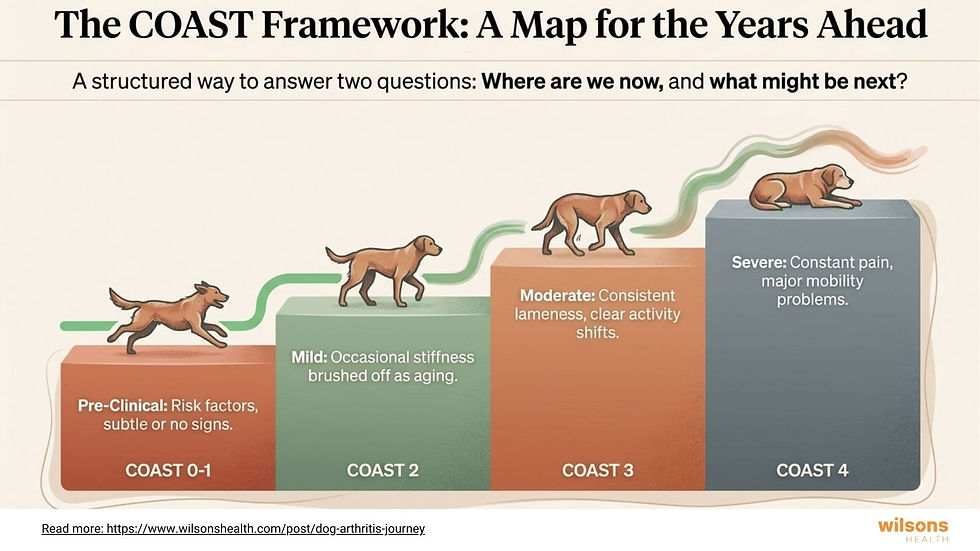
A useful way vets think about this is the COAST system (Canine OsteoArthritis Staging Tool), which groups dogs into stages from 0 to 4.[1][11][15] You don’t need to memorize the details, but the structure is helpful when you’re trying to understand “where are we now?” and “what might be next?”
COAST Stage | What it broadly means in real life |
0–1 | No obvious signs, but risk factors or very subtle changes may be present. |
2 | Mild OA: occasional stiffness or lameness, often brushed off as “just getting older.” |
3 | Moderate OA: consistent pain or lameness, muscle loss, clear changes in activity. |
4 | Severe OA: constant pain, major mobility problems, significant muscle wasting. |
The rest of this article loosely follows that arc: from the quiet pre-clinical phase into the more obvious years of living with arthritis.
Before the limp: the “pre-clinical” years (COAST 0–1)
Many dogs already have joint changes before anyone notices a problem. This can be:
Breed-related (e.g., large or giant breeds, dogs with hip or elbow dysplasia).[8][13][15]
Due to earlier injury, surgery, or developmental issues.
Linked to excess weight or very high-impact activity.
What you might see (or not see):
Absolutely nothing obvious.
Or very subtle things: a dog who is a bit slower to get up after a long nap, hesitates before jumping into the car, or seems stiff for the first few steps then “warms up.”

At this stage, arthritis is a risk and a process, not yet a clear clinical problem. This is also where early choices can make a real difference to the next decade.
How vets usually think about this phase
The focus is on:
Identifying risk (breed, body condition, past injuries).
Monitoring for early signs.
Starting joint-friendly habits: weight management, appropriate exercise, avoiding repetitive high-impact strain.[1][7][11][15]
From an emotional perspective, this stage can be oddly tricky. You might have a vet saying, “We should keep an eye on those hips,” while your dog still outruns every dog at the park. It can be hard to take a slow, preventive approach seriously when life still looks normal.
If that’s you: you’re not “overreacting” if you want to plan ahead. You’re also not failing your dog if you didn’t know to think about any of this until later. Most people don’t.

Early arthritis: the first clear shifts (roughly “Year 1–2” after you notice signs; COAST 2)
Once OA becomes mild but noticeable, life starts to change in small but persistent ways.
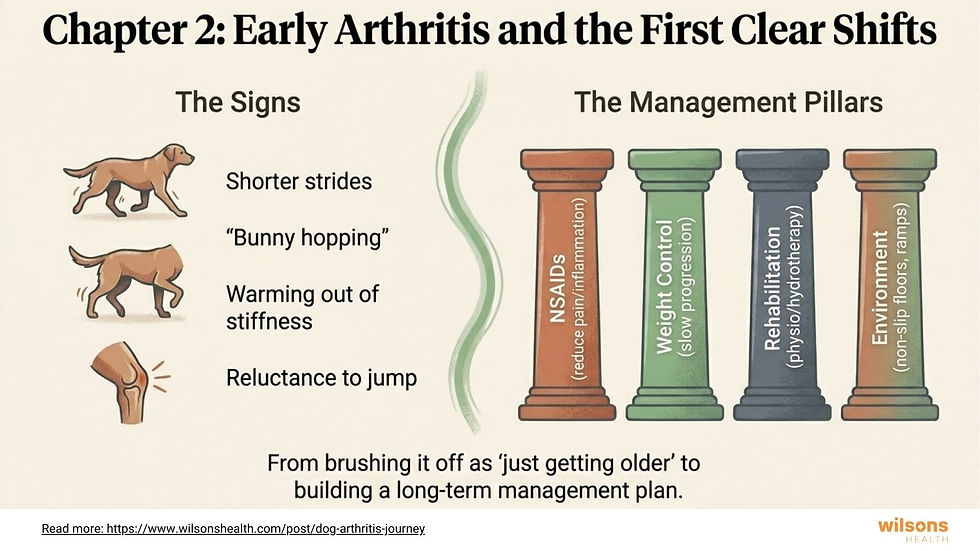
Common signs in this phase[1][3][5][7][9][13]:
Occasional lameness, especially after heavy exercise or long rest.
Stiffness getting up, then improvement as they move around.
Reluctance to jump on furniture or into the car.
Subtle changes in gait – a shorter stride, a “bunny hop,” or a slight head bob.
Less enthusiasm for long walks, but still very interested in going.
These signs are easy to attribute to age, weather, or “he overdid it yesterday.” That’s one reason many dogs are already in moderate OA by the time they get a clear diagnosis.
What’s happening inside the joint
Cartilage is thinning and fraying.
Inflammation is present but may come and go.
The body is starting to remodel the joint (laying down new bone).[1][3][7][15]
Treatment goals in early OA
Vets often aim to:
Reduce pain and inflammation (often with NSAIDs and other medications).
Protect remaining cartilage as much as possible.
Preserve muscle mass and joint range of motion.
Slow progression through weight control and controlled exercise.[1][7][11][15][17]
This is also when you might first hear about:
Rehabilitation / physiotherapy: targeted exercises, hydrotherapy, manual therapies.
Environmental tweaks: non-slip flooring, ramps, raised food bowls.
Supplements: joint-support products (with varying levels of evidence).
The key idea: you’re building a long-term management plan, not just reacting to bad days.
Flare-ups: why some days seem so much worse
Across all stages, many dogs experience flare-ups – short periods where pain and inflammation spike.[1][7][9]
Common triggers:
Overexertion (“He chased the ball like he was 2 again.”)
Slips or minor injuries.
Cold, damp weather (for some dogs).
Changes in routine or stress.

What it looks like:
Sudden worsening of lameness or stiffness.
Reluctance to move at all.
Increased panting, restlessness, or trouble getting comfortable.
Seeming “down” or irritable.
Flare-ups are not necessarily a sign that everything has permanently worsened, but they are a sign that the joint is vulnerable. They’re also emotionally draining: one bad weekend can make you question everything.
This is where having:
A clear plan with your vet for what to do during flares, and
Realistic expectations that these episodes will occasionally happen
can make the journey feel less like a crisis every time and more like something you know how to navigate.
Middle years with arthritis: when it becomes part of daily life (often “Year 2–4”; COAST 3)
As OA progresses into moderate disease, it stops being an occasional inconvenience and starts to shape the rhythm of your dog’s life – and yours.
Typical changes at this stage[1][3][5][7][9][15]:
Consistent lameness or stiffness, not just after big days.
Visible muscle atrophy (thinning) in affected limbs or over the hips.
Noticeable decrease in range of motion: difficulty squatting, climbing stairs, or turning tightly.
Audible or palpable crepitus – that crunching/grinding sensation in the joint.
Shorter walks, more frequent rests; sometimes stopping and refusing to go further.
Changes in posture, such as shifting weight off a painful leg.
X‑rays at this stage often show:
Narrowed joint spaces.
Bone spurs (osteophytes).
Irregular joint surfaces.[1][3][5][7][9][15]

You may find that your calendar is quietly reorganized around:
Timing walks for when your dog is most comfortable.
Planning car trips based on whether there’s a ramp.
Lifting, supporting, or guiding your dog more often.
The emotional side for dogs: not “just” physical pain
Chronic pain doesn’t stay neatly in the joints. It changes the brain’s stress and mood systems, and dogs are no exception.
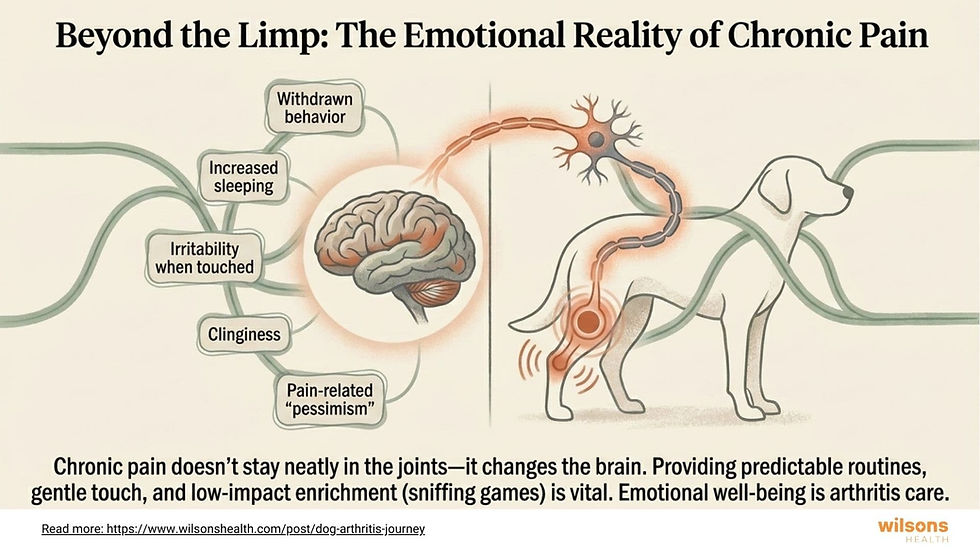
Studies and clinical observations suggest arthritic dogs can show mood and behavior changes resembling human depression or anxiety:[2][8][16]
Less interest in play or exploration.
More time sleeping or withdrawn.
Irritability or even aggression when touched near painful areas.
Increased clinginess, or the opposite – wanting to be left alone.
Changes in appetite or sleep patterns.
Research has found pain-related mood changes in arthritic dogs that look a lot like pessimism: they’re less likely to approach ambiguous situations optimistically.[16] That doesn’t mean your dog is “sad all the time,” but it does mean that emotional well-being is a real part of arthritis care.
Supportive things that often help:
Predictable routines.
Gentle, pain-free touch and grooming.
Low-impact enrichment: sniffing games, food puzzles, training that doesn’t stress joints.
Safe, comfortable resting spots where they can still be near family activity.
Pain management and emotional support are not separate projects; they reinforce each other.
The caregiver’s journey: how arthritis reshapes your life too
Chronic conditions don’t just belong to the patient. They live in the household.

Research on canine OA shows that owners’ quality of life is measurably affected across:[4]
Emotional wellbeing: worry, sadness, guilt, anticipatory grief.
Physical functioning: lifting a heavy dog, helping on stairs, disturbed sleep.
Daily activities: shorter outings, changes in travel or social plans, financial planning around treatment.
Common inner monologues include:
“Am I doing enough?”
“Is this medication hurting his liver?”
“She loves walks so much – am I cruel if I cut them shorter?”
“How will I know when it’s time to say goodbye?”
These are not signs you’re “not coping”; they are predictable responses to a long, uncertain caregiving role.
Interestingly, studies also show that when owners feel treatments are effective and manageable, their own stress levels and sense of burden are significantly lower – and this, in turn, is linked to better outcomes for the dog.[4] In other words, your experience of the treatment plan matters clinically, not just emotionally.
If you find yourself exhausted by the logistics or the decisions, that’s relevant information to share with your vet. A plan that looks perfect on paper but is impossible to sustain in real life is not a good plan.

Late-stage arthritis: when mobility and comfort dominate the conversation (often “Year 4–5+”; COAST 4)
In severe OA, the disease is no longer in the background. It dictates most of the day’s practical questions.
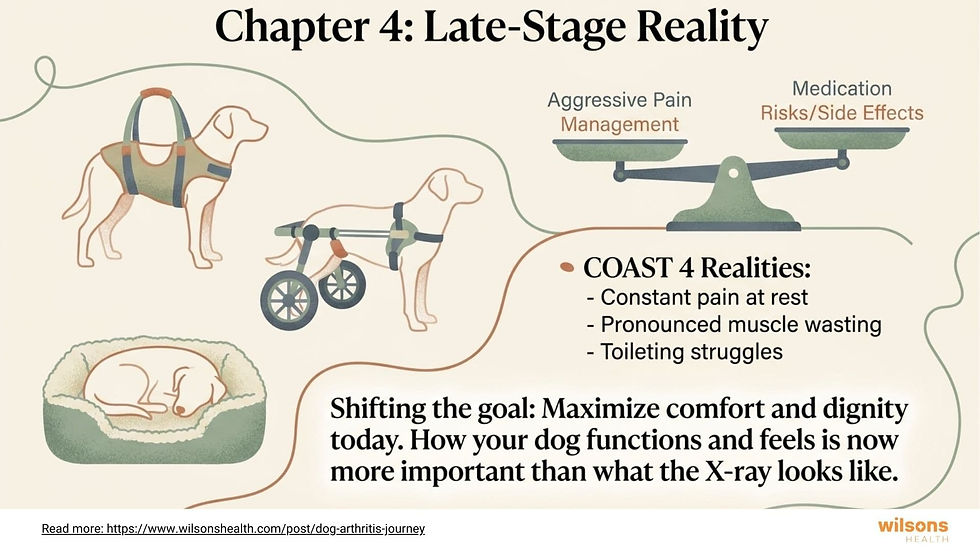
Common features at this stage[1][3][5][7][9][15]:
Constant pain, even at rest, without adequate management.
Markedly reduced mobility: difficulty standing, walking only short distances, or needing support to move.
Pronounced muscle wasting.
Struggling with basic tasks: toileting, getting to food and water, finding a comfortable position.
Incontinence or “accidents” because moving is too difficult or slow.
Possible secondary problems (pressure sores, overgrown nails, weight loss or gain).
Radiographs often show severe joint remodeling, but at this point, how your dog functions and feels is more important than what an X‑ray looks like.
Treatment focus in late-stage OA
The goal shifts more explicitly from “slow progression” to “maximize comfort and dignity today.” Vets often balance:
Aggressive pain management (including combinations of medications and possibly more advanced options)
vs.
Risks and side effects in elderly or multi-morbid dogs.[1][4][7][9][15][17]
Other pillars include:
Environmental support: slings, harnesses, ramps, non-slip pathways, easy access to toileting areas.
Assisted mobility: carts, orthopedic beds, careful skin and nail care.
Adjusting expectations: very short, pleasant outings instead of “walks” as such.
This is also the stage where ethical questions become more central:
When is it fair to continue? When is it kinder to let go?
How do we weigh a dog’s love of simply being with family against their physical limitations?
How much caregiver burden is sustainable, physically and emotionally?[4][9]

There are no formulas that can answer these. Quality-of-life scales and checklists can help structure your thinking, but they can’t replace your knowledge of who your dog is.
What research does suggest is that effective pain control and supportive care can reduce euthanasia driven purely by unmanageable arthritis, because both dogs and owners experience better quality of life for longer.[4] That doesn’t erase the eventual decision; it just means the road to it can be less desperate.
Talking with your vet over the years: what to ask, what to share
Because arthritis is a lifelong, evolving condition, the conversation with your vet needs to evolve too.

In early and mild stages (COAST 1–2)
You might ask:
“What stage would you say my dog is in?”
“What are realistic goals for the next 1–2 years?”
“What’s your approach to early pain management – when do you like to start NSAIDs or other medications?”
“What changes at home would make the biggest difference right now?”
And share:
Any subtle changes you’ve noticed (“He’s stiff after lying down; she hesitates at the stairs.”).
Your dog’s daily activity level and routine.
Your capacity and preferences (e.g., “I can manage daily exercises, but not multiple clinic visits per week.”).
In moderate stages (COAST 3)
You might ask:
“Can we review whether our current plan is still enough? What else is available?”
“How should we handle flare-ups? What’s the threshold for calling you?”
“What signs would tell us the disease is progressing into a new stage?”
“Are there rehab or physical therapy options that would suit my dog?”
And share:
How often your dog has bad days vs. good days.
Any behavior or mood changes you’ve seen.
How the treatment plan is affecting your own life and stress.
In severe stages (COAST 4)
You might ask:
“From your perspective, what is his quality of life like right now?”
“What are we treating for: comfort, mobility, both? Are our goals realistic?”
“What side effects of these medications should I watch for?”
“Can we talk about how we’ll know when it might be time to consider euthanasia?”
And share:
Specific examples of good moments your dog still enjoys.
Specific things that are now very hard (toileting, sleeping, eating, moving).
Your own physical limits (e.g., “I can no longer safely lift her.”).
This isn’t about getting a single definitive answer; it’s about shared decision-making over time.[1][4][5] Your observations and feelings are part of the clinical picture.
Living with the uncertainties
Some aspects of canine arthritis are well understood:
OA is progressive and incurable.
Treatment helps: pain can usually be reduced, and quality of life often improved, sometimes dramatically.[1][3][7][15]
Chronic pain affects behavior and mood, and addressing emotional wellbeing is part of care, not an optional extra.[2][8][16]
Owner stress and satisfaction with treatment are closely tied to adherence and outcomes.[4]

Other parts are still uncertain or variable:
The exact ways OA pain changes a dog’s emotional and cognitive world.[16]
The “best” combination and timing of different therapies for each stage.
How to fairly measure and support owner quality of life over the long term.[4]
The cumulative emotional impact on veterinary teams who walk this road with many families.
What this means practically: if your experience doesn’t match your friend’s or an online story, that’s not a failure. It’s the nature of a chronic disease that unfolds differently in different bodies, households, and hearts.
Reframing the “long journey”
It can help to stop thinking of arthritis as a straight downhill slope and instead as a series of chapters, each with its own tasks:
Early chapter: noticing, naming, and starting to protect the joints.
Middle chapter: building daily routines that work around limitations while still honoring your dog’s personality.
Late chapter: focusing on comfort, connection, and gentleness – and, eventually, on a good ending.
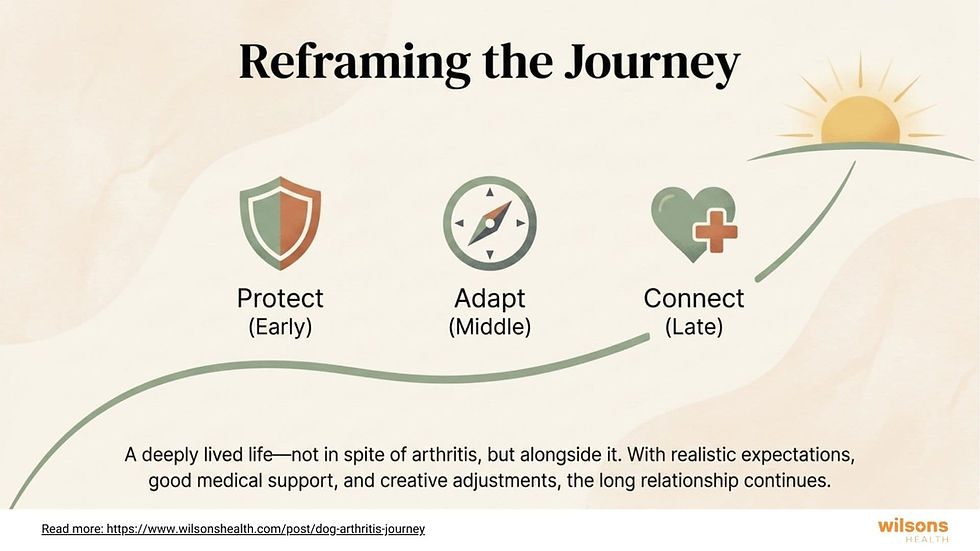
Across all of these, the constants are:
Your dog’s need for safety, companionship, and relief from pain.
Your need for honest information, emotional space, and a plan that fits your real life.
A relationship with your vet that allows for both science and feelings to be on the table.
Arthritis will change your dog. It will also change how you move through the world together. But it doesn’t erase who they are, or what you are to each other. With realistic expectations, good medical support, and some creative adjustments, many dogs with arthritis have long, deeply lived years – not in spite of their condition, but alongside it.
References
Onlinepethealth.com – Guidelines for Treating Canine Arthritis Through the Stages of Progression.
Allinflex.co – The Emotional Impact of Arthritis on Dogs.
GoodRx – 7 Dog Arthritis Symptoms (And Signs They Need Help).
Belshaw, Z., Asher, L., Dean, R. S. (2020). Development and validation of a quality of life and treatment burden instrument for canine osteoarthritis and its impact on owners. Frontiers in Veterinary Science.
Bestfriendsvet.com – Arthritis Stages and Protocols.
Arthritis Research Canada – Pros and Cons of Pet Ownership with Arthritis.
Toegrips.com – Osteoarthritis in Dogs: Everything You Need to Know.
Morris Animal Foundation – Understanding Osteoarthritis in Our Senior Pets.
Pawsintograce.com – Signs to Euthanize a Dog With Arthritis and Severe Pain.
Arthritis.org – The Healing Power of Pets.
Lascelles, B. D. X., et al. COAST Development Group – International consensus guidelines on canine osteoarthritis. Frontiers in Veterinary Science.
Simonvetsurgical.com – Canine Arthritis and Its Connection to Rheumatoid Arthritis.
Bluecross.org.uk – Arthritis in Dogs.
Mayo Clinic Health System – Dogs are good for your health.
Merck Veterinary Manual – Osteoarthritis in Dogs and Cats – Musculoskeletal System.
Phys.org – Can osteoarthritis affect a dog's mood? (Reporting on research into pain-related mood changes in dogs with OA).
Colorado State University Veterinary Teaching Hospital – Arthritis Management and Prevention.



Comments