
Food Allergy vs. Intolerance in Dogs – How to Tell Them Apart

Around 1 in 100 dogs is thought to have a true food allergy. Yet far more dogs are on “hypoallergenic” diets, and countless owners are told, “It’s probably something in the food.”
Hidden inside that mismatch is the real story: most dogs with food-related problems don’t have a food allergy at all – they have a food intolerance or sensitivity.[1][3][7][11]
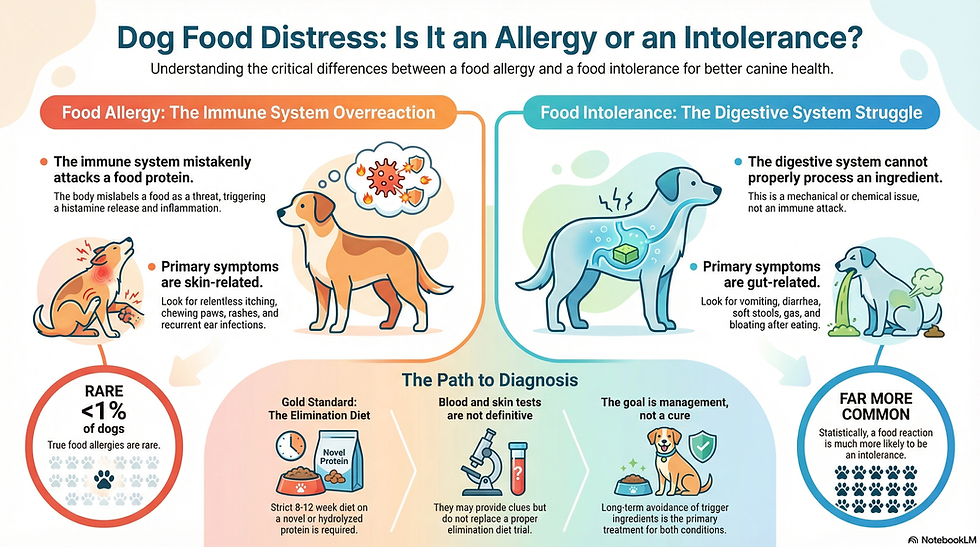
The symptoms can look almost identical from the outside: scratching, licking, vomiting, soft stools, gas, ear infections.
Inside the body, though, very different systems are involved, and that difference changes how you think about diagnosis, treatment, and long-term care.
This article is about learning to see that difference clearly – not so you can diagnose your dog at home, but so you can walk into the vet clinic with a calmer mind and sharper questions.
Allergy vs. intolerance: what’s actually different?
Let’s start with the simplest, most useful distinction:
Food allergy = the immune system is overreacting to a food, usually a protein.
Food intolerance = the digestive system is struggling with a food, without the immune system attacking it.
Same bowl, very different biology.
A side‑by‑side view
Aspect | Food Allergy | Food Intolerance / Sensitivity |
Main system involved | Immune system (hypersensitivity reaction) | Digestive system (enzymes, gut function, additives) |
Typical culprit | Proteins (chicken, beef, dairy, eggs, fish) | Proteins and things like lactose, grains, additives |
How it works | Body mislabels a food as “dangerous” → antibodies → histamine release → inflammation[7] | Body can’t properly digest or handle a component (e.g., lactose, certain carbs, fats, additives)[1][3][4][11] |
Onset after eating | Hours to days; often after repeated exposure | Often within minutes–hours, but can also be delayed |
Most common signs | Itchy skin, chewing paws, recurrent ear infections, rashes, sometimes vomiting/diarrhea[1][3][7] | Vomiting, diarrhea, gas, bloating, soft stools; sometimes mild skin issues |
Severity range | Mild itching → chronic infections → rarely anaphylaxis | Mild gas → severe diarrhea and weight loss |
Diagnosis | Elimination diet; sometimes supported by allergy tests | Clinical history + elimination diet |
Treatment focus | Strict avoidance of the allergen; often long‑term meds for itch/inflammation | Avoidance + choosing better‑tolerated ingredients |
People (and companies) often use “sensitivity” as a softer word for intolerance. In scientific terms, sensitivities are usually non‑immune, gradual reactions that worsen over time but don’t involve classic allergy antibodies.[1][3][5][7][9]

What’s happening inside your dog’s body?
In a food allergy: the immune system misfires
With a food allergy:
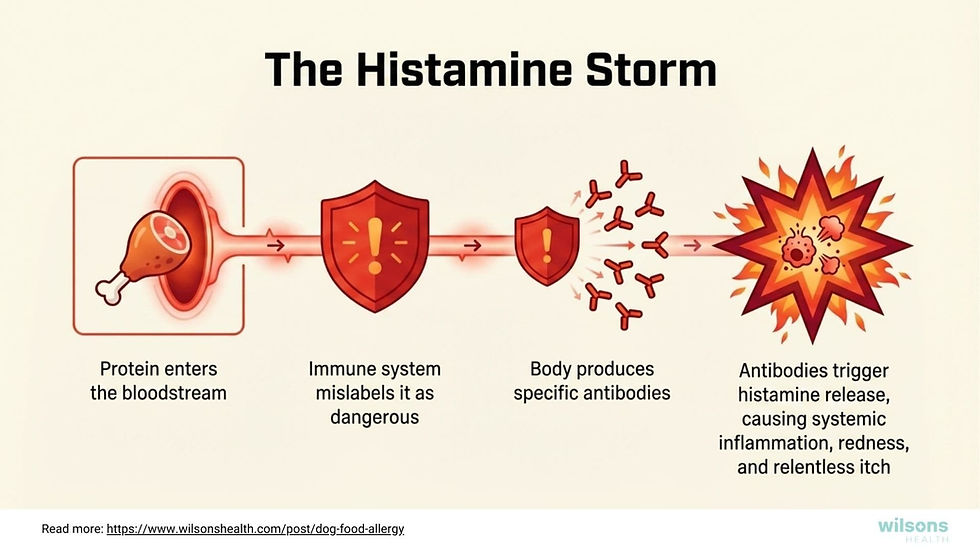
A protein from food (say, chicken) is broken down in the gut and absorbed.
The immune system mistakenly labels it as a threat.
It makes antibodies (often IgE) against that protein.
Next time your dog eats chicken, those antibodies trigger mast cells to release histamine and other chemicals.[7]
Histamine causes itching, redness, swelling, and inflammation – especially in the skin and ears.
That’s why allergic dogs often look like this:
Constant scratching or chewing at paws, belly, groin, armpits
Red, inflamed skin
Recurrent ear infections
Sometimes vomiting or diarrhea on top of the skin issues
The gut is involved, but in allergies, the immune reaction is the star of the show.
In a food intolerance: the gut is overwhelmed, not attacked
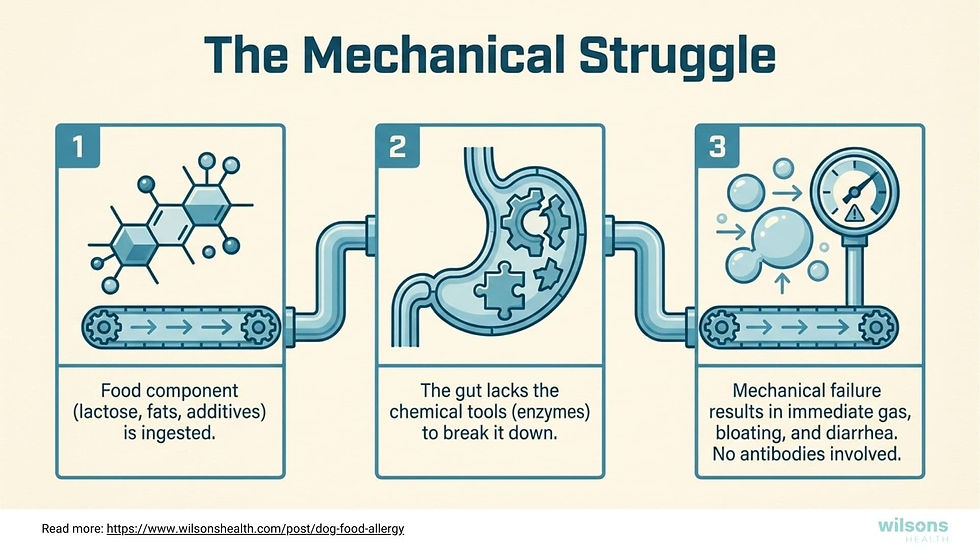
With a food intolerance, the immune system is mostly minding its own business. The problem is more mechanical or chemical:
Enzyme issues: for example, not enough lactase to digest lactose in dairy → gas, diarrhea, discomfort.[1][3][4][11]
Carbohydrate or fat handling: some dogs struggle with certain carbs or high‑fat foods.
Additive reactions: some dogs react badly to certain preservatives, colorings, or flavorings – not because they’re “allergic” in the immune sense, but because the additives irritate the gut.[1][3][4]
The result is usually:
Vomiting
Diarrhea or loose stools
Bloating, gas, discomfort
Occasionally some skin irritation, but itch is usually not the main event
No antibodies, no histamine storm – just a digestive system saying, “I can’t work with this.”
How common are food allergies, really?
This is where expectations and reality often part ways.
True food allergies in dogs are estimated to affect less than 1% of the canine population.[7]
Adverse reactions to food (including intolerances and sensitivities) are much more common, but we don’t have precise numbers.[7][5]

So when a dog reacts badly to food, statistically it’s more likely to be an intolerance or sensitivity than a classic allergy.
This doesn’t make it less real, or less miserable for your dog. It just means the way we think about it – and the way we talk to the vet – needs to be a bit more precise.
Symptoms: what tends to point where?
There’s no perfect checklist. Allergies and intolerances overlap a lot, and some dogs manage to be overachievers and have both.
But there are patterns that can guide your thinking.
Signs that lean toward food allergy
These are not proof, but they’re strong clues:
Relentless itchiness that doesn’t fully respond to flea control
Chewing/licking paws, belly, inner thighs, armpits
Recurrent ear infections (especially both ears, over and over)[1][3]
Red, inflamed skin, hives, or rashes
Symptoms that persist even when the stool looks fine
Problems that don’t clearly match a sudden diet change (they’ve been building over time)
Rarely, dogs can have severe allergic reactions (facial swelling, hives, difficulty breathing, collapse). These are emergencies, but they’re not typical of chronic food allergy in dogs.

Signs that lean toward food intolerance or sensitivity
Again, not definitive – but suggestive:
Vomiting that tends to happen after certain meals
Diarrhea or soft stools, sometimes with mucus
Gas, bloating, or obvious discomfort after eating
Symptoms that appear soon after a diet change or after specific treats
A dog who improves significantly with small, bland meals and worsens with richer foods
Intolerance symptoms can still be messy:
They may last for hours or days.
Sometimes they reappear a day or two after ingestion, which makes pattern‑spotting tricky.[1]
The confusing middle: where they overlap
Both allergies and intolerances can cause:
Vomiting and diarrhea
Weight loss or poor coat
Lethargy, irritability, and “just off” behavior

This is why self‑diagnosing based on symptoms alone usually doesn’t work. It’s also why vets lean heavily on elimination diets rather than quick tests.
Timing: how quickly do reactions show up?
You might assume an allergy is always “immediate” and an intolerance is always delayed. In dogs, it’s not that neat.
Allergies
Symptoms usually develop after repeated exposure to a protein over time.[3][7]
Once sensitized, a dog can react hours to days after eating the trigger.
It’s not always “I ate chicken at 6, I’m itchy by 7.”
Intolerances
Often show up within minutes to a few hours after eating.
But some effects, like gut irritation or altered microbiome, can make symptoms linger or reappear over the next day or two.[1]

So timing is helpful, but not a smoking gun. Think of it as one piece in a larger puzzle.
Why diagnosis is slower than anyone wants
If you’ve lived through this, you already know: there is no magical “allergy scan” that says,“Your dog is allergic to chicken, fine with turkey, and mildly intolerant to barley.”
The gold standard: the elimination diet
Across veterinary sources, one thing is consistent:an 8–12 week elimination diet is the gold standard for diagnosing food reactions.[1][3]

In practice, that means:
Choosing a very controlled diet
Either a novel protein your dog has never eaten before (e.g., venison, duck)
Or a hydrolyzed protein diet, where proteins are broken into tiny pieces less likely to trigger the immune system.
Feeding only that diet
No treats, table scraps, flavored meds, or chews that aren’t cleared by your vet.
This is often the hardest part emotionally and practically.
Monitoring symptoms
Skin and ears can take weeks to show improvement.
Gut signs may improve faster, but not always.
Re‑challenging
Once your dog improves, the suspected trigger is reintroduced to see if symptoms return.
This step is crucial to confirm causality, but can feel scary – which is why it’s done with veterinary guidance.

Most guidelines suggest 8–12 weeks for a reliable trial.[1][3] That’s two to three months of patience, doubt, and careful note‑taking. It’s not dramatic medicine – but it’s what actually works.
What about blood or skin tests?
You may see ads for serum allergy tests or intradermal tests that promise to identify food allergies quickly.
These tests can sometimes help, but they’re not as reliable for food as they are for environmental allergies (like pollens or dust mites).[1]
A negative test doesn’t always rule out food allergy, and a positive test doesn’t always match real‑world reactions.
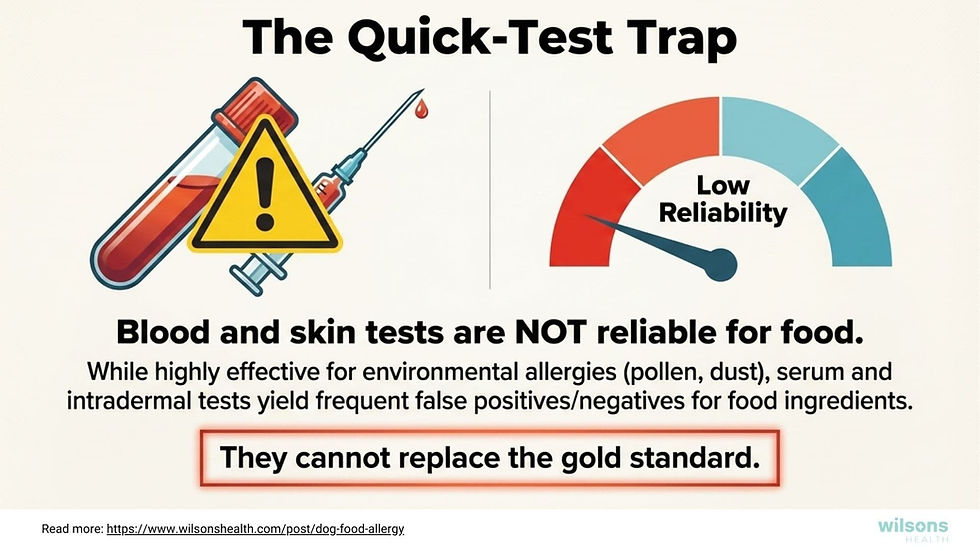
Vets may use these tests as supporting information, but they do not replace an elimination diet as the main diagnostic tool.[1][3][7]
Why your dog’s behavior might change too
One of the quieter burdens of chronic food reactions is how they affect a dog’s mood and behavior.
Research and clinical experience suggest that dogs with ongoing allergies or intolerances often show:[2][6]
Increased anxiety or irritability
Reduced focus and trainability
More reactivity or “short fuse” responses
Lethargy or withdrawal when they’re feeling unwell
Is this purely physical discomfort? Is there also a direct effect on the brain via the gut and immune system?The honest answer: we don’t fully know yet.[2][4][6]

What we do know:
Chronic itch, pain, or nausea is exhausting.
Dogs can’t say, “My stomach hurts,” so it may come out as clinginess, grumpiness, or seeming “stubborn.”
When symptoms improve, behavior often improves too.
If your dog is “acting different” and also has skin or gut issues, it’s reasonable to wonder if food is playing a role. Not as a blame game – but as another clue to share with your vet.
The emotional reality for owners
Living with a dog who’s always scratching, vomiting, or having messy stools is not just a medical issue. It’s a chronic stressor.
Common feelings owners describe:
Guilt – “Did I cause this by feeding the wrong thing?”
Frustration – “We changed food three times and nothing worked.”
Confusion – “Everyone online says something different.”
Financial stress – repeated vet visits, special diets, medications.[4]

On top of that, elimination diets ask you to:
Say “no” to begging eyes when everyone else’s dog is getting treats
Explain the restrictions to family, dog‑sitters, groomers
Live with uncertainty for weeks: “Is this helping? Are we sure?”
Veterinary teams feel this too. They’re balancing:
Your understandable desire for quick answers
The limitations of current tests
The chronic nature of these conditions – they’re managed, not cured[2][4][6]
If this has been hard, that doesn’t mean you’re doing it wrong. It means the situation is hard.
How to think about long‑term care (without burning out)
Because food allergies and intolerances are usually lifelong tendencies, the goal shifts from “fix it” to “manage it well.”
A few practical mindsets can make that more sustainable.
1. Expect management, not a cure
Once a dog has a confirmed food allergy or intolerance, the plan is usually:
Long‑term avoidance of the trigger ingredient(s)
Ongoing monitoring for new symptoms
Sometimes medication for allergic dogs to control itch and inflammation[1][3][4]
Dogs can also develop new sensitivities over time to ingredients they once tolerated.[7] That’s not your failure; it’s how biology sometimes behaves.
2. Treat diet changes as a process, not an event
Diet transitions can be stressful for dogs, and stress alone can upset the gut.[4] To support your dog:
Make changes gradually, unless your vet advises otherwise.
Keep routines (walks, sleep, play) as stable as possible during transitions.
Watch not just stools and skin, but mood and behavior.
Sometimes adding behavioral support (enrichment, gentle training, predictable routines) makes the whole process easier on both of you.

3. Use your vet as a thinking partner
Things it’s useful to discuss explicitly:
“Based on my dog’s symptoms, do you think allergy, intolerance, or both is more likely?”
“What kind of elimination diet makes the most sense here – novel protein, hydrolyzed, home‑cooked with a nutritionist?”
“What timeline should I realistically expect before we decide if it’s working?”
“How strict do we need to be about treats and flavored meds during the trial?”
“If this is an allergy, what are our long‑term options for itch control and flare‑ups?”
Having a shared plan can take some of the pressure off day‑to‑day decision‑making.
A practical way to observe your dog
You can’t diagnose at home, but you can collect good data at home, which is almost as valuable.

Consider keeping a simple log that notes:
What your dog ate (including treats, chews, table scraps, flavored meds)
Time of feeding
Symptoms (itching, ear shaking, vomiting, stool quality, gas, behavior)
Timing of symptoms relative to meals
Over a few weeks, patterns sometimes emerge:
“Every time we give this particular treat, the stools soften the next day.”
“Itch seems constant, not tied to specific meals.”
“Ear flares don’t match diet changes at all – maybe environmental?”
Bringing this log to your vet turns vague impressions into something you can both work with.
How to talk about this without getting lost in terminology
When you’re sitting in the exam room (or on the phone), it can help to use clear, neutral language:
Instead of:
“He’s allergic to everything.”
Try:
“He has ongoing skin/gut issues we suspect are related to food, but we’re not sure if it’s an allergy or intolerance yet.”
Instead of:
“The last food made him sick.”
Try:
“When we switched to [brand/protein], he developed [vomiting/diarrhea/itch] within [time frame]. When we stopped, it improved over [time frame].”

This isn’t about sounding “medical.” It’s about giving your vet the information they need to help you faster.
What science knows – and what it doesn’t
Well‑established:
Food allergy is immune‑mediated; intolerance is not.[1][3]
Food allergies are uncommon (<1%), while non‑allergic adverse food reactions are more common.[7][5]
Common triggers for allergies: beef, chicken, dairy, eggs, fish.[1][3][7]
For intolerances: grains, lactose, certain carbs, additives.[1][3][7][10]
Elimination diets (8–12 weeks) are the gold standard for diagnosis.[1][3]
Physical discomfort from allergies/intolerances can lead to behavioral changes.[2][6]
Still uncertain:
The true prevalence of intolerances and sensitivities – we mostly have rough estimates.
Exactly how much of the behavioral change is directly driven by immune or gut changes versus secondary to discomfort.[2][6]
The long‑term emotional impact of strict diets and chronic symptoms on dogs.
The best ways to combine nutrition, behavior support, and complementary therapies (like acupressure) for overall wellbeing.[4]
Knowing where the edges of knowledge are can actually be calming: if your vet doesn’t have a perfect, instant answer, that’s not neglect – it’s honesty.
Living with the uncertainty – and the dog in front of you
Food allergy and food intolerance are labels for complex, messy realities.They help guide decisions, but they don’t fully capture what it’s like to:
Clean up another bout of diarrhea at midnight
Watch your dog scratch themselves raw
Say no to the treat proffered by a well‑meaning stranger at the park
Underneath the terminology, the core question stays simple:“Is my dog more comfortable and more themselves on this plan than they were before?”

The science helps you understand why certain steps are necessary and why they take time.The day‑to‑day observations – the softer eyes, the calmer sleep, the easier walks – tell you whether it’s working.
You don’t have to solve the whole mystery alone, or all at once. You just have to keep noticing, keep asking, and keep adjusting alongside your dog and your vet, one bowl at a time.
References
Chewy. Food Allergies vs. Food Intolerances in Dogs.
Dogs4Life. Dog Food Linked To Negative Effect In Behavior.
PetMD. Food Allergies and Intolerances in Dogs.
Polltopastern. Understanding Dog Food Allergies: Causes, Symptoms, and Solutions.
Pet Honesty Blog. Dog Food Sensitivity vs Allergy.
YourVetWantsYouToKnow. Anxiety and Allergies.
Lyka Blog. Dog food allergies vs intolerances: our experts explain the difference.
Ankeny Animal & Avian Clinic. Let's Talk Food Sensitivities.
Vet Specialists. Addressing Food Allergies and Intolerances in Pets.
Overland Park Veterinary Specialists. IBD vs. Food Allergies in Pets.
Purina Institute. Pet Food Allergy and Food Intolerance.
American Academy of Allergy, Asthma & Immunology (AAAAI). Food Intolerance Versus Food Allergy.


Comments