
When Pain Affects Behavior in Dogs

Updated: May 19
Around 1 in 3 dogs is living with chronic pain at any given time, most often from osteoarthritis or other musculoskeletal disease.[2][6] Yet many of those dogs are never described as “in pain.” Instead, they’re called “grumpy,” “slowing down,” “suddenly reactive,” or “not themselves lately.”
When a dog starts growling at touch, hiding from family, or refusing to play, we tend to look for a training problem, a personality change, or even a “behavior issue.” Biology often has a quieter, less obvious answer: pain.
This isn’t about blaming yourself for missing it. It’s about finally having a framework that makes sense of what you’re seeing – and knowing what to do with that knowledge.

Why pain and behavior are so tangled in dogs
Pain in dogs is both very real and very hard to see.

Dogs can’t tell us “my hip aches constantly” or “my back hurts when I jump off the sofa.” Instead, pain shows up as shifts in:
Activity
Mood
Sociability
These changes are often subtle at first and may appear before any obvious limp or physical sign.[2][3]
Two big reasons this gets confusing:
Pain is subjective. Even in humans, pain is what the person says it is. In dogs, we have to infer it from behavior and physiology.
Pain and emotion share wiring. Chronic pain activates stress systems in the brain and body, including the hypothalamic–pituitary–adrenal (HPA) axis.[3] That can increase anxiety, fear, and even aggression – which look like “behavior problems.”

So when you see behavior change, you’re often seeing the only language pain has in a dog.
Key terms, in plain language
It can help to have a small vocabulary for what’s going on:
Acute pain: Sudden pain, often from injury or surgery. Usually clear: yelping, limping, guarding a leg.
Chronic pain: Pain that persists over time (weeks, months, years), often from arthritis, old injuries, spinal issues, cancer, or dental disease. It seeps into mood, sleep, movement, and social life.[2][3]
Maladaptive pain: Pain that has outlived its purpose as a warning signal and starts to rewire the nervous system and behavior. The dog’s emotional and social functioning change in ways that don’t simply “switch off” when the original injury is quieter.[5]

Pain sensitivity threshold: The point at which a dog reacts to a painful stimulus. This varies between individual dogs and breeds.[1][2][5]
Quantitative Sensory Testing (QST): A research method that applies controlled pressure or temperature to measure when a dog reacts. It shows there are breed differences in sensitivity – but they’re not as simple as “X breed is tough, Y breed is sensitive.”[1]
Behavioral habituation: When a dog learns pain-related behaviors (avoiding stairs, growling when touched) and keeps doing them even after pain is partly controlled.[5] The nervous system and habits need time to “unlearn.”
Animal Welfare Assessment Grid (AWAG): A structured tool used by professionals to look at an animal’s physical health, behavior, and environment together – including pain and quality of life.[2][3]
You don’t need to use these terms with your dog. But they can be useful when you’re talking with your vet.

How pain actually changes behavior
Not every dog in pain will show all of these signs. Some will show almost none. But these are the broad patterns research keeps finding.[2][3][7]

1. Activity and movement
Pain often shows up first in what your dog doesn’t do anymore.
Common changes:
Shorter walks by choice
Hesitation on stairs, into the car, or onto furniture
Lagging behind instead of pulling ahead
Avoiding jumping, rough play, or fetch
“Bunny hopping” on stairs or when running
Stiff or careful movements after resting
In chronic pain, these can creep in so gradually that they look like “just getting older.” But in many dogs, age and pain are overlapping stories, not the same story.
2. Sociability and mood
Dogs in pain often become quieter, more withdrawn, or more irritable.[2][3]
You might notice:
Less interest in greeting you at the door
Hiding in another room
Choosing solitude instead of family time
Less enthusiasm for games they used to love
Seeming “flat,” “sad,” or “shut down”
Owners frequently describe this as a “personality change” – only later realizing it was pain all along.
3. Fearfulness and irritability
Chronic pain keeps the body’s stress systems “on.” This prolonged activation can:[3]
Lower the threshold for fear reactions
Increase startle responses
Make a dog more on-edge or vigilant
Raise the risk of aggression
So you might see:
Growling when touched in certain areas
Snapping when being picked up, brushed, harnessed, or lifted into the car
Avoidance of children or other dogs
Reactivity to sounds or movements that never bothered them before
Research has found a strong positive correlation between the severity of clinical pain, poorer mobility, and more frequent fearful responses.[2][3]
4. Sleep and rest
Pain and sleep have a two-way relationship.
Dogs in pain may:
Struggle to get comfortable
Change their preferred sleeping spots (e.g., avoiding hard floors)
Wake more at night
Sleep more during the day because movement hurts
Adopt unusual postures to avoid pressure on sore areas
Owners often notice restlessness at night long before they see a limp.
5. Appetite and daily routines
Chronic pain can subtly disrupt daily life:
Reduced appetite or slower eating
Reluctance to chew hard treats or toys (possible dental pain)
House-soiling in previously clean dogs (reluctance to posture or walk to the door)
Changes in how they use their space (avoiding certain rooms, beds, or surfaces)
None of these are proof of pain on their own. But in combination – especially with age or known health issues – they become important clues.
Pain can look like a “behavior problem”
In some studies of dogs seen for behavior issues, 28–82% had pain contributing to or driving the problem, depending on the population studied.[7] That’s a wide range, but the message is consistent: pain and “bad behavior” are deeply intertwined.
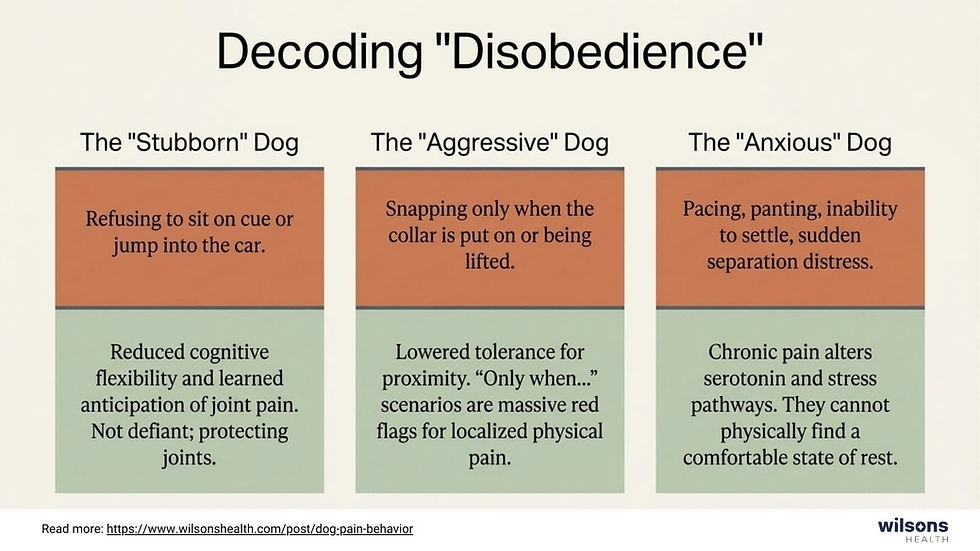
Aggression and reactivity
Pain can:
Lower tolerance for handling or proximity
Make normal interactions feel threatening
Turn a previously polite dog into one who growls or snaps
This is particularly true for:
Dogs with chronic joint or back pain
Dogs with ear infections, dental disease, or skin conditions
Dogs with painful memories of certain procedures or handling
Sometimes the aggression is very specific: only when being lifted, only when a collar is put on, only when another dog bumps them. Those “only when…” situations are red flags for pain.
“Stubbornness” or “disobedience”
A dog who suddenly “refuses” to:
Sit on cue
Jump into the car
Walk on certain surfaces
Go up or down stairs
…may not be defiant. They may have learned that these actions hurt.
Chronic pain can also reduce cognitive flexibility – the ability to adapt and learn – making training harder and frustration more likely.
Anxiety-like behavior
Because chronic pain alters serotonin and stress pathways, it can increase:
Noise sensitivity
Separation-related distress
A dog who paces, pants, or seems unable to settle may be anxious, in pain, or both. In practice, they often are both.

The quiet scale of the problem
A few numbers to hold in mind:
20–37% of dogs are estimated to experience chronic pain, mostly from osteoarthritis.[6]
Pain-related behavior changes are found in 28–82% of dogs seen for behavioral issues, depending on the study.[7]
95% of veterinarians in one survey agreed that dog breeds differ in pain sensitivity.[1][4] But their beliefs don’t always match objective testing.
At the same time, owner recognition of pain – especially chronic, low-level pain – is often delayed or inaccurate.[2] Many people only realize, in hindsight, how much their dog had been compensating.
None of this means you “should have known.” It means the system requires you to read a language you were never taught.
Breed myths, real differences, and why it matters
Pain sensitivity is not the same as pain expression.
What research actually shows
Using tools like Quantitative Sensory Testing (QST), researchers have found:
There are breed-related differences in pain sensitivity thresholds.[1]
These differences are not fully explained by fear, anxiety, or emotional reactivity.[1]
But they also don’t map neatly onto stereotypes like “stoic” vs. “dramatic.”
Meanwhile, studies of veterinarians show:
Beliefs about breed pain sensitivity are shaped heavily by training and clinic culture.[4][9]
“Tough” breeds (often larger, working, or guarding breeds) may be assumed to feel less pain and may receive less aggressive pain treatment.[1][9][10]
“Sensitive” or “dramatic” breeds may have their distress framed as emotional rather than physical.

This creates a quiet ethical tension: dogs may receive different levels of pain relief based on their breed’s reputation rather than their actual experience.
What this means for you
You don’t need to memorize QST data. But you can:
Be cautious about phrases like “this breed is very stoic” or “this breed is dramatic.”
Anchor conversations in your individual dog’s behavior:
“This is new for her,” “He’s moving differently,” “She used to love this and now avoids it.”
Ask how pain is being assessed and what tools are being used, beyond assumptions.
Your lived experience with your dog is a data source, not an anecdote.
Why pain is so hard to spot – even for vets
Even with training, pain assessment in dogs is challenging.[5][11]
Some of the hurdles:
Individual differences. Some dogs vocalize or limp dramatically with mild pain; others hide severe pain almost completely.
Overlap with behavior disorders. Anxiety, fear, and learned behaviors can look like pain – and pain can look like them.
Observer bias. What we expect to see shapes what we notice. If we expect a breed to be “tough,” we may under-score their pain.[1][9][10]
Subtle chronic pain. Dogs adapt. They redistribute weight, change posture, and avoid movements long before they show classic lameness.
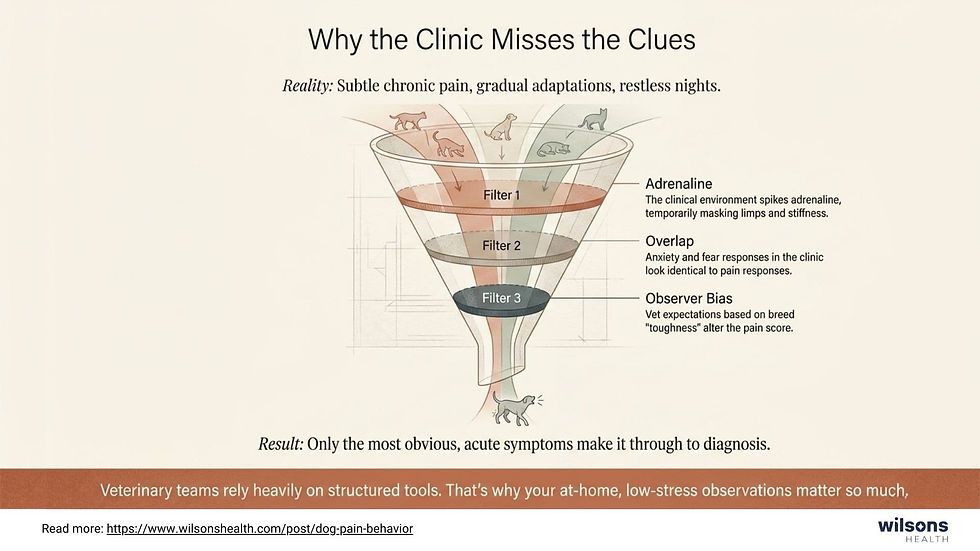
Veterinary teams rely heavily on:
Owner reports of behavior change
Clinical examination and palpation
Imaging (x-rays, ultrasound, etc.) when indicated
Structured tools like pain scales, AWAG, or qualitative behavioral assessments[2][3][5][11]
These tools improve detection, but they don’t remove all uncertainty. That’s normal – and it’s one reason your observations at home matter so much.
When pain and behavior get stuck together (maladaptive pain)
In some dogs, pain moves from being a symptom to being a whole-body, whole-life condition.
What maladaptive pain looks like
Maladaptive pain is when:
The nervous system becomes more sensitive over time.
Pain continues even after the original injury is healing.
Emotional and social changes become entrenched.[5]
You might see:
Ongoing aggression or fearfulness even when obvious pain has improved
Persistent avoidance of certain movements, places, or people
Heightened startle or sensitivity to touch
“Phantom” pain behaviors around a previously injured area
This is where behavioral habituation comes in: the dog has learned that certain actions or contexts predict pain, and those learning pathways don’t instantly disappear when pain is reduced.

It’s not “faking it.” It’s the brain doing what brains do: protecting, generalizing, overcorrecting.
Why treatment isn’t a quick on/off switch
Owners are often told, “We’ll try this pain medication and see if it helps.” That can be useful, but it’s rarely the whole story.
Why longer pain trials matter
Research on maladaptive pain suggests:
Short trials (a few days) may not capture the full effect of pain relief.
6–8 week pain trials are often recommended to:
Allow chronic pain to settle
See whether behavior gradually shifts
Distinguish ongoing pain from learned habits[5][7]

This timeline can feel long when you’re desperate for answers. But it’s more realistic for chronic conditions where the nervous system has been altered over months or years.
Multimodal management
Evidence supports multimodal approaches – using several strategies together – rather than relying on a single medication.[5][6] Depending on the case, that might include:
Different classes of pain-relief medications
Joint support measures
Environmental changes (ramps, rugs, softer bedding)
Gentle, guided exercise or rehab
Behavior modification and training to unlearn pain-linked responses

Your role isn’t to design this plan – that’s your vet’s job. Your role is to notice what changes, what doesn’t, and how your dog seems to feel over time.
What you can watch for at home
You don’t need to become a behavior scientist. You just need to become a slightly more systematic observer of your own dog.
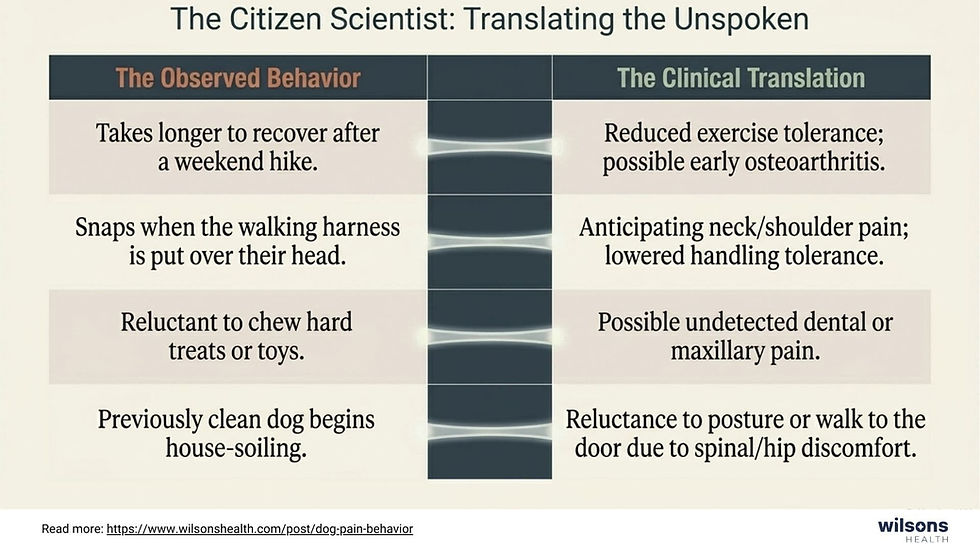
Simple ways to track behavior and possible pain
Consider keeping brief notes on:
Movement
How easily do they get up from rest?
Any hesitation on stairs, into the car, onto furniture?
Changes in gait: shorter steps, stiffness, limping?
Play and exercise
Do they start but stop quickly?
Avoid specific games they used to love?
Take longer to recover after activity?
Touch and handling
Any new flinching, growling, or moving away?
Sensitivity in specific areas (hips, back, neck, paws, ears)?
Changes in grooming tolerance or harness/collar handling?
Mood and sociability
More withdrawn or clingy than usual?
Avoiding certain family members or dogs?
Seeming “on edge” or less patient?
Sleep and rest
Restless at night? Pacing or frequent position changes?
New sleeping spots or postures?
More daytime sleeping but less restful?
Patterns over days and weeks are more valuable than any single moment.
Bringing this kind of information to your vet turns a vague “he’s off” into something they can work with.
Talking with your vet about behavior and pain
You don’t have to go into the clinic with a theory. You can go in with questions.
Some you might consider:
“Could pain be contributing to this behavior change?”
“What are the main things you look for when assessing pain in a dog like mine?”
“Are there structured tools, like pain scales or welfare grids, that we can use to track this over time?” (e.g., AWAG, chronic pain scales)[2][3][6]
“If we suspect pain, what would a reasonable trial of treatment look like – in terms of duration and what we’re watching for?”
“If some behaviors persist after pain is better controlled, how do we address the learned part?”

You can also share what you’re worried about:
“I’m afraid I’ll miss signs that he’s hurting.”
“I don’t want her to be over-medicated, but I also don’t want her to suffer.”
Good veterinarians are used to these tensions. Naming them often leads to clearer, more collaborative plans.
The emotional side: when you realize it might have been pain
Many owners only understand, in hindsight, that their dog had been in pain for a long time. They notice it when:
Pain relief suddenly reveals a more playful, relaxed dog.
A behavior problem improves after treating a physical issue.
Old videos show how differently their dog used to move.
This can come with a rush of guilt: How did I not see it? The honest answer is: you weren’t supposed to. Not alone.

Pain in dogs is:
Under-recognized even by professionals
Behaviorally complex
Wrapped up in cultural stories about breed, age, and toughness[1][4][9][10]
You were working with incomplete information in a system that often under-teaches pain literacy.
Recognizing it now is not “too late”; it’s the beginning of something better.
What is known – and what’s still being figured out
It can be grounding to know where the science is solid and where it’s still catching up.
Well-established
Chronic pain changes behavior. It affects physical, emotional, and social domains in dogs.[2][3]
Pain can drive or worsen aggression and other problem behaviors.[7]
Owner recognition is often delayed or inaccurate, especially for chronic or subtle pain.[2]
Multimodal, structured pain assessment and management improve outcomes.Using tools, scales, and owner input helps catch and track pain more reliably.[5][6]
Veterinary beliefs about breed and pain influence treatment decisions.[9][10]
Still uncertain or emerging
The exact genetic and physiological bases of breed differences in pain sensitivity.[1]
The best ways to separate fear/anxiety-driven behavior from pain behaviors in a clinical setting.
The optimal duration and design of pain trials to distinguish ongoing pain from behavioral habituation.[7]
How long-term pain-induced behavioral changes affect rehabilitation success and what retraining strategies work best.
Whether breed-specific pain management guidelines will ultimately improve care.
Science is moving, but it won’t deliver a neat algorithm any time soon. What you have, right now, is the ability to notice, to ask, and to stay curious about your dog’s inner experience.
Living with a dog whose behavior is shaped by pain
If your dog’s behavior has changed and pain is part of the picture, daily life can feel like a balancing act:
Wanting to protect them without over-restricting them
Wanting answers without putting them through endless tests
Wanting them comfortable without losing who they are to sedation
There isn’t a single “right” way to navigate this. But a few steady thoughts can help:
Behavior isn’t moral. Growling, hiding, snapping, refusing – these are not character flaws. They are information.
You’re allowed to adjust expectations. A dog in chronic pain may not be the social butterfly or agility star they once were. That’s not a failure; it’s an adaptation.
Improvement can be slow and uneven. Some days will look better than others. That’s typical in chronic conditions.
You don’t have to choose between “it’s all in his head” and “it’s all physical.” Pain and emotion are intertwined. Addressing both is not overkill; it’s appropriate.

Most of all: your dog doesn’t need you to get this perfect. They need you to keep paying attention, keep asking questions, and keep advocating for their comfort.
Pain bends behavior. Understanding that doesn’t just help you “manage a problem dog.” It lets you see the full picture of who your dog is, what they’re carrying, and how you can lighten that load – even a little – in the time you share.
References
American Kennel Club Canine Health Foundation. Breed-Specific Pain Sensitivity in Dogs.
Mills DS, et al. How does chronic pain impact the lives of dogs? Frontiers in Veterinary Science / PubMed Central. PMC11025458.
Ibid. (Companion Frontiers in Veterinary Science article on chronic pain and welfare in dogs).
NC State News. Vet School Transmits Culture, Not Just Data to Students.
Mills DS, et al. Detection of maladaptive pain in dogs referred for behavioral problems. Frontiers in Veterinary Science / PubMed Central. PMC12095257.
British Veterinary Journal. Development and validation of a chronic pain perception scale.
Veterinary Ireland Journal. Understanding the link between canine pain and problem behaviours.
Psychology Today. Pets’ Pain Often Goes Undiagnosed.
Nature Scientific Reports. Veterinary education and experience shape beliefs about dog breeds and pain.
PubMed Central. Tailoring treatment: dog breed status influences pain assessment and treatment.
PLOS One. Qualitative behavioral assessment of dogs with acute pain.


Comments