
Involving Younger Family Members in Senior Dog Care

Roughly 1 in 3 dog guardians will, at some point, care for a senior dog with chronic health needs.[5] Many of them describe the experience with the same words used for aging human relatives: “rewarding,” “draining,” “complicated,” “a privilege.” And in a lot of those homes, there’s a quiet, practical question in the background:
“Should we involve the kids in this… or protect them from it?”
That question isn’t sentimental; it’s logistical, ethical, and deeply emotional. An older dog needs consistent routines, gentle handling, and more emotional presence. Adults are tired. Children are curious. The dog is aging in real time in front of everyone.
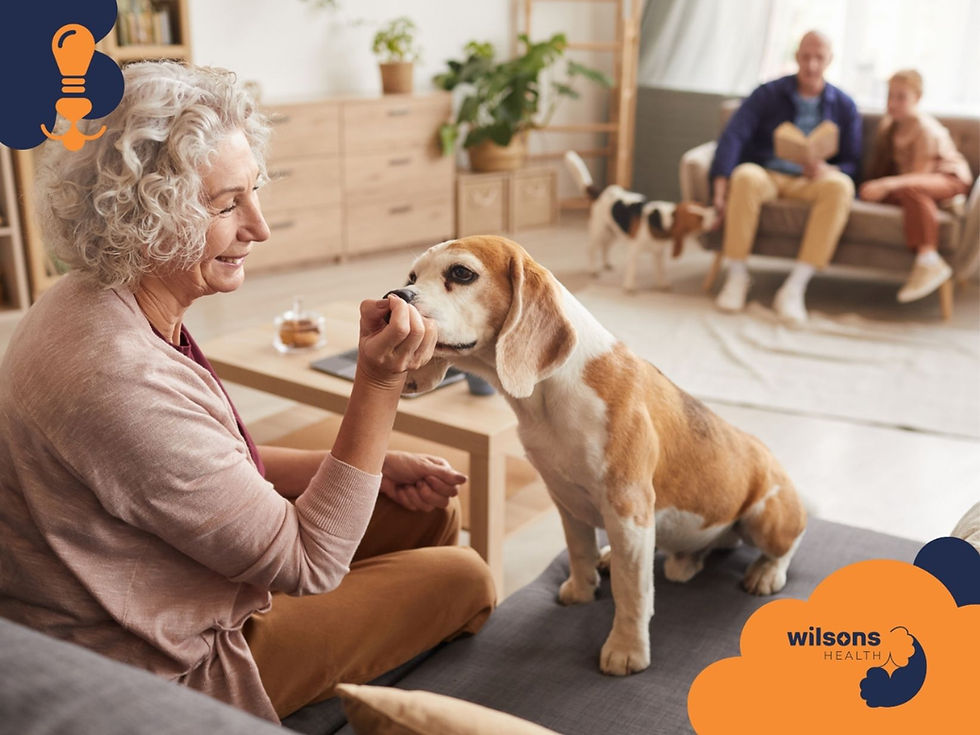
This article is about that intersection: how younger family members can meaningfully support a senior dog’s care and emotional life, and what that does to the emotional climate of the household—for better, and sometimes for harder.
Why an Old Dog Can Be a Child’s Greatest Teacher
Research on older adults and pets repeatedly finds the same themes: people talk about attachment, unconditional love, and interdependence when they describe life with their animals.[4][5] That bond often intensifies, not weakens, as a dog ages.
When younger family members are invited into that bond, several things happen at once:
The dog gains stability and social contact. Senior dogs generally do better with predictable routines, gentle engagement, and a calm sense of “we’re all here with you.”[5]
Adults gain support. Caregiver burden—emotional fatigue, time pressure, decision stress—is real in senior dog care.[4][5] Sharing appropriate tasks can ease that load.
Children gain a lived education in empathy and responsibility. Not in the “you must learn responsibility” sense, but through daily, embodied experience: noticing when the dog is stiff, walking more slowly, or needs help with the stairs.
In one study of 284 guardians of aging dogs, many described the experience as emotionally complex but deeply meaningful—very much like caring for elderly humans.[5] When children are gently included, they’re not just watching that meaning from the sidelines; they’re participating in it.
The Human–Animal Bond, Seen Through Younger Eyes
You could think of the human–animal bond as a kind of emotional ecosystem. For older adults, research shows that pets:
Reduce loneliness
Provide a sense of purpose
Contribute to feeling “at home” and secure[1][4][6]
When a senior dog is part of a family rather than a single-person household, that bond becomes shared. Children don’t just see an old dog; they see:
The way their parent’s face softens when the dog shuffles into the room
The extra care taken with stairs, medications, blankets
The small griefs and small joys of “good days” and “bad days”
Studies of older adults show that when family members are more involved in pet care, the humans’ well-being improves.[3] That intergenerational participation—grandparent, parent, child, dog—adds more points of connection and more emotional “scaffolding” around the dog.
For children, especially, this can quietly teach:
Attunement: “He doesn’t want to play fetch today; let’s just sit with him.”
Perspective: “She used to run so fast. Now we walk slow so her hips don’t hurt.”
Non-verbal communication: noticing subtle signs of tiredness, discomfort, or contentment.
None of this requires a lecture. It comes from being allowed to be near an aging dog and to matter in that dog’s daily life.
What Kids Can Actually Do: Age-Appropriate Roles
Not every task in senior dog care is suitable for younger hands. But many are—and they can be structured in ways that are safe, helpful, and meaningful.
Below is a rough orientation, not a rulebook. Children vary widely; so do dogs.
Everyday care tasks
These are the building blocks of a senior dog’s day. For many children, they’re also the safest entry points.
Task | Why it helps the dog | How it helps the child |
Measuring and offering food | Keeps diet consistent, supports weight and chronic condition management | Builds routine, attention to detail (“this scoop, not that one”) |
Refreshing water bowls | Encourages hydration, especially important for older kidneys | Simple, tangible “I did something that matters” |
Gentle brushing | Supports skin health, comfort, and early notice of lumps or sore spots | Teaches gentle touch, patience, and observation |
Slow walks (for appropriate dogs) | Maintains mobility and mental stimulation[4][6] | Shared activity, physical movement, learning to match the dog’s pace |
Preparing a cozy rest area | Reduces slips, pressure on joints, and anxiety | Invites nurturing behavior and creativity (“let’s make her bed extra soft”) |
Key point: predictability. Senior dogs often thrive on consistent routines—roughly the same times for meals, walks, rest. Children can be guardians of those small rituals.
Emotional support roles
Younger family members are often, without realizing it, the dog’s emotional anchors.
Companionship time: Sitting quietly with the dog during TV, homework, or reading.
Comfort rituals: Saying goodnight, offering a favorite toy, or announcing “nap time” and escorting the dog to their bed.
Gentle play adaptation: Shifting from rough games to low-impact ones—snuffle mats, food puzzles, scent games, or simple “find the treat” around the room.
These roles matter because senior dogs, like older humans, are vulnerable to loneliness and disorientation. Consistent, kind presence helps maintain their sense of security.[1][4][6]

What Children Should Not Be Responsible For (And Why)
Some aspects of senior dog care sit firmly in the adult column, even if children can observe or assist under supervision.
Medication management. Dosing errors, missed doses, or giving meds to the wrong dog (or person) can have serious consequences. Children might help by reminding adults of “pill time,” but the actual handling should be adult-led.
Monitoring chronic conditions. Assessing pain levels, mobility decline, cognitive changes, or side effects of medication is nuanced and emotionally loaded. Adults, ideally in partnership with a veterinarian, need to steer this.
Veterinary decision-making. Bringing children into the conversation at an age-appropriate level can be healthy; placing decisions on their shoulders is not.
Physically risky tasks. Lifting a large dog, managing a dog who may snap when in pain, or handling a dog in and out of the car is often too much for younger bodies (and sometimes adult backs, to be honest).
None of this is about underestimating children. It’s about acknowledging the complexity of senior dog health and keeping them in roles where they can succeed, not feel overwhelmed.
The Caregiver Burden Paradox: Helping Without Overloading
Adults caring for senior dogs often describe a mix of devotion and exhaustion: disrupted sleep, constant monitoring, financial stress, and anticipatory grief.[4][5] Involving younger family members can:
Distribute practical tasks (feeding, grooming, companionship)
Increase social support for both the dog and the adults[4][5]
Turn solitary care into shared family life
But there’s a paradox. While spreading responsibility can ease adult burden, it can also:
Add supervision work (“Did you actually feed her, or did you just think about feeding her?”)
Expose children to distress they may not fully understand
Create guilt in children if something goes wrong (“Did I forget something?”)
The solution isn’t to exclude them; it’s to be deliberate.
A simple family framework
You might find it useful to think in three layers:
Core medical care (adult + vet led)
Medications, treatment decisions, monitoring symptoms, financial decisions.
Shared practical care (adult + child)
Feeding routines, gentle walks, grooming, comfort measures.
Emotional ecosystem (whole family)
How you talk about the dog’s aging, how you handle “bad days,” and how you support each other.
When adults stay clearly responsible for layer 1, children can participate more freely in layers 2 and 3 without feeling like the dog’s fate rests on their shoulders.
Talking About Aging and Illness With Younger Family Members
Research doesn’t yet give us a detailed “best practice” guide for explaining pet illness and decline to children.[5] But several themes from human-animal bond and caregiving studies can help shape those conversations.[4][5][6]
Be honest, but not graphic
Children often know more than we think. They see the dog slowing down, struggling with stairs, or going to the vet more often. Clear, simple language can be a relief:
“His body is getting older, and his legs hurt sometimes.”
“Her heart isn’t as strong as it used to be, so we’re helping her rest more.”
Avoiding the topic can leave them alone with their own (often scarier) theories.
Name feelings as normal
Adults in caregiving roles frequently report anxiety and sadness about their pet’s vulnerability.[5] Children feel versions of that too. You can normalize it:
“I feel worried when she coughs like that. Do you ever feel that way?”
“It’s okay to feel sad that he can’t play like before. I do too.”
This doesn’t solve the sadness, but it makes it shareable rather than isolating.
Prepare gently for change
Senior dog care is, by nature, a relationship with change. That can be:
Loss of abilities (can’t jump on the bed)
New routines (more vet visits, medications)
Fluctuating “good days” and “bad days”
You might frame it as: “Our job now is to help her be as comfortable and loved as possible, every day.” This gives children a role—care—rather than a burden—control the outcome.
When the Vet Visit Is a Family Event
While there’s limited research specifically on children’s roles in veterinary communication, we know that:
Including all relevant family members can improve shared understanding of a dog’s condition and care plan.
Veterinarians can be valuable allies in explaining disease progression in age-appropriate ways.
You might consider:
Bringing older children or teens to occasional appointments so they can hear directly from the vet and ask questions.
Letting younger children draw pictures or write notes to send with the dog (“Ask the doctor if his tummy still hurts”), which can later be answered in simple terms.
If you’re unsure how to involve your children, you can explicitly ask your vet:
“We’d like to involve our kids in caring for Max without overwhelming them. What tasks do you think are safe and helpful? How would you explain his condition to a 7-year-old?”
Most veterinary professionals are familiar with family dynamics around aging pets and can help you calibrate involvement.

Building Routines That Help Everyone
Senior dogs often benefit from structured, predictable days.[5] Children, frankly, often do too. Thoughtful routines can support both.
Example daily rhythm (adaptable to your reality)
Morning
Adult: medication, quick physical check (eating, walking, bathroom habits)
Child: measure food, refresh water, offer a gentle greeting ritual
Afternoon / after school
Shared: short, slow walk or sniff session
Child: light grooming or interactive puzzle game
Evening
Adult: review any changes, note questions for vet
Child: “tuck in” the dog, arrange bedding, say goodnight
None of this has to be elaborate. The power is in the consistency and in the sense that “we are all caring for this old friend together.”
Coping With Decline: Making Space for Mixed Feelings
Caring for an aging dog is often described as both deeply rewarding and quietly heartbreaking.[5] Children live in that mix too.
They may feel:
Proud to help (“I’m the one who brushes her every night”)
Frustrated (“Why can’t he just be like before?”)
Guilty (“I forgot to close the gate and he slipped on the stairs”)
Scared of loss (“What happens when he dies?”)
Some ways to support them without overpromising:
Name the limits of control. “We can’t stop her from getting older, but we can make her days comfortable and full of love.”
Create small rituals of care and remembrance now, not just later. Taking photos together, telling “remember when she…” stories, making a “favorite things” list for the dog.
Acknowledge your own uncertainty. “I don’t know exactly how long he’ll be with us. The vet is helping us watch his health closely, and we’ll keep doing what’s kind for him.”
Children often feel steadier when adults are honest about what they do and don’t know, instead of offering false certainty.
When You Worry About “Too Much, Too Soon”
A common hesitation is: Are we exposing our children to too much illness and death? It’s an understandable concern.
The research doesn’t yet give definitive answers about long-term psychological outcomes of children involved in senior pet caregiving.[5] But we do know from broader work on grief, attachment, and caregiving that:
Shielding children from all exposure to decline and death doesn’t prevent distress; it often just postpones it to a time when they have fewer supports.
Guided, age-appropriate involvement can foster resilience, empathy, and a more realistic understanding of life cycles.
The ethical tension is real: we want to protect children from harm, but we also don’t want to deny them experiences that can deepen their capacity for care.
A useful guiding question might be:
“Does this give my child a chance to care and understand, or does it ask them to carry something too heavy?”
If it feels like the latter—such as involving them in euthanasia decisions, or expecting them to manage complex nursing tasks—it’s reasonable to step back and keep their role smaller.
When Resources and Realities Don’t Match the Ideal
Not every family has the same time, money, housing stability, or emotional bandwidth to orchestrate ideal intergenerational caregiving.[2]
Some realities:
An older adult may rely on an adult child for transportation and finances, while grandchildren are the ones physically present with the dog.
Housing rules, work schedules, or health issues can limit what’s possible.[1][2]
There may be tension over “who gets the dog” if living arrangements change.[2]
In those situations, clarity helps:
Name what you can reliably do, rather than what you wish you could.
Avoid making promises to children you might not be able to keep (e.g., “He’ll live with us forever,” when housing is uncertain).
Use your vet as a practical ally in planning—sometimes the kindest decision for an old dog is shaped by human constraints as much as by medicine.
The goal isn’t perfection; it’s a pattern of care that is good enough, sustainable, and grounded in reality.
How Veterinarians Can Support the Whole Family
Veterinary teams are often quietly doing family work as much as medical work. They can:
Suggest age-appropriate ways for children to participate in care
Provide clear explanations of diagnosis and prognosis that you can relay to younger family members
Help you plan for difficult transitions, including how to talk about euthanasia and grief
If you feel unsure, it’s entirely reasonable to say:
“We’re trying to involve our kids in caring for Bella, but we’re not sure how much is appropriate. Can you help us think this through?”
You’re not expected to navigate the medical and emotional landscape alone.
When Love Learns to Slow Down
In many families, the old dog becomes the quiet center of the household. The one everyone steps around, covers with a blanket, waits for at the bottom of the stairs. The one the youngest child insists on saying goodnight to, even when she’s “just sleeping again.”
Research tells us that pets, especially in later life, are woven into our sense of home, comfort, and emotional support.[1][4][6] It also tells us that caring for an aging dog is often as complex and meaningful as caring for an elderly person.[5]
What the studies can’t fully capture is the small, daily choreography that unfolds when children are allowed to be part of that care:
The teenager who now walks at the dog’s pace instead of their own
The 8‑year‑old who knows exactly how to arrange the blanket around arthritic hips
The shared family language—“good day,” “tired day,” “extra gentle today”—that grows around the dog
Involving younger family members in senior dog care is not about training perfect little caregivers. It’s about letting love change shape as a dog grows old—and letting children see, from up close, that this, too, is part of what love looks like.
References
Ryan, T., & Ziebland, S. “‘They’ve probably had those animals for years: They are like family’: Accommodating pets in care homes and their contribution to creating a sense of home.” International Journal of Care and Caring. Cambridge University Press.
Toohey, A. M., McDonald, J., & Rock, M. “‘Whoever takes the dog gets the house’: How older adults negotiate pet care resources.” Journal of Aging Studies. Available via PubMed Central (PMC).
Gee, N. R., Mueller, M. K., & Curl, A. L. “Ownership of dogs and cats leads to higher levels of well-being and family and community involvement in late life.” Frontiers in Veterinary Science.
Street, H., & colleagues. “The role of pets in the support systems of community-dwelling older adults.” Journal of Aging & Mental Health. Taylor & Francis Online.
Spitznagel, M. B., et al. “Canine Caregivers: Paradoxical Challenges and Rewards.” Anthrozoös. Available via PubMed Central (PMC).
Friendship Centers. “The Impact of Pet Ownership on Senior Happiness and Health.”
Human Animal Bond Research Institute (HABRI). “New Research Confirms the Strong Bond Between People and Pets.”


Comments