
Physical Changes in Senior Dogs and Emotional Impact
- Jan 6
- 10 min read
Updated: May 19
By the time a dog is over 12, they are about 23 times less likely to be classified as “healthy” than a young adult dog of the same species.[1]Not because something has “gone wrong,” but because aging itself quietly reshapes almost every system in their body: joints, muscles, brain, immune system, senses.
You don’t usually see that number on the exam room wall.What you see is your dog hesitating at the stairs for the first time.Sleeping through the doorbell.Standing in the middle of the room at 3 a.m., confused and calling for you.
And what you feel is not “23 times less healthy.”You feel: Something is happening to him. And I don’t know how to be okay with it.
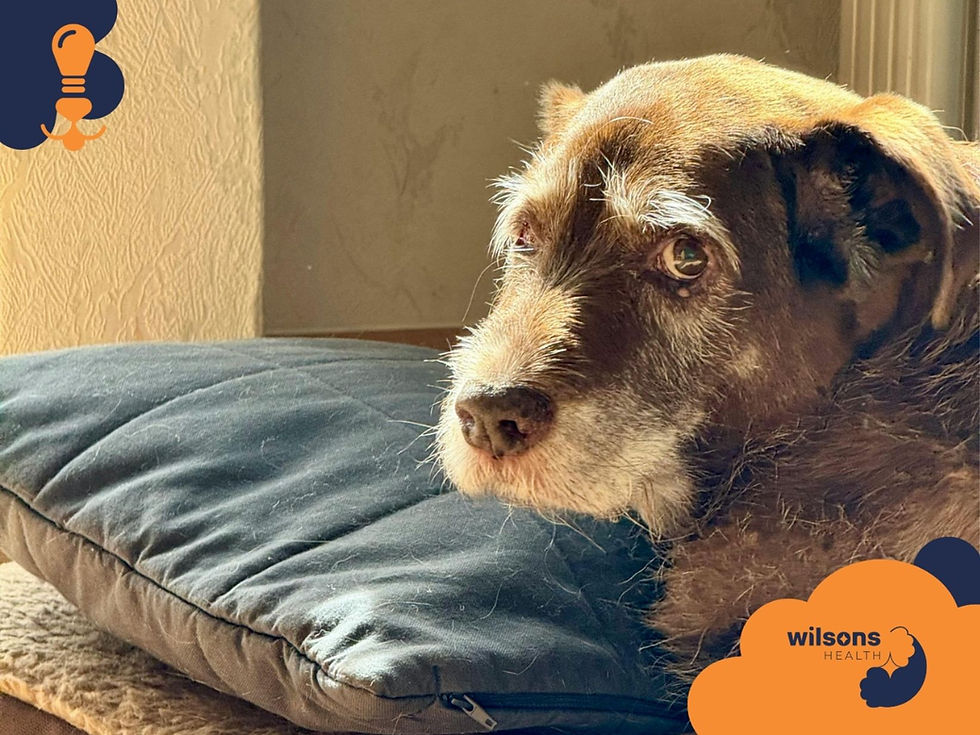
This article is about that intersection: the very physical, measurable changes in senior dogs — and the very human, often wordless emotional impact on you.
When “Old Age” Stops Being Abstract
Veterinary medicine usually defines the geriatric stage as the last third of a dog’s expected lifespan. That might mean:
A Great Dane is “senior” by 6–7.
A Labrador by 8–9.
A small terrier may not hit that stage until 10–11.
From the outside, it can look like “he just got old suddenly.” Biologically, a lot has been building for years.
The body quietly rebalances
Research across tens of thousands of dogs shows:[1][3]
Large/heavy dogs age faster. Body weight alone explains about 44% of the differences in mortality risk between breeds.[1]
Dogs over 12 are dramatically more likely to have:
Joint disease and mobility problems
Vision and hearing loss
Oral/dental disease
Weight changes (up or down)
These aren’t isolated “problems” so much as a shift in how the whole body works — what scientists call senescence.
To you, that shift looks like:
Needing a boost into the car
Shorter walks
Cloudy eyes that don’t quite track a tossed toy
A coat that doesn’t shine like it used to
Pants a bit tighter from carrying them up the stairs
And under all of that, something else: a quiet, chronic ache in your own chest.
The Slow Fade of Mobility — and the Fast Rise of Worry
Mobility is often the first, and loudest, physical change you notice.
What’s happening in their body
Common age-related changes include:[2][5][7]
Osteoarthritis: cartilage thins, joints inflame, movement hurts.
Muscle loss: especially in the hind limbs; less strength, poorer balance.
Frailty: a broader syndrome where the body has less reserve to handle stress. A skipped meal, a hot day, or a long walk takes more out of them than it used to.
Researchers are now using mobility tests and even creatine-based muscle measures to track this frailty over time.[5][7] In other words, your sense that “he just can’t bounce back like he used to” has a real physiological basis.
What it feels like to you
Mobility decline is oddly emotional because it’s visible and symbolic:
The dog who once dragged you down the street now shuffles behind.
The leap to the couch that once annoyed you now feels like a small miracle.
You start calculating every outing: “Is this too much? Not enough?”
Common emotional reactions:
Grief for the dog who used to sprint, hike, wrestle.
Guilt about past years — “Did I exercise him too hard? Not enough? Should I have caught this earlier?”
Hypervigilance: watching every step, every stumble.
Frustration when they lag or refuse, followed immediately by shame for feeling frustrated at all.
You are not alone in that mix. Owner surveys and clinical observations consistently show stress, anticipatory grief, and burnout around caring for mobility-impaired senior dogs — especially when there’s chronic pain involved.
How this changes your daily life
You may find yourself:
Choosing routes with fewer hills and less pavement.
Rearranging furniture to clear paths.
Lifting 60 pounds of dog three times a day and wondering how long you can keep doing it.
Cancelling social plans because you don’t want to leave them alone on a “bad day.”
None of that makes you dramatic. It makes you a caregiver.
When Their Senses Fade — and You Become Their Anchor
Aging affects vision, hearing, and sometimes even smell.[2]
In their body
Common sensory changes in older dogs:
Hearing loss: often gradual; they stop reacting to high-pitched sounds first.
Vision decline: from lens changes, cataracts, or retinal disease; the world becomes fuzzier and more confusing.
Oral and dental issues: painful teeth and gums, difficulty chewing, bad breath.[1][2]
These changes are so common in older dogs that they’re often underreported — almost treated as “background noise” in vet visits.
In your mind and heart
Sensory loss can trigger a surprising amount of emotion:
The first time you realize your dog didn’t hear you come home.
Calling their name at the park and watching them keep sniffing, oblivious.
Seeing them bump into the coffee table they’ve walked around for ten years.
You might feel:
A sharp stab of loss — “He doesn’t look at me the same way.”
Protectiveness — walking on the traffic side, clapping or stomping to “speak louder” in other senses.
Loneliness — when the familiar rituals (the dash to the door, the instant eye contact) soften or vanish.
What’s important to remember:Your dog isn’t choosing to ignore you. Their brain is receiving less information. You become, quite literally, their interpreter and guide.
That role can be deeply bonding — and quietly exhausting.

The Brain Changes Too: Cognitive Decline and the Dog You “Used to Know”
Not all change in older dogs is physical in the obvious sense. Some of the hardest shifts are cognitive and behavioral.
Canine Cognitive Dysfunction Syndrome (CCDS)
CCDS is often called “dog dementia.” It’s not rare:
14–35% of dogs over 8 are affected, depending on how strictly you define it.[2]
Symptoms include:
Disorientation (getting stuck in corners, staring at walls)
Altered sleep–wake cycles (night pacing, daytime sleeping)
Increased vocalization (whining, barking at nothing)
Anxiety, clinginess, or irritability
House soiling in previously fully housetrained dogs
Losing learned behaviors or routines
Behavioral tests and brain imaging show that older dogs:[3][4][6]
Have reduced memory and learning ability
Show more object avoidance and altered social behavior
Exhibit brain shrinkage and accumulation of abnormal proteins, similar in some ways to Alzheimer’s disease in humans
Show disrupted protein quality control in the brain, which may drive some of the degeneration
This isn’t “stubbornness” or “spite.” It’s biology.
Why CCDS feels so destabilizing
Many owners say cognitive changes are emotionally harder than physical ones. Why?
Because they touch identity.
The stoic dog becomes anxious and vocal.
The independent dog becomes panicky if you leave the room.
The perfectly housetrained dog starts peeing indoors.
The sound sleeper starts pacing all night.
Emotionally, this can trigger:
Confusion: “Is he suffering? Is he aware of what’s happening?”
Anger and shame: snapping in the middle of the night, then hating yourself for it.
A feeling of “losing him in pieces.” The body is still here, but the familiar mind is changing.
Veterinary teams now recommend routine cognitive screening for senior dogs for exactly this reason: catching subtle shifts early can guide management and, just as importantly, prepare you emotionally.[1][2][4]
The Invisible Layer: Immune System, Weight, and “Just Not Himself”
Beyond what you can see, aging also reshapes internal systems.
Inside their body
Research shows that older dogs:[2][3]
Have a weaker immune system, making them:
More prone to infections
Slower to recover from illness or surgery
Often experience weight changes:
Some gain weight due to lower activity and slowed metabolism
Others lose weight due to muscle wasting, dental disease, or chronic illness
These shifts contribute to what researchers call frailty — a state where the dog is more vulnerable to any stressor: heat, cold, changes in diet, new environments, even emotional stress.[5]
Inside your mind
You might notice:
More vet visits.
Recoveries that take weeks instead of days.
Bloodwork that starts showing “little flags” in multiple places.
Emotionally, this can feel like:
Constant low-level alarm: always waiting for the next thing.
Decision fatigue: “Do we treat this aggressively? Gently? At all?”
A sense of walking a tightrope between protecting them and overwhelming them.
None of this means you’re failing. It means their body’s resilience is changing — and you’re being asked to adjust alongside it.
The Emotional Labor of Loving an Aging Dog
Caring for a senior dog is not just a “sweet final chapter.” It is work — emotional, physical, and sometimes financial.
Common emotional experiences
From owner reports and clinical observations:[1–3]
Anticipatory grief: grieving long before death, each time a new ability is lost.
Guilt: over past choices, current irritations, or not feeling “strong enough.”
Helplessness: when treatments don’t restore the dog you remember.
Burnout: especially with chronic conditions that disrupt sleep or demand constant supervision.
Ambivalence: loving them deeply and also sometimes wishing for relief — then feeling terrible for even thinking that.
These feelings are not a sign that you don’t love your dog enough.They are a sign that you do.
Your emotional response is part of the caregiving ecosystem, just as real as their joint inflammation or brain changes.
You, Your Vet, and the Space Between You
How you experience your dog’s aging is strongly shaped by your relationship with your veterinarian.
What vets are aiming for
Current recommendations emphasize that all senior dogs should be regularly assessed for:[1][2][5]
Mobility and joint health
Sensory function (eyes, ears)
Cognitive and behavioral changes
Nutrition and weight
Oral health
Overall frailty
There’s growing interest in longitudinal monitoring — tracking changes over time with owner input, not just snapshots in the exam room.[5][7] You’re not just a bystander; you’re a data source and a partner.
Where it gets complicated
Real life is messier than guidelines. Communication can be strained by:
Different perceptions of “normal aging.”
You see a heartbreaking change; a vet may see something typical and expected.
Hope, denial, and fear.
Owners may minimize or over-interpret signs; vets may struggle to match medical facts with emotional readiness.
Hard decisions:
Should we start medications with side effects?
Is surgery worth the stress?
Are we prolonging life or prolonging suffering?
Is it time to consider euthanasia?
These are ethical tensions, not math problems. There is rarely a single “right” answer.
What can help:
Naming your emotional state in the appointment (“I’m scared I’m missing something,” “I’m overwhelmed by choices”).
Asking process-oriented questions:
“What changes should I watch for over the next 6–12 months?”
“What would a good day look like for a dog in his condition?”
“What are the realistic goals of this treatment — comfort, function, more time, or all three?”
You’re not just asking for medical information. You’re asking for orientation — a map of what might be coming.

Quality of Life vs. More Time: The Quiet Ethical Weight
One of the most painful parts of caring for an aging dog is the growing awareness that you may one day have to choose their death.
The research doesn’t give simple answers here. It does highlight the tensions:[1–3]
Risk of under-treatment
Avoiding pain relief or supportive care because “he’s just old” or “I don’t want to put him through anything.”
Risk of over-treatment
Pursuing aggressive interventions to keep them “like they used to be,” even when the dog’s daily experience is dominated by fear, confusion, or pain.
Add in cognitive decline, and it becomes even harder. How do we measure emotional and cognitive suffering in a being who can’t describe it?
Veterinary teams sometimes use structured quality-of-life scales, but these are guides, not verdicts. Ultimately, the decision rests on:
The dog’s day-to-day experience
The family’s capacity — emotional, physical, financial
The shared values of everyone involved
If you feel caught between “too soon” and “too late,” that’s because there usually is no perfect moment. There is only the best decision you can make with the information and love you have.
Practical Ways to Live With These Changes (Without Losing Yourself)
You can’t stop your dog from aging. But you can shape how you both move through it.
1. Shift from “fixing” to “supporting”
Instead of asking, “How do we get him back to normal?” try:
“What does comfort look like for him now?”
“What can he still enjoy, and how do we protect that?”
“How do we make everyday tasks easier on his body?”
This mindset aligns with how researchers talk about healthspan — not just how long a dog lives, but how well.[5]
2. Use your observations as data, not self-criticism
You are with your dog far more than any professional. Your notes matter.
Track (even informally):
Mobility: stairs, jumping, pace on walks
Sleep patterns: restlessness, nighttime waking
Behavior: new anxiety, confusion, house soiling
Appetite and weight
“Good days” vs. “bad days”
Then bring these observations to your vet as information, not evidence that you’ve failed.
3. Adapt the environment instead of forcing the body
Small changes can ease frailty without demanding “more” from your dog:
Ramps or steps to furniture and cars
Non-slip rugs on slick floors
Raised bowls if bending is painful
Night lights for visually impaired dogs
Quiet, predictable routines for cognitively impaired dogs
Think of it as renovating the house to fit the new tenant’s needs.
4. Protect your own mental health
Caregiver burnout is real in veterinary contexts, even if it’s rarely named.
Consider:
Sharing tasks with family or friends when possible.
Scheduling your own breaks — even a walk alone can reset your nervous system.
Talking honestly with your vet about your limits (“I can’t safely carry him upstairs much longer,” “I’m not coping with the nighttime pacing.”)
Seeking support — from pet loss/grief groups, therapists familiar with animal-related grief, or trusted friends who “get it.”
Needing support doesn’t mean you’re failing your dog. It means you’re taking the role seriously enough to sustain it.
5. Prepare emotionally, not just medically
As research into dog aging advances — MRI, EEG, molecular markers — we may get better at predicting and tracking decline.[3][4][6] But the emotional work will still be human-scale and slow.
It can help to:
Talk early about end-of-life values:
“I don’t want him to be scared and in pain.”
“I want him to have more good days than bad.”
Ask your vet what the likely trajectory of your dog’s conditions is — not just worst-case scenarios.
Allow yourself to grieve in installments as each new change appears, instead of saving it all for the end.
Grief spread out over time is still grief. It’s also a way of staying present.
A Different Kind of Love Story
Research on aging dogs is becoming more sophisticated:frailty scores, mobility trials, molecular pathways, environmental risk factors.[1][3][5][7]
Yet in the exam room and in your living room, it comes down to something simpler:
A body that is changing in predictable, measurable ways.
A human who is changing in response — learning new patience, new limits, new tenderness.
A relationship that is shifting from adventure partner to being you gently help up the stairs.
None of this is easy. But understanding the biology can take some of the sting out of the mystery.
Your dog is not “letting you down” by aging. You are not “failing” by finding it hard.
You are both doing what living beings do: adapting, day by day, to bodies that do not stay the same.
If there is a lesson in watching a beloved dog grow old, it may be this:Love is not measured by how fast they run to you, but by how steadily you walk beside them when they can’t.
References
Hoffman, J.M., Creevy, K.E., & Promislow, D.E.L. (2018). Demographic Change Across the Lifespan of Pet Dogs and Their Owners. Frontiers in Veterinary Science, 5:200. https://www.frontiersin.org/journals/veterinary-science/articles/10.3389/fvets.2018.00200/full
American Kennel Club. Aging in Dogs: Physical and Mental Signs. https://www.akc.org/expert-advice/health/aging-in-dogs-physical-mental-signs/
Gilmore, K.M., & Greer, K.A. (2024). Dog Aging: Molecular, Cellular, and Physiological Changes. Frontiers in Veterinary Science / PMC. https://pmc.ncbi.nlm.nih.gov/articles/PMC11675035/
Chapagain, D. et al. (2022). A Test Battery for Measuring Age-Related Changes in Memory and Related Cognitive Functions in Dogs. Scientific Reports 12, 15611. https://www.nature.com/articles/s41598-022-19918-7
North Carolina State Veterinary Hospital. Research Study for Senior Dogs: Targeting Frailty to Improve Healthspan and Well-being. https://cvm.ncsu.edu/research-study-for-senior-dogs-targeting-frailty-to-improve-healthspan-and-well-being/
BrainFacts.org. Inside the Brain of Aging Dogs. https://www.brainfacts.org/thinking-sensing-and-behaving/aging/2023/inside-the-brain-of-aging-dogs-020723
Dog Aging Project. Inside the Measurement: Mobility & Activities. https://dogagingproject.org/inside-the-measurement-mobility-activities

Comments