
Reflecting on How Illness Changed Your Bond

Updated: May 16
By some estimates, when one partner develops a chronic illness, the other partner’s mental health and quality of life decline as much—or more—than the patient’s own.[9]Yet when you scroll through social media or sit in a waiting room, what you mostly see are “before and after” photos of the dog, medication lists, and lab values. The quiet transformation of the relationship itself—between you and your dog, and often between you and other humans—rarely gets named.
But it’s there.
The way you move through your home changes. The way you sleep, spend money, plan weekends, notice small symptoms, and even argue with your partner changes. And in the middle of all that, your bond with your dog is being rebuilt, sometimes painfully, into something deeper and very different from what it was “before.”
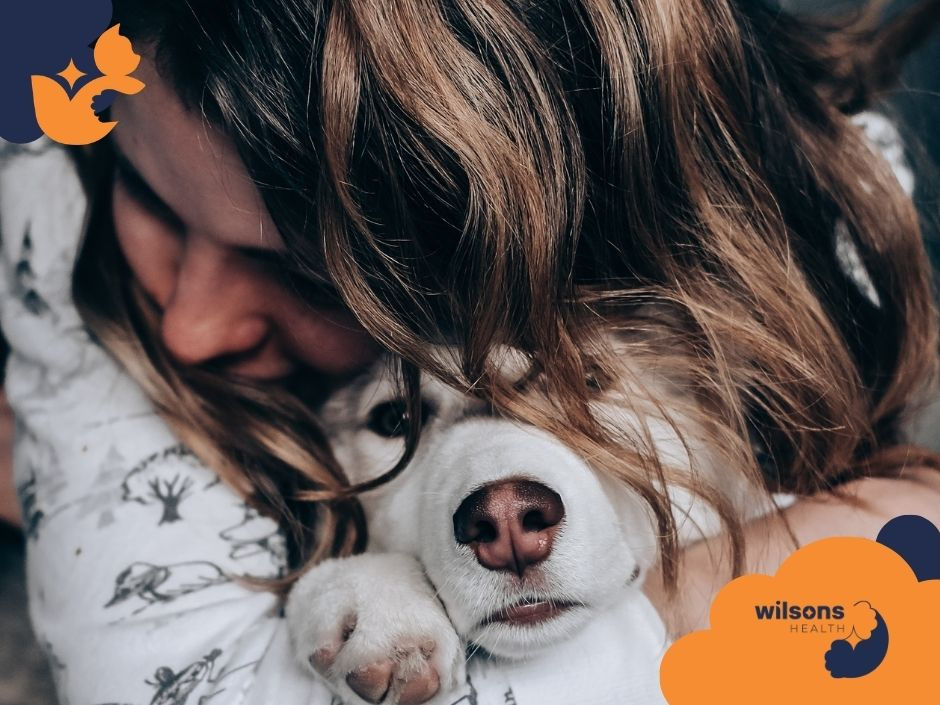
This article is about that rebuilding—how illness can change your bond in meaningful ways, including ways that are hard, beautiful, and both at once.
When illness becomes “ours,” not “theirs”
Researchers studying couples and chronic illness talk about shared illness appraisal: the moment both partners stop seeing the illness as “your problem” or “my problem” and start seeing it as our shared challenge.[1]
You can feel a similar shift with a sick dog.
Before: “My dog has kidney disease.”
After: “We’re living with kidney disease.”
That tiny change in language reflects a deeper mental shift. Studies in human couples show that when partners hold this shared view:
They communicate more openly about symptoms, fears, and needs.[1]
They’re more likely to work as a team—what researchers call dyadic coping—instead of one person silently carrying everything.[1]
Relationship satisfaction and emotional closeness are generally higher.[1]
In the dog world, this might look like:
You and your partner both learning to read your dog’s subtle “I’m not feeling well” signals.
One person handling medications while the other manages vet communication.
Seeing the dog’s good days as something you all created together, not a lucky accident.
This shared appraisal doesn’t erase grief or stress. But it changes the story from “I’m failing at keeping them healthy” to “we’re facing this together, and that matters.”
The slow erosion no one warns you about
There is a quieter finding in the research that many caregivers recognize instantly:even when couples start out united, communication and shared coping often decline over time.[1]
Not because anyone stops caring. Simply because long-term stress is exhausting.
In human chronic illness studies, over months and years researchers see:
Less frequent, less open illness-related conversations[1]
More emotional distance and irritability[2][4]
A drop in overall relationship satisfaction, even if sexual satisfaction stays surprisingly stable for some couples[1]
With a chronically ill dog, this erosion can show up as:
You and your partner talking only about meds, money, and logistics—never about how scared you both are.
One of you diving into research while the other avoids it, creating an invisible gap.
Snapping at each other over tiny things because there’s no energy left for patience.
None of this means you’re doing it “wrong.” It means you are living something that has been documented, measured, and named. And once something has a name, it becomes easier to work with.
The invisible job: caregiver burden
In medical literature, the term caregiver burden describes the emotional, physical, and social strain of caring for an ill partner.[3][9]
Key patterns show up again and again:
Caregivers often report higher stress, anxiety, and depression than the person who is actually ill.[9]
They experience social isolation—friends drift away, plans are cancelled, life shrinks.[9]
They carry decision fatigue from constant choices: adjust meds, call the vet, try another treatment, schedule another test.[3][5]
If you are the primary caregiver for your dog, you may recognize versions of this:
You are the one who wakes at 3 a.m. to check breathing or blood sugar.
You are the one who knows every dose, every side effect, every “off” behavior.
You are the one who has to ask, again and again, “Is this still a good life for them?”
Caregiver burden doesn’t mean you love your dog less. In fact, it often grows out of loving them so much that you keep saying “yes” to more responsibility, more vigilance, more emotional labor.
What research adds is this:your exhaustion, guilt, or resentment are not character flaws. They are common, measurable responses to prolonged caregiving stress.[3][5][9]

When roles quietly rearrange themselves
Chronic illness doesn’t just add tasks; it rearranges identities.
In couple studies, researchers describe role reversals and role shifts: the partner who once handled finances now can’t work; the one who used to be “the emotional rock” becomes fragile; the other becomes organizer, advocate, decision-maker.[3][6]
With a dog, the roles are different but the theme is similar:
You might become a nurse, pharmacist, physical therapist, and dietitian—all on top of “best friend.”
If you live with another person, you may silently split into “medical one” and “emotional one,” or “realist” and “optimist.”
If you live alone, you may feel like you’ve taken on an entire invisible profession.
These shifts can be meaningful in both directions:
What can feel lost
The carefree “let’s just go for a hike” days
Spontaneous travel or late nights out
The sense of being equals with a partner, when one of you is always “on call”
What can deepen
A quieter, more deliberate way of being together
A new respect for each other’s strengths under pressure
A fierce tenderness toward this dog who now needs help for things they once did easily
Partners in chronic illness often describe grief for the relationship they used to have, and gratitude for the one they have now.[3] Both can be true at once.
The fading person behind the disease
One of the most painful findings in the research is this:spouses sometimes say their partner’s identity seems to fade behind the disease.[3]
The partner becomes “the diabetic,” “the cancer patient,” “the one with bipolar,” instead of the funny, infuriating, specific person they are.
It can happen with dogs too:
Your dog becomes “the kidney dog,” “the seizure dog,” “the hospice dog.”
Conversations with vets, friends, and even your own thoughts revolve around numbers: creatinine, ALT, glucose curves, tumor size.
You start scanning their body for symptoms before you notice their personality that day.
Caregivers in human studies talk about feeling lonely in the same house, living next to someone they love but mostly interacting with their illness.[3] With a dog, you may feel lonely in the same room—sitting beside them for hours but feeling worlds away from the dog who once dragged you to the park.
Noticing this is not a failure. It’s a cue.
Sometimes, very small acts help the dog step back out from behind the diagnosis:
Talking to them the way you used to, not only in the soft “sick voice”
Doing a tiny version of an old ritual: a shorter walk, a gentler game, a familiar car ride where you just sit and watch the world
Taking one photo that isn’t about their body—no tumor, no bandage—just their eyes, their expression
Research on emotional intimacy suggests that shared moments of “normalcy”—even brief—help couples feel like partners again, not just patient and caregiver.[3] You and your dog are a kind of partnership too. You’re allowed to want that feeling back.
Intimacy, when touch and energy change
In human relationships, chronic illness often disrupts sexual and emotional intimacy:
Physical symptoms and treatment side effects reduce desire and energy.[6]
Pain, fatigue, and body changes make touch complicated.[6]
Emotional strain leads to withdrawal, tension, or feeling “too much” for the other person.[2][4][6]
With dogs, intimacy isn’t sexual, of course, but it is deeply physical and emotional:
Maybe you can’t wrestle on the floor anymore because of arthritis.
Maybe they can’t jump on the bed, or they flinch when you touch a painful area.
Maybe you’re afraid to cuddle too closely because you’re monitoring a catheter, IV port, or surgical site.
The research suggests that when usual forms of closeness are disrupted, alternative forms of intimacy can still support connection and satisfaction.[6] Translated into your world, that might be:
Replacing long hikes with slow “sniff walks” where they set the pace and you just follow.
Turning medication time into a ritual of gentleness—soft voice, favorite blanket, a predictable pattern.
Learning new ways they like to be touched now: a softer stroke, a different area, shorter but more frequent contact.
You’re not trying to re-create the past exactly. You’re building a new language of closeness that fits the body they have today.
The paradox of talking (and not talking) about it
Across multiple studies, communication difficulties are one of the strongest predictors of relationship strain under illness.[2][4][6]
There’s a paradox:
You need to talk about fears, symptoms, and decisions to feel like a team.[1]
You also want to protect each other from distress—so you stay quiet, minimize, or change the subject.[1][6]
With a sick dog, this paradox can show up between you and:
A human partner: one of you wants to discuss quality of life; the other shuts down.
Family or friends: you feel pressure to “stay positive” when you’d rather say, “I’m scared.”
Your vet: you want to ask, “How bad can this get?” but worry about what the answer will do to you.
Research doesn’t offer a simple fix, but it does highlight a pattern:couples who maintain even imperfect, messy communication about the illness tend to fare better emotionally than those who avoid it altogether.[1][2][4]
In practical terms, that might mean:
Telling your partner, “I don’t need you to fix this, I just need you to hear it,” before you start talking.
Saying to your vet, “I’m afraid of the answer, but I think I need to understand the likely paths this could take.”
Admitting to yourself, “I love this dog, and sometimes I feel trapped by this illness,” without immediately correcting or judging that thought.
You’re not aiming for perfect communication. You’re aiming for honest enough to feel a little less alone inside your own head.
Mental health: both of you are changed
Chronic illness is strongly linked to higher rates of anxiety, depression, and stress in both patients and caregivers.[2][4][6][9] That’s clear in the research.
For caregivers and partners, common emotional themes include:
Grief for the life and relationship they had before[3]
Guilt—for not doing enough, for feeling resentful, for having moments of relief when plans are cancelled[3][5]
A sense of failure or inadequacy when they can’t “fix” things[3][5]
Burnout: emotional numbness, irritability, and exhaustion[1][3][9]
If you recognize yourself in any of this, you are not overreacting. You are living through something that, in human research, is sometimes compared to chronic mild trauma—not in the sense of a single catastrophic event, but an ongoing, low-level strain that rarely lets up.
And yet, there’s a quieter, hopeful thread in the literature too.
Some couples report that, over time, navigating serious illness together deepens their intimacy and sense of meaning.[5][11] They describe:
A stronger sense of “us against the problem”
A more realistic, compassionate view of each other’s limits
A reordering of priorities: what mattered before doesn’t matter as much now
With your dog, this might look like:
Feeling more present with them than you ever were when they were young and “invincible”
A new tenderness in how you move through daily routines
A sense that caring for them is one of the most important things you’ve ever done, even if it’s also one of the hardest
This isn’t universal, and it doesn’t cancel out the pain. But it’s a reminder that growth under strain is possible, and that your changed bond may hold forms of meaning that didn’t exist before illness.

The veterinarian as part of your “coping team”
Most relationship research focuses on humans, but there are useful parallels in owner–veterinarian dynamics when a dog has chronic illness.
In a way, you and your vet form a kind of dyad too. How you communicate, share information, and make decisions together can either:
Support your coping and sense of partnership, or
Increase your stress, confusion, and isolation
Veterinary professionals can help reinforce positive coping by:
Validating your emotional experience instead of rushing past it
Framing decisions in terms of shared goals for your dog’s quality of life
Encouraging you to bring another person (if you have one) into big conversations, so you’re not carrying all the information alone
You’re allowed to say things like:
“I’m feeling overwhelmed—can we step back and talk about what matters most right now?”
“I need to understand what ‘good enough’ looks like for my dog’s quality of life.”
“I’m struggling emotionally with all this. Do you know any support resources for pet caregivers?”
In human medicine, there’s growing recognition that illness is always a family system issue, not just an individual one.[7][9] You can gently invite your dog’s medical team to see it that way too.
Making sense of how your bond has changed
One of the hardest parts of caregiving is the sense that you’re just reacting—putting out fires, following instructions, trying not to fall apart. Reflection can feel like a luxury.
But taking time to notice how illness has changed your relationship can be quietly stabilizing. It helps you see not just what’s been taken, but what’s been built.
You might ask yourself:
How has our “we” changed?
Before illness, what defined your bond with your dog?
Now, what moments feel most like “us”?
Where did roles shift?
What are you doing now that you never imagined you’d do?
Are there ways that role makes you proud, even if it’s heavy?
What have you grieved?
Specific activities, routines, or parts of their personality that feel distant now.
It’s okay to name them. Grief likes clarity.
What have you gained, that you didn’t expect?
A different kind of patience?
A new capacity to sit with discomfort?
A sharper sense of what matters in your days together?
What would “enough” look like for you?
Not perfection, not cure—just enough connection, enough comfort, enough meaning to feel that the way you are loving them through this aligns with who you are.
None of these questions have right answers. They’re simply ways of bringing into words what your nervous system and heart have been living wordlessly for a long time.
When you worry that you’re not the person (or guardian) you used to be
Many caregivers say some version of:“I don’t recognize myself anymore. I’m either too much or not enough.”
The research quietly agrees: illness changes people, and it changes relationships.[1][3][5][9] That is not a personal failure; it’s a predictable outcome of long-term strain and adaptation.
You may be:
More cautious than you used to be
Quicker to tears, or slower to feel anything at all
Fiercely protective, sometimes to the point of conflict with others
Deeply tired in a way that sleep doesn’t fix
And you may also be:
More attuned to subtle shifts in your dog’s comfort
Better at making hard decisions with incomplete information
More tender with vulnerability—in yourself, in others, in animals
Illness has probably taken things from you and your dog that you would have given anything to keep.It has also, quietly, been shaping a different version of your bond: one built not just on shared joy, but on shared endurance, care, and presence.
You don’t have to be grateful for the illness to acknowledge that the relationship it forced you to build has its own kind of depth.
If you can look at your dog—today, in the body they have now—and sense even a small thread of, “We became closer than ever, because of the struggle,” that is not you romanticizing suffering.
That is you recognizing something the research keeps circling back to, but can’t quite measure:
Under sustained strain, love often becomes less about how things look and more about how faithfully we stay.
References
Badr H, Acitelli LK, Taylor CL. Couples and Concealable Chronic Illness: Investigating Dyadic Coping and Relationship Outcomes. National Institutes of Health / PMC.
Orlando Treatment Solutions. A Closer Look at Mental Health Conditions in Relationships.
Bøckmann K, Kjeken I, Steinsbekk A. Longing for Normalcy in Couple Relationships: How Chronic Illness Impacts Partnership. Frontiers in Public Health.
Regopark Counseling. How Do Mental and Emotional Illnesses Affect Social Health?
McCay E, et al. Strengths, Struggles, and Strategies: Adults with Serious Mental Illness in Romantic Relationships. National Institutes of Health / PMC.
Relationship and Sexual Wellness. The Impact of Chronic Illness on Marital Relationships.
PACJA (Psychotherapy and Counselling Journal of Australia). Intimate Relationships and Chronic Illness: Literature Review for Counselors and Couple Therapists.
Prime Behavioral Health. How Toxic Relationships Affect Your Mental Health.
Weitzner MA, et al. Quality of Life: Impact of Chronic Illness on the Partner. National Institutes of Health / PMC.
Ohio Psychiatric Services. How Mental Health Conditions Can Impact Your Relationships.
American Psychological Association. Life-saving Relationships.
Willow House for Women. How Emotional Health Contributes to Relationship Health.
Advanced Science News. Satisfying Relationships Can Help Prevent Chronic Illnesses.
Psychology Today. How Your Romantic Partner Affects Your Mental Health.
Deconstructing Stigma. Love, Stress, and Support: Mental Health and Relationships.


Comments