
Sleep Changes in Senior Dogs

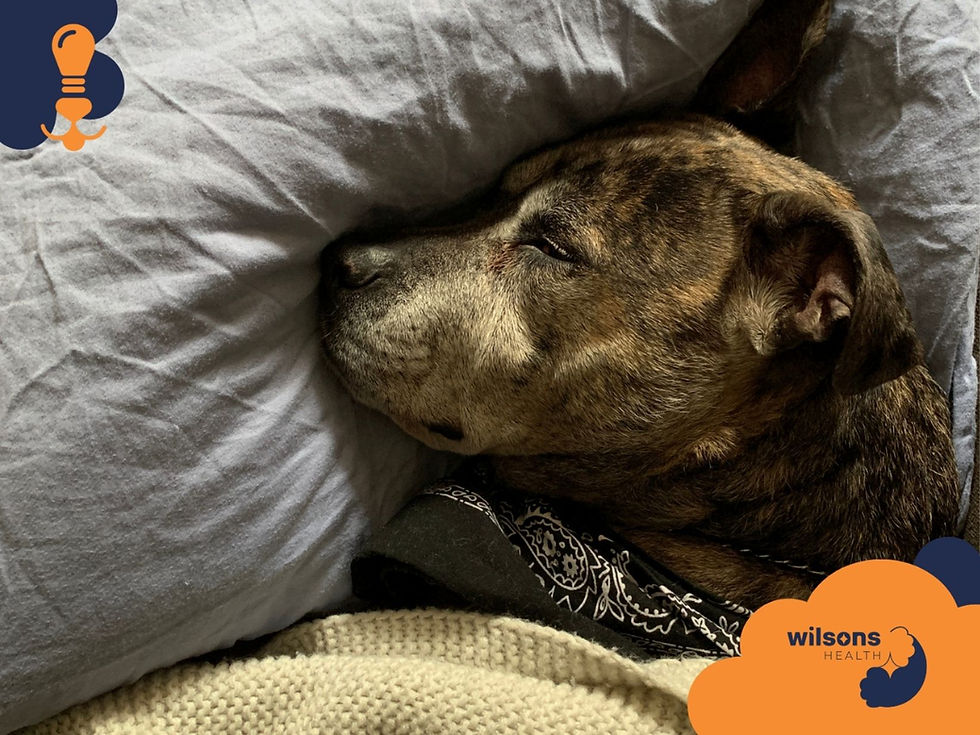
Somewhere between 12 and 15 hours a day – that’s how long a typical senior dog sleeps, according to large observational studies and veterinary guidance.[4][5]But here’s the part that quietly unsettles many owners: as dogs age, how they sleep changes more than how much they sleep.
They may take longer to fall asleep, wake more often at night, pace or pant in the dark, or nap heavily during the day but seem restless when you’re trying to rest. In one sleep-lab study of 28 senior dogs, those with worse scores on a canine dementia scale spent significantly less time in deep NREM and dream-rich REM sleep, even if their total hours in bed didn’t look dramatically different.[1]
To a researcher, that’s altered sleep architecture and EEG spectral power. To an owner, it’s: “We used to sleep through the night. Now we’re both awake at 3 a.m., and I don’t know what’s happening to my dog.”

This article sits in that gap — between brain waves and lived experience — and is about two things at once:
what’s actually happening to sleep in older dogs, and
what it does to the humans who love them, and how to emotionally adjust without losing yourself in worry.
What really changes in a senior dog’s sleep?
1. Total sleep time: often similar, but rearranged
Across several studies of pet dogs living in homes, adult and senior dogs typically sleep around 10–12 hours per 24 hours, with many seniors comfortably landing in the 12–15 hour range.[4][5]
What often changes is not raw quantity, but distribution:
less solid, uninterrupted night sleep
more frequent waking overnight
more daytime naps, sometimes longer or deeper
a “shift” in when the body seems to prefer rest
So if your 12-year-old dog sleeps much of the afternoon but is suddenly up at 2 a.m. pacing, that’s not you imagining patterns. It’s a known part of aging biology.
Where to be cautious:
20+ hours of sleep a day or a sudden jump in sleepiness can be a red flag for medical issues like pain, heart or kidney disease, hypothyroidism, or cancer.[5]
A dog who goes from “normal senior sleepy” to “barely awake, barely interested in anything” deserves a veterinary conversation.
You don’t need to count every hour. But noticing changes from your dog’s usual baseline is important information.
2. Sleep latency: the new, slower slide into sleep
Sleep latency is the time it takes to fall asleep after lying down. In controlled studies, older dogs take longer to fall asleep than younger adults.[3]
Owners often describe this as:
more position changes before settling
lying down, then getting up again
pacing, circling, or “searching” even when they seem tired
finally falling asleep, only to wake again soon after
On paper, this shows up as longer sleep latency and more wakefulness during sleep periods.[3]In real life, it can look like agitation, anxiety, or “restless nights” — for both of you.
This doesn’t automatically mean dementia. It can be:
stiff joints making it hard to get comfortable
bladder changes
sensory loss (hearing or vision) making the dark feel confusing
age-related changes in brain chemistry that make sleep lighter
But it is a legitimate aging change, not a personality flaw or “bad behavior.”
3. Lighter, more fragile sleep: what EEG studies show
When researchers attach EEG leads to dogs (with a lot of treats and patience), they can see which sleep stage the brain is in:
Wake
Drowsiness
NREM sleep (non-REM, often called “deep” or restorative sleep)
REM sleep (dreaming sleep, often with twitching paws or soft noises)
In a polysomnography study of 28 senior dogs, scientists found:[1][2]
Dogs with worse cognitive performance (higher dementia scores):
spent less time in NREM and REM sleep
had more fragmented, shallow sleep
showed altered EEG coherence (how brain regions “sync up” during sleep)
Aging in general was associated with:
more time awake during what should be sleep periods
increased alpha, beta, and sigma EEG power — brainwave patterns linked to lighter or more fragmented sleep[3]
You don’t have to remember the technical terms. The takeaway is simple:
Many older dogs are in bed a lot, but not getting the same depth and continuity of sleep they did when they were younger.
If you’ve ever lain awake at 3 a.m. knowing you’re technically “in bed” but not actually resting, you already understand this from the inside.

When sleep changes hint at cognitive decline
Sleep disruption can be one of the earliest and clearest signs of Canine Cognitive Dysfunction Syndrome (CCDS) — often described as a canine parallel to Alzheimer’s disease.[1][2][6]
Veterinary teams often use the shorthand “DISHA” to remember common CCDS signs:
Disorientation (getting lost in familiar places, staring at walls)
Interactions changed (less social, more clingy, or oddly irritable)
Sleep–wake cycle changes (up at night, sleeping more by day)
House soiling (forgetting house training)
Activity changes or anxiety (pacing, restlessness, new fears)
Sleep changes live right in the middle of this cluster.
What studies specifically show about dementia and sleep
In the senior dog sleep-lab study, higher dementia scores were strongly associated with:
less NREM and REM sleep
shallower sleep, as seen in EEG patterns
more fragmented sleep architecture overall[1][2]
Dogs with more advanced dementia showed more sleep disruption than cognitively healthy senior dogs, mirroring human dementia.[2]
For owners, this often looks like:
pacing or wandering at night
barking or whining in the dark for no clear reason
appearing confused about where to sleep or how to settle
switching day and night: “He sleeps all day, then roams all night.”
None of this automatically means CCDS — many medical issues can cause similar patterns. But persistent or escalating night disturbance is a valid reason to ask your vet specifically about cognitive screening.
Tools like the Canine Dementia Scale Questionnaire help turn your observations into something structured your vet can interpret.[1] You’re not “overreacting” by bringing in a list of sleep changes; you’re supplying data.
Normal aging vs. “something is wrong”: the uncomfortable gray zone
One of the hardest parts of caring for a senior dog is living inside a constant question:
“Is this just getting older… or is my dog suffering in a way I can do something about?”
Sleep changes sit squarely in this gray area.
What’s considered “normal-ish” for many seniors
Patterns that often fit within expected aging (but still worth mentioning to your vet):
Taking longer to fall asleep at night
More shifting, repositioning, or brief waking episodes
Increased daytime napping, especially after activity
Occasional mild restlessness in the evening (“sundowning-lite”)
Some vocalization or attention-seeking at night, but settles with reassurance
These can reflect:
lighter sleep architecture
mild sensory decline
age-related anxiety
normal brain aging without full CCDS
What usually deserves more urgent attention
Changes that more strongly suggest pain, medical disease, or significant cognitive decline:
Sudden increase in sleepiness or collapse in energy
Sleeping 20+ hours a day with little interest in food, play, or family[5]
Dramatic day–night reversal that doesn’t improve with routine adjustments
Persistent pacing, panting, or distress at night
New house soiling in a previously reliable dog
Clear disorientation: getting stuck in corners, staring at walls, not recognizing familiar places[6]
The ethical tension is real: you don’t want to medicalize every quirk of aging, but you also don’t want to miss treatable pain, disease, or distress.
A helpful mental reframe:
You’re not trying to decide “normal vs. abnormal” on your own. You’re gathering a timeline and pattern to bring to your vet.
How these changes land on the human side
Sleep disruption in senior dogs is not just a veterinary topic; it’s a family systems topic.
Owners in aging-dog studies and support groups commonly describe:
Anxiety: “Is this the beginning of the end?”
Guilt: “I’m frustrated with him at 3 a.m. and then feel terrible in the morning.”
Exhaustion: “We basically sleep in shifts now.”
Ambivalence: “I’d do anything for her, but I also really need sleep.”
Uncertainty: “Is this suffering? Is she scared? Or just… old?”
The emotional load is intensified by:
the progressive nature of CCDS (if present)
the unpredictability of good vs. bad nights
the ambiguity of what your dog is subjectively experiencing
Veterinary teams are increasingly aware that they’re not just treating dogs; they’re supporting caregivers who are often quietly burnt out.[5][6]But owners don’t always say this out loud. It can feel selfish to talk about your own sleep when your dog is the one aging.
It isn’t selfish. Sleep deprivation changes how patient, attuned, and kind any of us can be — including to our dogs.
Working with your vet: what to bring, what to ask
You don’t need to walk into the clinic with a fully formed theory. But a few concrete pieces of information make the appointment far more useful.
What to track for 1–2 weeks
You can jot this in a notebook or a phone note:
Bedtime and wake time (roughly)
How long it seems to take your dog to fall asleep
Number of obvious night awakenings (pacing, barking, asking to go out)
Any accidents overnight
Notable behaviors: disorientation, getting stuck, unusual fearfulness, vocalizing
Daytime: energy level, appetite, interest in play or walks, nap patterns
You’re not aiming for perfection; patterns matter more than precision.
Questions you might ask
“Given his age, which of these sleep changes feel expected, and which concern you?”
“Could pain, arthritis, or another medical condition be contributing to his restlessness?”
“Would a cognitive assessment or a Canine Dementia Scale questionnaire be appropriate?”[1]
“If this is early cognitive decline, what kinds of interventions — medical or environmental — are reasonable to consider?”
“How will we know if his quality of life is still good, even with sleep changes?”
You are allowed to add:
“I’m also struggling with my own sleep and worry about making good decisions when I’m this tired.”
That’s clinically relevant. It shapes what’s realistic in any care plan.

What science can and can’t currently offer
Well-established
Senior dogs show longer sleep latency and more wakefulness during sleep periods than younger dogs.[3]
Many older dogs have lighter, more fragmented sleep, reflected in EEG changes (higher alpha, beta, sigma power).[3]
Dogs with more severe cognitive impairment spend less time in NREM and REM sleep, with shallower sleep overall.[1][2]
Typical seniors sleep 12–15 hours a day, and significant deviations or sudden changes can flag underlying disease.[4][5]
Less certain
How best to use polysomnography (sleep studies) and advanced EEG features in everyday clinical practice — these are still mostly research tools.[1][2]
How much we can reverse or meaningfully modify sleep architecture in dogs with CCDS versus simply supporting comfort and routine.
The long-term emotional trajectories of owners living with chronically disrupted nights — and what kinds of support help most.[6]
Emerging directions
Research is moving toward:
combining behavioral, cognitive, and sleep data to better predict how CCDS will progress[1][2]
exploring whether early sleep changes might serve as a warning sign before obvious dementia behaviors appear
refining questionnaires and scales so owners’ observations become more actionable
In other words: you’re not imagining that sleep is central to what’s happening. Science agrees, even if it doesn’t yet have a neat algorithm for what to do about it.
Making the nights more livable (for both of you)
This isn’t a list of cures, because we don’t have those. But there are levers you can gently adjust to make the situation more bearable.
Think in three layers: environment, routine, and your own boundaries.
1. Environment: making sleep easier to find
Ideas to discuss with your vet and adapt to your dog:
Lighting: A small night light can help dogs with vision or cognitive changes navigate the dark with less anxiety.
Sound: Soft, consistent background noise (fan, white noise) can blunt external sounds that trigger night waking.
Comfort: Orthopedic beds, non-slip rugs, and easy access to water can reduce pacing driven by discomfort or thirst.
Temperature: Older dogs may be more sensitive to heat or cold; a slightly cooler, well-ventilated room can sometimes reduce restlessness.
The goal is not perfection, just less friction between “tired” and “asleep.”
2. Routine: helping the body clock stay oriented
Dogs, like humans, have a circadian rhythm that can drift with age. You can gently anchor it:
Keep meal times and walk times as consistent as your life allows.
Aim for daytime activity — short, appropriate walks, gentle play, sniffing games — so sleep pressure builds for night.
Avoid unintentionally turning 3 a.m. into “fun time.” If your dog must go out, keep it calm, low-key, and boring.
Develop a simple pre-bed ritual: last walk, light snack if recommended, lights dimmed, same sleeping spot.
Routine is not a cure for CCDS or medical disease, but it can reduce confusion and anxiety around transitions — especially nightfall.
3. Your boundaries: protecting the caregiver
This part often goes unspoken, but it matters: you are not a 24-hour hospital.
Some realities to make room for:
It is okay to ask for help — from family, friends, or pet sitters — so you can occasionally get a full night’s sleep.
It is okay to say, “I can manage this level of disruption, but not more,” and to share that honestly with your vet.
It is okay to feel both love and resentment in the same breath. That doesn’t mean you love your dog less; it means you are human and tired.
Your dog benefits when you are even moderately rested and emotionally resourced. Protecting your sleep where you can is an act of care, not neglect.
When you’re thinking about “how long we can keep doing this”
Sleep changes, especially when tied to dementia, often bring the quiet question of quality of life closer.
Owners sometimes describe a turning point like this:
“We started sleeping in shifts.”
“I moved to the couch to be closer to him at night.”
“We were both exhausted, but still waking up together.”
There isn’t a single correct line between “manageable” and “too much.” But science can offer a few orienting thoughts:
Fragmented sleep likely feels worse for your dog than it looks; those EEG patterns of shallow NREM and reduced REM suggest less true restoration.[1][2]
Ongoing distress behaviors at night (relentless pacing, panting, vocalizing) can signal that your dog is not just awake, but struggling.
If medical and environmental options have been tried and your dog is still persistently unsettled, it’s reasonable to have an explicit quality-of-life conversation with your vet.
These conversations are not about giving up. They’re about aligning:
your dog’s current experience
the likely trajectory of their condition
your family’s capacity to provide care without collapsing
You’re allowed to take your own sleep and mental health into account when making decisions. That doesn’t make you less devoted; it makes you honest.
Living with the new rhythm
Sleep in older dogs is not just a biological process; it’s a shared landscape you both move through, night after night.
The science tells us:
your dog’s brain really is changing
their sleep really is lighter and more fragile
cognitive decline, if present, really does tangle with their nights
Your experience tells you:
which nights feel sustainable and which don’t
when your dog still wakes up interested in the world
when the bond between you feels intact, even if the routine has frayed
Between the EEG tracings and the 3 a.m. pacing, there is a small, steady truth:you are adapting to each other in real time.
You may not sleep the way you used to. You may sleep in shifts, or on different furniture, or with a night light you never needed before. But as long as you’re still waking up together and there is some curiosity, some comfort, some shared ease in the day — there is still a relationship here, not just a condition to manage.
Understanding the biology doesn’t make the nights shorter. It does, however, give you a map: of what’s likely normal, what’s worth checking, and what’s simply hard. And sometimes, having a map is the difference between feeling lost and feeling like you’re walking a difficult road with your eyes open.
References
Iotchev, I. B., et al. Sleep and cognition in aging dogs. A polysomnographic study. Frontiers in Veterinary Science. (Referenced via PMC).
North Carolina State University News. New Study Looks at Role of Sleep Disruption in Dogs With Dementia.
Iotchev, I. B., et al. Developmental features of sleep electrophysiology in family dogs. Scientific Reports (Nature).
Kinsman, R. H., et al. Sleep Duration and Behaviours: A Descriptive Analysis of a Cohort of Companion Dogs. Animals (Basel). (Referenced via PMC).
American Kennel Club (AKC). Too Much Sleep: Is There Such a Thing for Senior Dogs?
Dog Aging Project. Understanding Behavioral Changes in Senior Dogs.

Comments