
Visual Journaling for Dog Owners

By the time researchers had pooled 50 different studies of visual art therapy, one pattern was clear: adding visual expression to words measurably helped a subset of patients cope, with improvements seen in about 18% of outcomes they tracked.[4][6]
That’s not a miracle cure. It’s something quieter: enough evidence to say that drawing, collaging, or photographing your way through hard experiences isn’t just “being artsy.” It changes how the brain processes stress and emotion.

When you’re caring for a dog you adore—especially through aging, illness, or loss—that matters. Because there are days when words simply cannot hold what’s happening.
Visual journaling gives those days somewhere to go.
What visual journaling actually is (and what it isn’t)
Visual journaling is a way of keeping a journal that mixes words with images: photos, sketches, collage, diagrams, paint, digital layers—whatever helps you say what you can’t quite write.
It’s different from “art journaling” in one important way: the goal here is not to make something beautiful or impressive. The goal is personal expression and emotional processing.[1][5]
You might:
Tape in a photo of your dog at the vet and surround it with scribbled questions.
Draw the same sleeping position they always curl into.
Make a collage of torn paper in the colors of your worry.
Create a timeline of their illness using tiny icons instead of paragraphs.
The page becomes a container: somewhere your fear, love, frustration, and tenderness can exist outside your body for a while.
Researchers describe visual journaling as a practice that:
Activates both the analytical “left” and creative “right” sides of the brain at once[1]
Helps integrate thoughts and feelings instead of keeping them in separate boxes
Supports self-understanding and reflection in a way plain text often can’t[1][10][11][12][14]
For dog owners, that can mean: “I don’t just know I’m overwhelmed. I can see how I’m overwhelmed—and where the love is in all of this.”
Why pictures and scraps of paper can feel so strangely stabilizing
It can feel almost suspicious: how can taping a photo into a notebook make anything better?
The answer lies in how your brain handles images, space, and story.
1. It gives your feelings a shape
Emotions like anticipatory grief (“I know this won’t last”) are notoriously hard to put into words. Visual journaling lets you bypass the bottleneck of language.
Research shows that visual journaling and related art practices:
Help express complex, hard-to-name emotions like grief, confusion, and trauma[1][13]
Allow for metaphor and symbol—drawing a storm instead of writing “I’m scared”
Create a safe space to “hold” unresolved feelings without needing to solve them immediately[1][12][13]
For a dog owner, that might look like:
Drawing your dog as a tiny figure in a huge empty park when you’re afraid of losing them
Collaging vet bills, appointment cards, and a photo into a single page that finally matches the chaos in your head
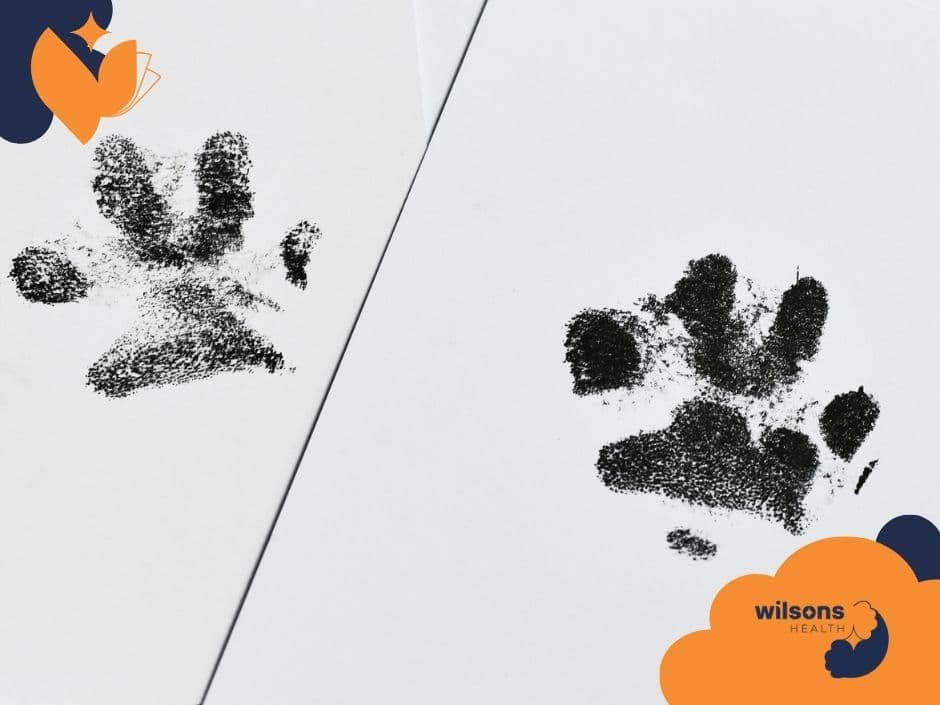
Sketching only their paws or ears on days when a full portrait feels too painful
You don’t have to explain why you chose those images. Your nervous system often understands before your conscious mind does.
2. It quietly supports focus and attention
Visual journaling isn’t just emotional; it’s also cognitive. Studies in education and psychology show that using spatial layouts, color-coding, and visual “chunks” can strengthen:
Working memory
Focus and attention regulation
Executive function (your brain’s planning and organizing system)[7][8][9]
This is similar to mindfulness: your attention is anchored in the page, in this moment, with this pen or brush.
On a practical caregiving day, that might mean:
Making a color-coded page for medications or symptoms
Using boxes and arrows to map out questions for your vet
Creating a weekly “snapshot” spread with tiny drawings of how your dog seemed each day
You’re not just making something pretty. You’re helping your brain manage a lot of moving parts.
3. It offers a sense of control when life feels uncontrollable
In chronic stress or trauma, even small choices can feel powerful. Research on visual journaling and art therapy highlights:
A sense of agency: I choose what goes on this page and how it’s arranged[3][11]
A feeling of control over your own emotional landscape, even when you can’t control the illness or outcome
The ability to revisit and rework pages as your perspective changes
You can’t stop your dog from aging. But you can decide:
How you want to remember this week
Which moment becomes the central image
What colors feel like “today”
That’s not trivial. It’s a way of asserting, “I’m still here. I’m still participating in this story.”
How visual journaling shows up in real settings (and what that means for you)
Visual journaling isn’t just a Pinterest idea. It’s been used in:
Schools – to reduce stress and anxiety in adolescents, and to improve creativity and relationships with peers and teachers.[2][8][9]
Counseling and art therapy – as a reflective tool to process trauma, grief, and complex emotions.[1][12][13]
Research and professional training – to deepen self-reflection and insight.[10][11][14][16]
A meta-analysis of visual art therapy more broadly (which overlaps with visual journaling) found measurable improvement in about 18% of patient outcomes across 50 studies.[4][6] Not every person, not every problem—but enough to say: this is a real, evidence-informed tool.
For dog owners, you can think of it this way:
It’s not a replacement for therapy, medication, or veterinary care.
It’s a low-risk adjunct: something that can sit alongside those supports, helping you process what they stir up.

Formats that tend to work well for dog owners
You don’t need to be “creative.” You just need a way to get what’s inside, outside.
Below are formats drawn from research and practice—adapted to the realities of life with a dog.
1. Time-based vs. theme-based journals
Researchers describe two broad approaches:[5]
Time-based: You track experiences as they happen—daily, weekly, or around key events.
For dog owners, that might be:
A “one photo, three words” page each day of a treatment cycle
A weekly spread with a small sketch, a rating of your dog’s comfort, and one sentence about your own mood
A visual log of appetite, walks, or playfulness using icons
Theme-based: You focus on a specific topic rather than the calendar.
Possible themes:
“Her favorite places” – one page per location with drawings, photos, and memories
“Things I’m afraid of” – each fear represented as a symbol or collage
“What changed after diagnosis” – a before/after spread that holds both grief and gratitude
Many people naturally end up with a hybrid: some chronological pages, some deep dives into particular issues.
2. Techniques that make emotional sense
Research and practice highlight several techniques that help people express and organize feelings:[1][5]
Technique | What it might look like with your dog |
Sequential panels (like comics) | A four-panel strip: “Before the vet,” “In the waiting room,” “During the exam,” “After we got home.” No drawing skill needed—stick figures work. |
Central illustration | A big drawing or photo of your dog in the middle, with small notes, arrows, or doodles radiating out: “What I wish I could tell you,” “What I’m proud of us for.” |
Metaphorical imagery | Drawing your dog as a lighthouse, a worn but sturdy stuffed animal, a small sun. Let the image carry the meaning. |
Mixed-media timelines | A strip across the page with taped appointment cards, small icons for good/bad days, and color blocks for your own emotional states. |
Word collages | Cutting words from magazines (“brave,” “wait,” “storm,” “home”) and gluing them around a photo of your dog. |
Mind maps | Writing your dog’s name in the center, branching out: “Health,” “Routines,” “Fears,” “Joy,” then adding tiny sketches or symbols. |
Spatial organization | Dividing a page into “Then / Now,” “What I can control / What I can’t,” or “His needs / My needs.” |
The point is not to be clever. The point is to find a structure that lets your feelings land somewhere specific.
Analog vs. digital: does it matter if you use an iPad?
Researchers are surprisingly honest here: we don’t fully know.
We do know:
Traditional (analog) media—pens, pencils, paint, paper, collage—offer tactile, sensory engagement that many people find grounding.[1][5][9]
Digital media—tablets, phones, laptops—offer flexibility: undo buttons, layering, easy photo integration, and an expanded color palette.[1][5][9]
What’s still uncertain:[1][5]
How the lack of physical touch in digital tools affects emotional processing and mindfulness
Whether different people benefit more from one medium than the other over time
For dog owners, a practical way to think about it:
If you crave something physical to hold onto—especially around end-of-life or grief—paper and printed photos can be deeply comforting.
If your life is chaotic (late-night vet visits, travel, kids), a digital journal may be the only sustainable way you’ll actually keep up with the practice.
Many people use both: jotting quick digital notes or photos in the moment, then later printing or redrawing key images into a physical journal when they have space to reflect.
When visual journaling starts to feel like therapy (because it kind of is)
Visual journaling sits close to art therapy and counseling. Studies and clinical reports show it can:
Reduce stress and anxiety
Support trauma processing
Encourage critical self-reflection and insight[1][2][12][13][14]
That’s powerful—but it also comes with some cautions.
Emotional intensity is possible
Because images can tap into deep layers of memory and feeling, visual journaling may:
Stir up painful memories (e.g., a previous pet’s death)
Bring forward fears you’ve been keeping in the background
Trigger strong emotional release—tears, anger, or even numbness
In formal settings, trained facilitators or therapists are there to help contain this process and prevent overwhelm.[3][12] On your own, it’s wise to:
Notice if certain topics or images reliably leave you shaken for hours
Take breaks, work in small doses, or choose “lighter” pages when you’re already overloaded
Consider sharing the journal (or selected pages) with a therapist if you have one
If you ever feel actively worse or unsafe because of what the pages bring up, that’s not a sign you’ve “failed.” It’s a sign the material may be better held with professional support.
Ethical edges in groups and online spaces
Visual journaling is increasingly used in:
Group workshops
Online communities
Educational programs[2][3][8][9]
Researchers flag some tensions:[3]
How much structure vs. free exploration is safe, especially for people with trauma histories?
What training should facilitators have if they’re not therapists?
How do we respect privacy when images can feel more exposing than words?
If you join a group:
You’re allowed to keep pages private.
You can choose what to share and what to hold back.
You can ask how your images will be stored, used, or discussed.
Your journal belongs to you, even in a shared space.
What the science can’t yet tell us (and what it still offers)
Visual journaling research is promising but imperfect.
Limitations include:
Small sample sizes and irregular attendance in school studies[2]
Highly varied methods and populations in meta-analyses, making it hard to compare outcomes directly[4][6]
Lack of standardized “success” metrics—what counts as “better,” exactly?[4][6]
Limited data on long-term effects and on digital vs. analog tools[1][5]
What is relatively well-established:[1][2][7][13]
Visual journaling helps many people express emotions and reflect on their experiences.
It can reduce stress and support attention and focus.
It works well as an adjunct to other forms of therapy and education.
For you, this means:
You don’t have to believe visual journaling is magical.
You can treat it as a low-cost, low-risk experiment: “Does this help me feel even 5% clearer or calmer?”
You can adjust or abandon it without guilt if it doesn’t feel right.

A few grounded ways to begin (without turning it into a project)
These are not prescriptions—just starting points you can adapt.
If your dog is aging or ill
The “tiny daily square”: Draw a one-inch square each day. Inside: a quick symbol of how your dog seemed (a full bowl, a curled tail, a couch). Underneath, one word for your own state. That’s it.
The “questions for the vet” page: Paste or draw a simple outline of your dog. Around them, write or sketch questions, worries, or observations. Bring the page to your appointment—it can help you communicate when you’re emotional.
The “what’s still good” collage: Once a week, make a page of only what still brings them joy: a crumpled leaf, a sun patch, a specific treat. Photos, doodles, words. This isn’t denial—it’s balance.
If you’re in anticipatory grief
Drawing them sleeping: Many people find it easier to draw their dog at rest than awake. The stillness helps. Research on reflective visual journaling suggests that repeated depictions can deepen understanding and acceptance over time.[10][11][12][14] If you find yourself drawing the same pose again and again, that’s not “stuckness.” It might be your way of rehearsing letting go.
Before / After spreads: Divide a page: “Before we knew” / “After we knew.” On each side, add memories, routines, and feelings. Let yourself see both the loss and the ways you’ve adapted.
If you’re grieving a dog you’ve already lost
Non-linear timelinesInstead of a straight line, draw a spiral or circle. Place key memories along it: adoption, favorite walks, hard days, the end, and what came after. This echoes how grief actually feels—circling, not marching.
Metaphor pagesDraw or collage something that represents your grief: an empty leash, a lighthouse, a nest. Let the image hold what words can’t. Studies of visual journaling in reflective research show that metaphor often unlocks new insights without forcing them.[10][14][16]
The “I’m not ready to look” envelopeTape an envelope into your journal. When photos or mementos feel too raw, slip them inside. You still have a place for them, but you control when to open it.
How this can help you talk with your veterinarian or therapist
Visual journaling isn’t just private. It can become a bridge in difficult conversations.
You might bring:
A page showing your dog’s “good days vs. bad days” over a month
A visual log of symptoms, appetite, or mobility
A collage that captures your fears about treatment or euthanasia
For professionals who are used to verbal checklists, seeing your experience laid out visually can:
Clarify patterns that are hard to describe
Signal how emotionally overwhelmed you are (or aren’t)
Help them tailor information and support to where you actually are
In therapy, visual journaling pages can serve as:
Starting points for exploring grief, guilt, anger, or relief
Evidence of your coping strategies and strengths
A way to work with memories that are hard to talk about directly
You’re not asking them to interpret your art like a test. You’re saying: “This is how it feels inside my head. Can we start here?”
What “success” might quietly look like
Because visual journaling isn’t about producing masterpieces, its “success” signs are subtle:
You notice you can stay in hard feelings a little longer without shutting down.
Your vet appointments feel slightly more organized or less overwhelming.
You find yourself flipping back through pages and thinking, “We’ve been through a lot, and I can actually see it.”
When you look at a drawing of your dog sleeping, there’s a small sense of peace mixed in with the ache.
The research language calls this “critical reflection,” “emotional integration,” “enhanced self-awareness.”[10][11][12][14]
In everyday language, it’s simply: “I understand myself—and what’s happening with my dog—a bit better than I did before. And that makes this whole thing just barely more bearable.”
That’s not dramatic. But when you love a dog, those small shifts can be the difference between feeling lost in the experience and feeling present with it.
References
Journaling Insights. Visual Journaling Guide in 2025.
Dole, K. (2022). Effects of Visual Journaling on Adolescents. ERIC. https://files.eric.ed.gov/fulltext/ED628496.pdf
Hadar, R. The Visual Journey Journaling.
Nair, A. et al. (2024). Active Visual Art Therapy and Health Outcomes. NIH / PMC. https://pmc.ncbi.nlm.nih.gov/articles/PMC11393726/
Fiveable. Visual Journaling | Art Therapy Class Notes.
Nair, A. et al. Active Visual Art Therapy and Health Outcomes. JAMA Network.
Your Visual Journal. Unlock Your Focus: How Visual Journaling Boosts Attention.
University of Nebraska. The Art and Science of Observation: Visual Journaling in a Co-Taught Science Classroom.
The Scholarly Teacher. Visual Journaling.
CEPS Journal. The Visual Journal as a Way to Strengthen Students' Ability to Self-Reflect.
Spotted Rabbit Studio. Exploring Self-Discovery Through Visual Journaling Practices.
Deaver, S. (2005). Reflective Visual Journaling During Art Therapy and Counseling. Old Dominion University. https://digitalcommons.odu.edu/context/chs_etds/article/1109/viewcontent/Deaver_3356758.pdf
Psychology Today. Visual Journaling as a Reflective Practice.
Washington State University. Visual Journaling as Reflective Research. https://rex.libraries.wsu.edu/view/delivery/01ALLIANCE_WSU/12361842760001842/13361842750001842
My Blank Paper. Visual Journaling Blog.
Indiana University. Visual Reflective Journaling. https://scholarworks.indianapolis.iu.edu/server/api/core/bitstreams/3265466a-524f-42e7-8bbc-aafe32e33232/content
Daisy Yellow Art. Art Journaling 101.


Comments