
Warning Signs of Burnout for Dog Caregivers

Updated: Aug 28
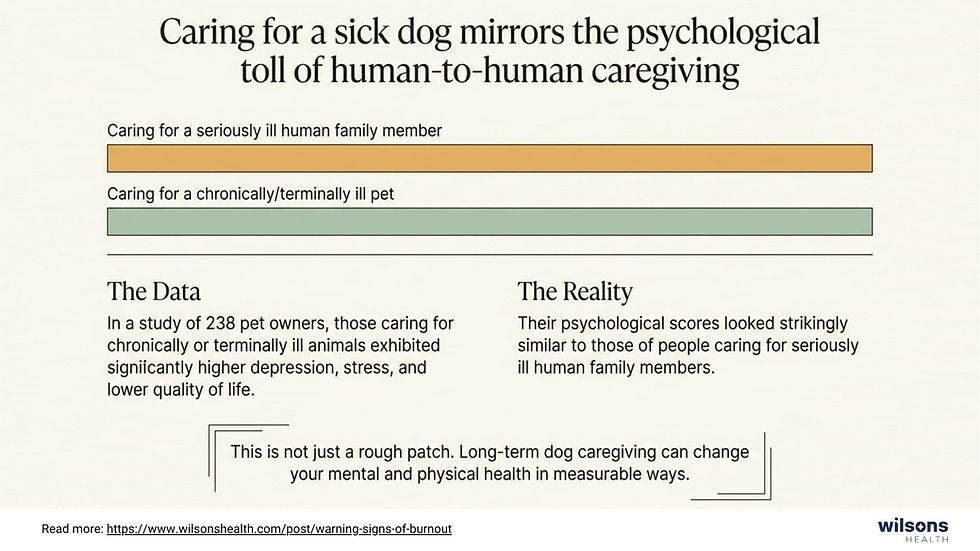
In one study of 238 pet owners, those caring for chronically or terminally ill animals had significantly higher depression, stress, and lower quality of life than owners of healthy pets.[2] Not just “a bit tired.” Their scores looked strikingly similar to those of people caring for seriously ill human family members.[3]

If you’ve been telling yourself, “It’s just a rough patch, I should be able to handle this,” it’s worth pausing. The research is quietly saying: this is not just a rough patch. Long‑term dog caregiving can change your mental and physical health in measurable ways — and burnout often arrives gradually enough that you don’t see it coming.
This article is about learning to see it.
Prefer to listen?
Explore this topic as a conversation on Wilson’s Health: Dog Health, Explained — a clear, thoughtful discussion of what it means and why it matters.
Listen below, or keep reading.
What “Burnout” Means When the Patient Is Your Dog
Burnout for dog‑caregivers isn’t an official diagnosis. It’s a state that develops when the demands of caring for your dog — medical, emotional, logistical, financial — consistently exceed your resources.
Researchers describe related ideas with a few terms:
Pet caregiver burden
The overall strain of being responsible for your dog’s health and well‑being — emotional, physical, social, and financial.[2][4]
Caregiver fatigue / burnout
Emotional and physical exhaustion after prolonged caregiving. You feel depleted, less patient, less motivated, sometimes detached.
Psychosocial functioning
How your mental health and social life are doing: anxiety, depression, stress, sleep, relationships.
Quality of life (QoL)
Your own sense of how livable and satisfying your life feels — not just whether you’re coping, but whether you’re okay.
The important thing: this isn’t about how much you love your dog or how “good” a caregiver you are. Two people can be doing the exact same tasks; one feels stretched but okay, the other is quietly falling apart. The difference is not character — it’s capacity, support, and timing.
Why Dog Caregiving Can Hit So Hard
Research on pet caregivers keeps turning up the same pattern: owners of very sick pets carry a heavy psychological load.

Across several studies:
Owners of chronically or terminally ill pets show higher levels of depression, anxiety, and perceived stress than owners of healthy pets.[2][3]
Their symptoms can approach those seen in clinical depression and generalized anxiety disorder.[1][3]
Many describe feeling “broken mentally, physically, and financially” from the daily demands of care.[1]
Unlike a short‑term crisis, chronic care is a long haul. You may be:
Waking up multiple times a night for bathroom trips or medications
Managing complex treatment schedules (insulin, pain meds, dressings)
Cleaning up accidents, monitoring symptoms, watching for subtle changes
Making repeated vet visits, often with high emotional stakes
Absorbing the emotional weight of your dog’s suffering — and your own anticipatory grief
All of this is happening on top of the rest of your life: work, family, finances, your own health.
Burnout is what happens when that stack becomes too tall for too long.
The Warning Signs: What Burnout Looks Like in Dog‑Caregivers
Burnout often doesn’t announce itself as “burnout.” It shows up as a collection of small changes that are easy to blame on lack of sleep, age, or “just being stressed.”
Below are warning signs that research and caregiver reports consistently highlight — translated into what they might actually look like in daily life.
1. Emotional Exhaustion and Irritability
What the research says: Caregivers report feelings of sadness, irritability, and emotional depletion, mirroring symptoms of anxiety and depression.[1][2][3]

What it can look like at home
You snap at your dog for something that wouldn’t have bothered you six months ago.
You feel numb during moments that “should” feel tender, like hand‑feeding or cuddling.
You cry in the car after vet visits, or feel on the verge of tears for no clear reason.
Small setbacks (a new accident on the carpet, a missed medication dose) feel huge.
A useful internal question:
“Am I reacting to this situation, or to the weight of all of it?”
When your reactions feel outsized compared to the moment, that’s a sign your emotional reserves are low.
2. Anxiety, Worry, and Persistent Sadness
What the research says: Owners of very ill pets show higher rates of anxiety and depression, sometimes approaching clinical levels.[1][2][3]

What it can feel like
A constant mental background noise of “What if…?”
What if she has a seizure when I’m at work?
What if I miss a symptom and she suffers?
You replay decisions (a treatment choice, a delayed vet visit) and feel intense guilt, even when you did your best with the information you had.
You feel a heavy sadness not just when your dog is struggling, but in ordinary moments — like watching them sleep.
Your mind jumps ahead to their death — and you feel both dread and an uncomfortable flicker of relief when you imagine “it being over.”
That last part is important: feeling a mix of dread and relief about the end of caregiving is a common, human response to chronic strain, not a sign you love your dog less.
3. Physical Fatigue and Sleep Disruption
What the research says: Caregivers often experience physical exhaustion and sleep disturbances due to their dog’s needs and other family obligations.[1]
Daily‑life examples
Getting up several times a night for bathroom trips, seizures, pain episodes, or restlessness
Setting alarms for early‑morning or late‑night medications
Lying awake listening for your dog’s breathing or movement, even when they’re sleeping soundly
Feeling lightheaded, run‑down, or “foggy” during the day[1]
Over time, chronic sleep loss and physical strain don’t just make you tired; they lower your emotional resilience, making everything feel harder.
4. Feeling Overwhelmed by Routine Care
What the research says: Some caregivers describe their home life as running a “small nursing home” — administering insulin, managing incontinence, cleaning, monitoring, and more.[1]
You might notice
The care routine feels complex and fragile — one small disruption (a late meeting, traffic, a sick child) sends everything off the rails.
You begin to dread certain tasks: expressing bladders, giving injections, changing bandages.
You find yourself making more mistakes: missed doses, confusion about which medication was given when.
You feel a constant sense of “I can’t keep all these balls in the air.”
This sense of being overwhelmed is not a personal failing; it’s often a sign that the care plan is bigger than one human can sustainably manage without adjustments or support.
5. Social Withdrawal and Shrinking World
What the research says: Caregiving can erode social life, leading to isolation and reduced external support.[1][4]

Signs this might be happening
You decline invitations because you can’t leave your dog — or because you’re too tired to go.
You stop talking honestly with friends or family about how hard things are, because you don’t want to “complain again” or they “don’t get it.”
Your world narrows to work, home, and vet visits. Hobbies, exercise, and casual social time fall away.
You feel like no one else understands what it’s like to live this way — and you’re too drained to try to explain.
Isolation doesn’t just feel lonely; it also removes buffers that usually help protect against anxiety and depression.
6. Financial Strain and Money‑Related Guilt
What the research says: Caregivers often face financial stress from ongoing veterinary care and medication costs, which impacts overall well‑being.[1][4]

How this can show up
You feel a pit in your stomach every time a new test or treatment is suggested.
You start measuring costs in mental trade‑offs: If I pay for this MRI, what happens to rent?
You feel guilty both ways: guilty if you spend the money, guilty if you don’t.
You delay your own medical or dental care, or other essentials, to cover your dog’s needs.
This financial pressure can quietly intensify burnout — especially when it’s layered with the belief that “a good owner would find a way, no matter what.”
7. Changes in How You Relate to Your Dog
This one is rarely talked about out loud, but it shows up in research and caregiver stories.
What studies suggest
Dogs with aggressive or fearful behaviors are linked to poorer owner mental health outcomes — more anxiety, more depression.[5]
There may be a feedback loop: stressed owners may find it harder to manage difficult behaviors, which then increase stress.[5]
What you might notice
You feel a flash of resentment when your dog growls, snaps, or refuses treatment — especially if you’re exhausted.
You find yourself avoiding certain interactions (grooming, nail trims, medication) because they’re emotionally draining.
You feel guilty for feeling frustrated, which then adds another layer of self‑criticism.
None of this makes you a bad caregiver. It means you’re human, operating under sustained stress.
8. Care Slipping Through the Cracks
What the research says: Burnout can lead to failures in caretaking duties, which can harm the dog’s welfare and increase caregiver distress.[5]
Possible signs
You postpone vet follow‑ups because you “can’t deal with it this week.”
You skip recommended therapies (physio, training, enrichment) not because you don’t care, but because you’re at capacity.
You feel ashamed about the corners you’re cutting — and that shame makes it harder to ask for help or be honest with your vet.
When your ability to carry out care starts eroding, that’s not proof you’re irresponsible. It’s strong evidence that the care load is exceeding your current resources.
9. Identity Strain: “Who Am I If I Can’t Keep Doing This?”
What the research says: Many owners experience caregiver identity struggles — feeling trapped between love, duty, and their own limits.[1][3][4]
This can sound like:
“If I really loved him, I wouldn’t feel this tired of it all.”
“A good dog parent wouldn’t think about giving up.”
“Everyone else seems to manage — what’s wrong with me?”
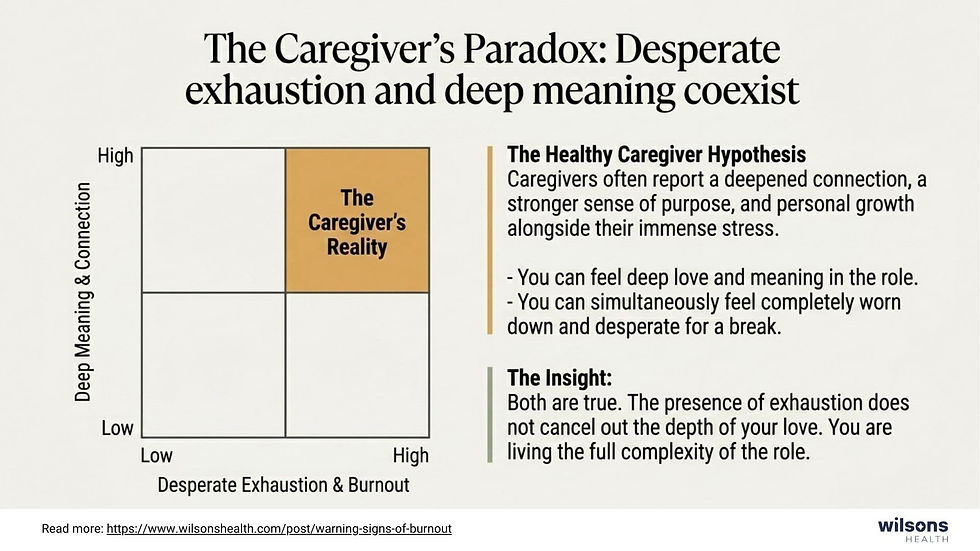
Research on human and pet caregivers alike shows a painful paradox: You can feel deep love and meaning in the caregiving role and simultaneously feel overwhelmed, resentful, or desperate for a break.[4]
Both are true. The presence of one does not cancel the other.
The Strange Bright Side: When Caregiving Feels Meaningful
Burnout isn’t the whole story.
Some research points to a “healthy caregiver hypothesis”: people who are relatively healthier and better supported going into caregiving may actually experience psychosocial benefits — more purpose, stronger bonds, even improved health behaviors.[4]
Caregivers often report:
A deepened connection with their dog
A stronger sense of purpose (“I’m the one keeping them comfortable”)
Personal growth in patience, empathy, and resilience
This is not to romanticize the experience. It’s to acknowledge that burnout and meaning can coexist.
If you feel intensely connected to your dog and also completely worn down, that doesn’t mean you’re contradicting yourself. It means you’re living the full complexity of this role.
Why Recognizing Burnout Matters (For You and Your Dog)
Burnout isn’t just about feeling bad. It has practical consequences:
For your dog
More missed doses or appointments
Less patience for training, handling, or behavior issues
Reduced ability to notice subtle changes in their condition
For you
Increased risk of anxiety, depression, and physical health problems[2][3]
Strained relationships with family, friends, and veterinary teams[2]
A sense of hopelessness that makes problem‑solving harder
Veterinary professionals are increasingly aware that caregiver well‑being directly affects patient care. Some researchers argue that monitoring caregiver burden should be a routine part of managing chronic or terminal illness in pets.[2][3]

Recognizing warning signs isn’t self‑indulgent. It’s part of taking care of your dog responsibly — and of yourself.
Talking About Burnout With Your Vet (Without Feeling Like You’re Failing)
You don’t need to walk into the clinic and declare, “I’m burned out.” You can start with concrete realities, which are easier to discuss and directly relevant to your dog’s care.

Here are some phrases that align with what research shows and open the door to collaboration:
“I’m finding it hard to keep up with the current medication schedule. Can we look at simplifying it?”
“The night‑time routine is really affecting my sleep. Are there adjustments that might still keep her comfortable?”
“I’m feeling stretched financially. Could we prioritize which tests or treatments matter most right now?”
“I’m more anxious and emotional about his care than I expected. Do you have any resources or support groups you recommend?”
Many vets are relieved when owners raise these realities, because it allows them to:
Adjust treatment plans to be more sustainable
Connect you with behavioral support if your dog’s behavior is part of the stress[5]
Offer counseling, palliative care options, or referrals to mental health professionals[2][3]

If you sense your vet hasn’t considered caregiver burden before, you might gently frame it as:
“I want to make sure I can keep this up for the long term. Here’s where I’m struggling…”
That sentence alone can shift the conversation from “perfect adherence” to realistic, sustainable care.
How to Think About Next Steps (Without a 27‑Point Self‑Care List)
This isn’t the moment for a lecture about bubble baths.
Instead, here are some grounding ways of thinking about burnout that can guide your decisions:
1. Burnout is About Fit, Not Failure
If the care your dog needs right now doesn’t fit the life you actually have — your job, your body, your finances, your other responsibilities — that’s a mismatch, not a moral flaw.

Useful question:
“If someone I loved described my situation to me, would I think they ‘should just try harder’ — or would I think, ‘That’s a lot for one person’?”
2. Sustainability Is a Medical Goal
A treatment plan that looks perfect on paper but can’t be sustained by a real human in a real life is not actually a good plan.
It’s reasonable to ask your vet:
“What’s the minimum we need to do to keep her comfortable?”
“If we had to simplify this plan, what could change first?”
3. Your Well‑Being Is Part of Your Dog’s Welfare
Ethical questions about “how far to go” with treatment often focus only on the dog’s suffering. But research and veterinary ethics increasingly acknowledge that owner quality of life matters too.
You are part of your dog’s environment. If you are collapsing under the weight of care, that environment is not as safe or nurturing as it could be.
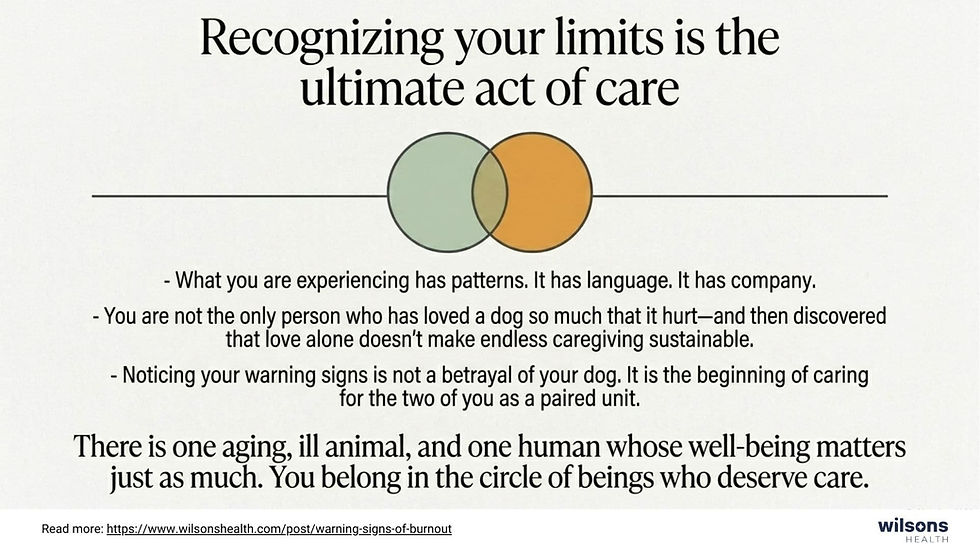
Recognizing your limits is not abandoning your dog. It’s including yourself in the circle of beings who deserve care.
4. Mixed Feelings Are Normal, Not a Red Flag
You can:
Love your dog deeply
Hate what caregiving is doing to your life
Be grateful for the time you’ve had
Wish it were over already
And feel guilty about all of the above
Research on caregivers — human and animal — shows this mix is standard, not abnormal.[3][4] You don’t have to resolve these feelings before you’re allowed to seek support.
When to Consider Professional Support for Yourself
You don’t need a formal diagnosis to ask for help. But it may be especially important to talk to a mental health professional if:
Your sleep problems, anxiety, or low mood have lasted weeks to months
You’re having thoughts like “Everyone would be better off without me,” even in passing
You’re using alcohol, medication, or other substances to get through the day
You feel unable to make decisions about your dog’s care because of overwhelming guilt, fear, or confusion

A therapist doesn’t have to be a “pet grief specialist” to be helpful. Many are familiar with caregiver burden from human medicine, and the emotional mechanics are remarkably similar.
If it feels easier, you can frame it as:
“I’m caring for a chronically ill family member and it’s affecting my mental health.”
It’s accurate. “Family member” just happens to have four legs.
A Quiet Reminder as You Read This
If you recognized yourself in several of these warning signs, you may feel a wave of defensiveness, or shame, or even relief.
Defensiveness: “It’s not that bad. Other people have it worse.”Shame: “I shouldn’t feel this way. It means I’m not strong enough.”Relief: “So this feeling has a name. I’m not just failing at life.”
All of those are understandable.
The research is clear: dog‑caregivers of sick or aging pets are carrying a load heavy enough to affect mental health, sleep, relationships, and finances.[1][2][3][4][5]What you’re experiencing has patterns. It has language. It has company.
You are not the only person who has loved a dog so much that it hurt — and then discovered that love alone doesn’t make endless caregiving sustainable.
Noticing the warning signs isn’t a betrayal of your dog. It’s the beginning of caring for the two of you as a pair: one aging or ill animal, and one human whose well‑being matters just as much.
References
ToeGrips. When Caring For A Sick Pet Becomes Too Much – Pet Caregiver Fatigue.
dvm360. Journal Scan on Caregiver Burden of Owners with Very Ill Pets.
Kent State University News. When Caring for a Sick Pet Becomes Too Much.
Spitznagel, M.B., Jacobson, D.M., Cox, M.D., & Carlson, M.D. (2019). Caregiver burden in owners of a sick companion animal: A cross-sectional observational study. (Referenced via PMC summary: “Canine Caregivers: Paradoxical Challenges and Rewards.”)
Brooks, H.L., Rushton, K., Lovell, K., Bee, P. (2020). The relationship between dog owner mental health and dog behavioural problems and care. Scientific Reports, Nature Publishing Group.


Comments