
What Chronic Illness Means for Dogs

Updated: Aug 28
About 40% of dogs are living with osteoarthritis alone – a single chronic disease that often goes unrecognized for months or years because it “just looks like getting older.”[1] Add in kidney disease, heart disease, diabetes, endocrine disorders, and cancer, and a quiet reality emerges: a large share of our dogs are not simply aging. They are living with chronic illness.

If you’ve ever looked at your dog and wondered, “Is she just slowing down, or is something actually wrong?” – that question is exactly where chronic illness lives.
This article is about what “chronic illness” really means for dogs: medically, emotionally, and practically – for them and for you.
Prefer to listen?
Explore this topic as a conversation on Wilson’s Health: Dog Health, Explained — a clear, thoughtful discussion of what it means and why it matters.
Listen below, or keep reading.
What “chronic illness” means in veterinary language
In veterinary medicine, a chronic illness is a condition that:
Persists for a long time (often months to years, sometimes for life)
Usually cannot be fully “cured”
Needs ongoing management, not a one-time fix
Often fluctuates – better days and worse days – rather than following a straight line
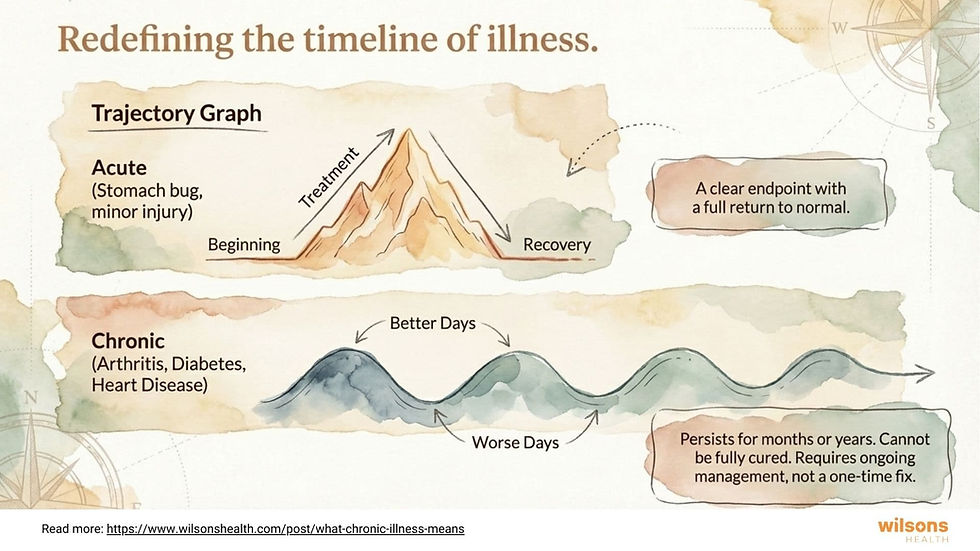
This is different from an acute illness, like a stomach bug or a minor injury, where there’s a clear beginning, treatment, and recovery.

Common chronic illnesses in dogs include[1][3][5][9][11]:
Osteoarthritis (degenerative joint disease) – affects ~40% of dogs[1]
Chronic kidney disease
Heart disease (e.g., mitral valve disease, cardiomyopathy)
Endocrine disorders – such as diabetes, Cushing’s disease, Addison’s disease[5][11]
Chronic pain syndromes – often from old injuries, spinal issues, or cancer[1][7]
Cancer – many forms are managed long-term rather than cured
Chronic illness is less about one label on a test result and more about a pattern over time: ongoing symptoms, repeated vet visits, adjustments in medication, and a gradual reshaping of daily life.
How chronic illness actually shows up in a dog’s life
From the outside, chronic illness can look deceptively ordinary. A dog with significant disease may still wag, greet visitors, and ask for treats.
Yet under that familiar surface, several things are happening:
Physical signs you might notice
Not all at once, and not always dramatically – but often in combinations like these[1][5][7][9][11]:
Reluctance to jump on the couch or into the car
Stiffness after rest, “warming up” slowly on walks
Limping, altered gait, or toe-dragging
Difficulty with stairs or slippery floors
Shorter walks by choice, not by instruction
Less interest in play or toys they used to love
More time sleeping or simply “standing and staring”
Eating more slowly, or walking away from food
Picky behavior that’s new for your dog
Increased thirst or urination (often seen with kidney disease, diabetes, Cushing’s)[5]
Weight loss or, less often, unexplained weight gain
Whining, yelping, or grumbling when moved or touched[1][7]
Guarding certain areas of the body
Changes in posture – hunched back, tucked abdomen, “praying” position
Licking or chewing at a joint or body area

Emotional and behavioral shifts
Chronic disease is not only physical. Dogs show stress, anxiety, and depression-like states when illness and pain persist[2][4][12]:
Social withdrawal
Choosing to rest alone instead of seeking company
Ignoring invitations to play or interact
Avoiding other dogs they previously enjoyed
Growling when touched in certain areas
Snapping when disturbed from sleep
Less tolerance for children or other pets
Anxiety and agitation
Pacing, panting, restlessness (especially at night)
Startling more easily
Clinginess or separation distress
Depression-like signs
Lethargy that’s more than “tired from a walk”
Loss of interest in favorite activities
Changes in sleep patterns – sleeping much more, or restless and unable to settle[4][12]
These changes are often subtle and gradual. Many owners later say, “I thought he was just getting old.” Age and illness do overlap – but age itself is not a disease. Chronic illness is what turns “slowing down” into suffering.

Chronic pain: the invisible engine behind many chronic illnesses
One of the most important – and most misunderstood – aspects of chronic illness in dogs is chronic pain.

What makes pain “chronic”?
Chronic pain is pain that:
Lasts beyond normal tissue healing time
Has no clear endpoint
Is often driven by changes in the nervous system itself, not just the original injury or disease[1][7]
In conditions like osteoarthritis or cancer, pain can become widespread and hypersensitive. A dog may react to gentle touch or normal movement as if it’s strongly painful.
Common sources of chronic pain in dogs include[1][7]:
Osteoarthritis (by far the most common)
Spinal disease (disc disease, lumbosacral stenosis)
Cancer
Old injuries or surgeries that never fully resolved
How chronic pain changes behavior
Pain doesn’t just make dogs limp. It affects their entire emotional state[2][4][7]:
More fearful or cautious in daily life
Less tolerant of handling, grooming, or play
Increased startle responses
Avoidance of activities that used to bring joy
Over time, pain and stress can feed each other. Chronic stress from pain can lead to compulsive behaviors, aggression, and in dogs[4].
If your dog seems “grumpy,” “suddenly old,” or “not himself,” chronic pain is often the missing piece of the puzzle.
Quality of life: the central question in chronic illness
Veterinary teams use the term quality of life (QoL) to capture something you probably think about every day: Is my dog still comfortable? Still themselves? Still getting enough good moments to outweigh the hard ones?

Quality of life is multidimensional[11]:
Physical comfort (pain level, nausea, breathing)
Mobility and ability to do basic functions (walk, get up, toilet)
Appetite and enjoyment of food
Social interaction (with you, with other animals)
Emotional state (anxiety, fear, engagement)
Daily routine – can they participate in the life they’re used to?
QoL isn’t a “score” you’re supposed to get right. It’s a framework for conversation with your vet, and a way to track change over time.
Many owners find it helpful to keep simple notes: “How was today, on a scale from 1–10, for pain, appetite, and joy?” Patterns over weeks often reveal more than any single “bad day.”
How chronic illness is diagnosed (and why it’s often late)
Chronic diseases in dogs are frequently diagnosed later than ideal, because early signs are vague: a little stiffness, a bit of extra drinking, a quiet day here and there.

Diagnosis often involves[5][7][9][11]:
History and observation
Your description of behavior changes at home (which your vet never sees in a 15‑minute exam)
Patterns over time: “He’s been slower for months,” “She’s drinking more lately”
Physical examination
Joint palpation and range of motion (for arthritis)
Heart and lung auscultation (for heart disease)
Body condition, muscle loss, coat quality
Laboratory tests
Bloodwork – to assess kidneys, liver, blood sugar, electrolytes
Urinalysis – especially important for kidney disease and diabetes[5]
Hormone testing – for Cushing’s, Addison’s, thyroid disorders
Imaging
X‑rays – for arthritis, spinal issues, chest or abdominal concerns
Ultrasound – for abdominal organs, heart structure
Sometimes advanced imaging (CT/MRI) in complex cases
Because early symptoms are subtle and non-specific, your sense that “something is off” is often the first and most important diagnostic tool. You are the chronic-illness historian; your vet is the interpreter.
Treatment: not fixing, but managing
For most chronic illnesses in dogs, the goal is not cure but management: keeping your dog comfortable, functional, and emotionally well for as long as possible.

Treatment plans are usually multi-modal – several pieces working together[5][11]:
1. Medications
Pain relief for arthritis or other painful conditions (various classes of drugs)
Disease-specific meds
Insulin for diabetes
Heart medications for congestive heart failure
Hormone-regulating drugs for Cushing’s or Addison’s
Adjuncts – anti-nausea meds, appetite stimulants, anti-anxiety medications when needed

2. Diet and nutrition
Prescription diets for kidney disease, some GI conditions, and certain endocrine disorders[5]
Calorie adjustments for weight loss (to relieve joint pressure) or weight gain in muscle-wasted dogs
Managing salt, protein, or phosphorus intake depending on the disease
3. Physical and environmental support
Physical therapy and rehabilitation – exercises, hydrotherapy, laser therapy for mobility and pain[5]
Non-slip flooring, ramps, raised bowls, supportive harnesses
Orthopedic beds and warm, draft-free sleeping areas
4. Monitoring and adjustment
Regular check-ups and bloodwork to track disease progression[5][11]
Dose changes as the disease or your dog’s response evolves
Adding or removing treatments based on quality-of-life discussions
Chronic care is not a static “treatment plan” you receive once. It’s an ongoing collaboration, adjusted as your dog changes.
The dog’s inner world: stress, fear, and adaptation
Chronic illness affects more than movement and lab values. It shapes how a dog feels in their own body and in the world.

Research and clinical observation show that dogs with chronic illness often experience[2][4][12]:
Heightened fear and anxiety – especially around handling, vet visits, or activities that have become painful
Social changes – withdrawing, or becoming unusually clingy
Chronic stress – which can:
Suppress immune function
Worsen existing disease
Lead to behavior changes like aggression or compulsive licking/chewing[4]
In some dogs, this constellation resembles depression: less initiative, less exploration, less joy.
This doesn’t mean your dog is “giving up.” It means their brain and body are trying to cope with ongoing discomfort and uncertainty – just as humans do.
You, the caregiver: when love becomes a second full-time job
Caring for a chronically ill dog is not just “more pet care.” It is a form of caregiving, and it carries a real psychological weight.

Studies of owners of chronically ill dogs and cats show[6][8]:
Higher levels of stress, anxiety, and depression compared to owners of healthy pets
Feelings of loneliness and isolation – especially when friends or family don’t understand why you’re so attached or so worried
Financial strain and worry about being able to afford ongoing care
Time pressure – scheduling medications, special diets, extra vet visits
Over 90% of pet owners consider their pets family members[8]. That bond is beautiful – and it means chronic illness in a dog often feels emotionally similar to chronic illness in a human family member.
Researchers use the term caregiver burden to describe this cluster of emotional, physical, and financial stressors[6]. It is not a sign you love your dog less. It is a sign you are deeply engaged.
The emotional tangle: guilt, hope, and doubt
Owners of chronically ill dogs commonly report[6][8]:
Guilt about:
Not noticing symptoms sooner
Wondering if they caused the disease
Questioning whether they are doing “enough"
“Am I prolonging her life or her suffering?”
“Should I try this new treatment or let him be?”
Grieving changes in your dog long before death is near
Flashes of dread when you see a bad day and wonder if it’s “the beginning of the end”
These emotions are not pathology. They are part of loving a being whose health is changing.
The shared stress of dog and human
One striking finding: a study of dogs and their owners showed that their long-term stress levels were synchronized – measured through hair cortisol concentrations.[14]
In simple terms: when owners’ stress increased, their dogs’ long-term stress also tended to be higher.

For chronic illness, this means:
Your dog’s condition understandably stresses you
Your stress can, in turn, shape your dog’s emotional state
The two of you live inside a shared emotional ecosystem
This is not a reason to blame yourself. It’s a reason to treat your well-being as part of your dog’s care plan, not separate from it.
Working with your vet: from “fix this” to “let’s manage this together”
Chronic illness changes the nature of the relationship between owner and veterinarian.
Instead of a single problem-solution visit, you’re entering a long-term partnership.
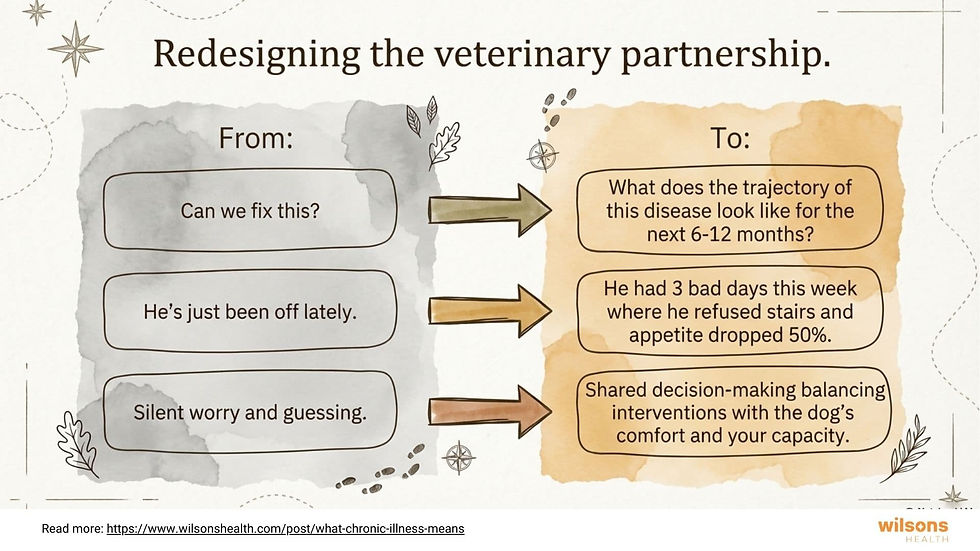
Some useful shifts in mindset:
From cure to trajectory
Rather than asking, “Can we fix this?” it can be more grounding to ask[11]:
“What does the typical course of this disease look like?”
“What might the next 6–12 months involve?”
“What are realistic best-case and worst-case scenarios?”
Understanding disease trajectory helps you plan emotionally, practically, and financially.
From “good or bad” days to patterns
Vets often rely on your observations to adjust treatment. It can help to share:
Frequency of “good,” “okay,” and “bad” days
Specific changes in appetite, mobility, mood
Videos of odd gaits, breathing patterns, or behaviors that don’t show up in the clinic
This moves the conversation from “He’s been off” to “He’s had 3 bad days this week where he refused stairs and his appetite dropped by half.”
From silent worry to shared decision-making
Ethical tensions are common in chronic care[6][11]:
When is treatment helping, and when is it only extending time?
How do we balance aggressive interventions against your dog’s comfort and your capacity?
When should euthanasia be part of the conversation?
These are shared decisions, not tests you pass or fail. Good veterinary care includes:
Clear explanations of options and likely outcomes
Honest talk about quality of life
Respect for your values, finances, and emotional limits
If you feel rushed, confused, or intimidated, it’s reasonable to say, “I need help understanding my options,” or, “Can we slow this down and talk about what this means for her daily life?”
What’s known – and what we’re still figuring out
Veterinary medicine knows a lot about chronic illness – and is still learning. It can be helpful to see where the ground is solid and where it’s still shifting[1][2][4][5][6][7][8][11][14].

Aspect | Well-established | Still uncertain or emerging |
Common chronic diseases | High prevalence of arthritis (~40% of dogs), plus kidney disease and endocrine disorders are common in older dogs[1][5][11] | Best timing and intensity of interventions to optimize both lifespan and comfort |
Pain signs & behavior | Limping, reluctance to move, vocalizing, and social withdrawal are reliable signs of pain[1][7] | The most accurate ways to measure chronic pain and suffering in everyday life |
Owner caregiver burden | Owners of chronically ill pets have higher stress, anxiety, and depression than owners of healthy pets[6][8] | Which specific supports (counseling, support groups, communication styles) most effectively reduce burnout |
Psychological impact on dogs | Chronic illness and stress can cause anxiety, depression-like states, and behavior changes[2][4][12] | Long-term effects on cognition and aging of the canine brain |
Stress synchronization | Dogs’ and owners’ long-term stress levels tend to correlate[14] | How exactly this coupling works, and how best to use that knowledge to support both |
Living with uncertainty is part of chronic illness – for vets, for dogs, and especially for owners. Naming that uncertainty often makes it more bearable.
Practical ways to think about next steps
Without giving medical instructions, we can talk about orientations that often help owners feel less lost.
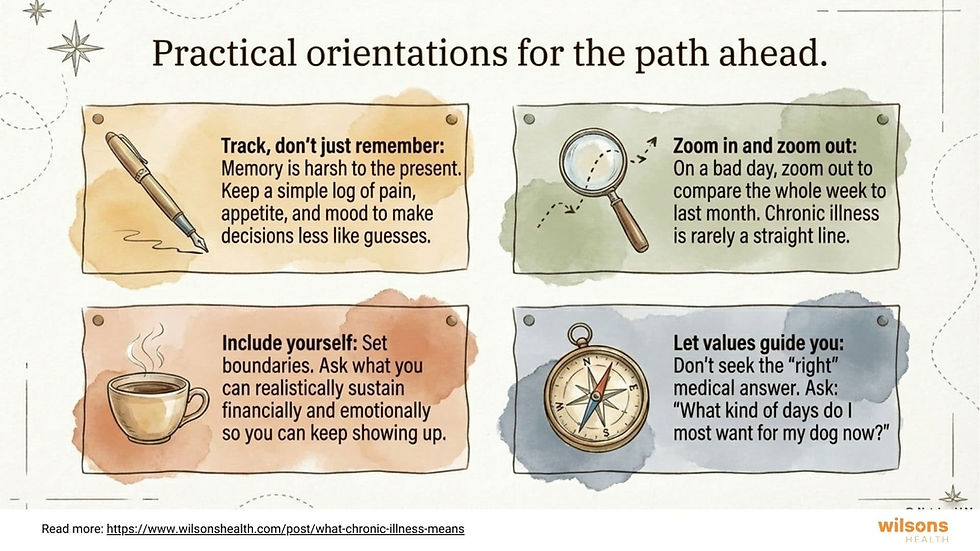
1. Track, don’t just remember
Memory is kind to the past and harsh to the present. A simple log (paper, notes app, calendar) with:
Pain/mobility: better / same / worse
Appetite: normal / reduced / refused
Mood: engaged / quiet / withdrawn
…can make your conversations with your vet more precise and your decisions feel less like guesses.
2. Zoom in and zoom out
On a bad day, it’s easy to feel like “It’s all downhill.” Try to:
Zoom in: What exactly is hard today? Pain? Breathing? Anxiety?
Zoom out: How does this week compare to last month?
Chronic illness is rarely a straight line. Seeing the pattern prevents both false hope and unnecessary despair.
3. Include yourself in the care picture
Ask yourself:
“What can I realistically sustain – emotionally, financially, time-wise?”
“Where do I need help – from family, friends, support groups, or professionals?”
“What boundaries do I need so that I can keep showing up for my dog?”
Your well-being is not a luxury add-on to your dog’s care. It’s part of the treatment environment they live in.
4. Let values, not fear, guide big decisions
When facing choices about advanced treatments or euthanasia, it can help to ask:
“What kind of days do I most want for my dog now?”
“What do I fear most for them – pain, panic, breathlessness, confusion?”
“What would ‘a good last phase’ look like, even if I can’t control the exact timing?”
These are painful questions, but they often bring more clarity – and more peace – than trying to find the one “right” medical answer.
When you catch yourself thinking, “It’s just old age…”
Sometimes it is mostly aging. Bodies slow down. Joints get creaky. Naps get longer.

But often, behind “old age” is something treatable, manageable, or at least soften-able:
Arthritis pain that can be reduced
Kidney disease that can be slowed
Anxiety that can be eased
Environments that can be adapted
You are not expected to know where aging ends and illness begins. That’s what your veterinary team is for. Your role is to notice, to care, and to speak up when your internal alarm says, “This feels different.”
Chronic illness in dogs is not a single diagnosis, but a long conversation between biology, behavior, and relationship. It asks a lot of you – attention, patience, emotional courage. In return, it often deepens the bond you already have, turning ordinary days into something quieter and more deliberate.
Not every problem can be fixed. But understanding what’s happening – and naming it as chronic illness rather than vague “old age” – can transform confusion into orientation. And orientation, even in hard seasons, is a kind of relief.
References
Greensboro Vet – Signs of Chronic Pain in Dogs, Osteoarthritis. Guilford-Jamestown Veterinary Hospital. https://www.guilfordjamestownvet.com/site/blog-greensboro-vet/2023/10/15/chronic-pain-dog
AZ Canine Rehab – Psychological and Emotional Aspects of Pain in Dogs. https://www.azcaninerehab.com/blog/psychological-and-emotional-aspects-of-pain-in-dogs
ASPCA – Common Dog Diseases. https://www.aspca.org/pet-care/dog-care/common-dog-diseases
Chill Paws – Canine Health: The Effects of Chronic Stress. https://www.chillpaws.com/blogs/news/canine-health-the-effects-of-chronic-stress
Vista Veterinary Hospital – Chronic Disease Overview. https://vistavetfalmouth.com/services/chronic-disease
PetMD – Caregiver Burden in Pet Parents with Chronically Sick Dogs and Cats. https://www.petmd.com/dog/caregiver-burden-pet-parents-chronically-sick-dogs-and-cats
Cornell University College of Veterinary Medicine – Recognizing Pain in Dogs. Riney Canine Health Center. https://www.vet.cornell.edu/departments-centers-and-institutes/riney-canine-health-center/canine-health-topics/recognizing-pain-dogs
Time Magazine – Having a Sick Pet Can Be as Stressful as Caring for a Sick Spouse. https://time.com/4946189/sick-pets-caregiver-burden-stress/
Veterinary Specialty & Emergency Center of Toronto (VSEC) – Common Dog Illnesses: Symptoms & Treatment. https://www.vsecto.com/site/blog/2023/01/30/common-dog-illnesses-symptoms-treatment
CreakyJoints – How Pets Help Chronic Illness Patients (Human Angle). https://creakyjoints.org/living-with-arthritis/mental-health/how-pets-help-chronic-illness-patients/
VetSpecialists – Chronic Disease Management for Your Dog. https://www.vetspecialists.com/vet-blog-landing/the-vet-specialists-blog/2023/10/12/chronic-disease-management-for-your-dog
Guardian Vet Care – Pet Mental Health: Recognizing Signs of Anxiety and Depression in Pets. https://www.guardianvetcare.com/services/blog/pet-mental-health-recognizing-signs-anxiety-and-depression-pets
Sundman A-S, et al. Long-term stress levels are synchronized in dogs and their owners. Scientific Reports. 2019;9:7391. https://www.nature.com/articles/s41598-019-43851-x"


Comments