
Age-Appropriate Conversations About Dog Illness

Updated: Aug 28
"Only about a third of seriously ill older adults ever have a documented “serious illness conversation” with their doctor—and when it does happen, it’s often just 33 days before they die.[2]
By then, families are scrambling: trying to understand medical words, manage emotions, and somehow explain all of this to the children in the house. What you say to a 5‑year‑old about illness and death is not what you say to a 15‑year‑old. Many parents know this instinctively—but not how to do it, or when to start.

When the one who is ill is the dog—your child’s best friend, your own quiet companion—the same questions appear, just with more fur and fewer guidelines. How honest should I be? Will I scare them? Am I saying too much…or not enough?
This article is about those conversations: how to think about them by age, what science suggests about children and serious news, and how to talk about your dog’s illness in a way that is both truthful and bearable.
Prefer to listen?
This article is also available as a conversation on Wilson’s Health: Dog Health, Explained.
Listen below, or keep reading.
Why “age‑appropriate” matters more than “perfect”
Developmental psychologists and communication researchers use a simple idea that’s surprisingly grounding: developmental appropriateness.
That means matching what you say to:
What the listener can understand (cognitively)
What they can handle (emotionally)
How they currently make sense of the world
It’s been studied in:
Older adults whose communication changes with age[1]
Adults with serious illness making end‑of‑life decisions[2]
Children and teens living with chronic illness themselves[3]
Families talking to children when an important adult is dying[4][5][6]
We don’t have parallel large studies about “how to tell a child the dog is dying.” But the patterns in human research translate surprisingly well:
Too little information leaves children confused and often self‑blaming.
Too much, too soon can overwhelm them.
Honest, age‑appropriate explanations, even when sad, tend to support better psychological outcomes for children and families.[3–5]

The goal isn’t to deliver a flawless speech. It’s to keep communication real, simple, and revisitable—so your child can come back with questions as they grow into the situation.
A quick mental model: three layers of any illness conversation
Whether you’re talking to a small child, a teenager, or an adult relative, every conversation about your dog’s illness has roughly three layers:
Facts: What is happening in the body? What do we know, and what don’t we know?
Meaning: What does this mean for our dog’s daily life? For our routines? For the future?
Feelings: How do we feel about it? What is hard? What is still good? How do we support each other?

With young kids, you spend more time on concrete facts and routines.With teens, you spend more time on meaning and feelings, and often on ethics and fairness. With adults, especially older adults, you might spend more time on planning and values.
Keeping these three layers in mind can help you adjust your words without losing honesty.
What changes with age: how people process serious conversations
Older adults: when your parent is also losing a dog
Research on healthy aging shows that older adults often have:
More difficulty with:
Complex expression
Pragmatics (picking up implied meanings)
Coherence and staying on topic
Emotional prosody (tone of voice)[1]
But also:
Fewer word‑finding difficulties than younger adults
More “verbal initiative”—they may talk more, tell more stories[1]
This matters when you’re explaining your dog’s diagnosis to an older parent or grandparent:
Keep explanations simple and direct, without many side‑tracks.
Avoid relying on hints or euphemisms (“She’s slowing down,” “It’s time”)—clarity helps distinguish normal aging in the dog from disease.
Pause often and check understanding: “Does that make sense?” “Do you want me to go over that again?”
Expect more storytelling in return—about dogs they’ve lost, illnesses they’ve seen. That’s not avoidance; it’s often how older adults process serious news and connect meaningfully.
There’s another important layer: many older adults, like many doctors, avoid serious illness conversations until very late. In one study, only 37% of seriously ill older adults had a documented serious illness discussion, and on average it was only 33 days before death.[2]

So if your older parent says, “Let’s not talk about that yet,” they’re not unusual. But it does mean you may be the one gently keeping the conversation open—about the dog’s comfort, about euthanasia decisions, about what “a good last phase” might look like.
Children and teens: what we know from human illness research
Most research on “age‑appropriate illness conversations” in young people comes from children and teens who are ill themselves.
A few key findings translate directly to talking with them about a sick dog:
Children and adolescents carefully manage what they disclose and to whom, based on expected reactions.[3]
When they do share and receive empathy and support, they tend to have better psychological wellbeing.[3]
When they fear stigma, pity, or misunderstanding, they may withdraw and hide feelings.[3]
Being educated about the illness (in an age‑appropriate way) makes them more confident and less anxious in conversations.[3]
Professionals who help families talk to kids about serious illness emphasize:
Early, honest, but gentle explanations
Using concrete language
Returning to the conversation over time
Naming uncertainty rather than pretending it doesn’t exist[4–6]

You can think of children and teens as active participants in these conversations, not passive recipients. They’re constantly deciding:
“How much do I want to know? How much can I say? Who is safe to talk to?”
Your job isn’t to force openness, but to make sure your side of the door is open—and that what comes through is honest and digestible.

Talking to a preschooler (roughly 3–6 years)
At this age, children are:
Very concrete thinkers
Prone to “magical thinking” (“Did I cause this?”)
Focused on what happens today or this week
Sensitive to changes in routine and mood, even if they don’t have words for them
What to focus on
Simple, concrete facts
What will change in daily life
Reassurance that:
They did not cause this
They cannot “catch” the illness
Adults are taking care of the dog

Example phrasing:
“The vet told us that Max’s body is very sick on the inside. His heart is not working well anymore.”
“That means he gets tired very fast and can’t run like before.”
“We have medicine to help him feel more comfortable, but the medicine can’t make him all better.”
“You didn’t do anything to make Max sick. Nothing you said or thought made this happen.”
If death is approaching:
“Soon, Max’s body will stop working, and he will die. That means he will not breathe or feel or wake up anymore.”
“When that happens, we will be very sad, and we can cry and talk about him together.”
Avoid phrases like:
How much detail?
At this age, short is kind. Think in one‑ or two‑sentence pieces, followed by a pause. Most children will ask more if they want more. If they change the subject, that’s not denial; it’s healthy pacing.
Talking to a school‑age child (roughly 7–11 years)
Children in this stage:
Understand that death is final and universal, but may still struggle with the idea emotionally.
Can follow more complex explanations.
Often worry about fairness, responsibility, and what happens next.
What to focus on
A simple explanation of the diagnosis
What treatment can and cannot do
The idea of comfort vs. cure
Their role in caring and saying goodbye

Example phrasing:
“The vet found out that Bella has something called kidney disease. The filters in her body that clean her blood aren’t working very well anymore.”
“The medicine and special food help her feel better and give her more good days, but they can’t fix the kidneys completely.”
“At some point, her body will get too tired, and she will die. We don’t know exactly when, but the vet thinks it might be in months, not years.”
“When Bella’s bad days start to be more than her good days, and she seems uncomfortable most of the time, we will help her die gently at the vet. That means the vet will give her a special medicine that makes her fall asleep and then die without pain.”
Invite participation, but don’t assign responsibility:
“You can help her by being gentle, giving her space when she’s tired, and spending time with her.”
“The decision about when to help her die is a grown‑up decision. We will listen to what you think and feel, but you are not in charge of that decision.”
This age group often asks surprisingly direct questions: “Will she die today?” “Will it hurt?” “Are you sure?” Honest, simple answers are protective, not harmful.

Talking to a teenager
Adolescents are closer to adults in how they think—but with more intensity and less life experience to cushion the blow.
Research on chronically ill teens shows that they:
Strategically decide who to tell and how much, based on expected reactions.[3]
Often fear being seen as “different” or pitied.
Do better when they feel informed and involved, not shielded.[3]
With a sick dog, teens may:
Want detailed medical information—or none at all.
Question treatment decisions and ethics (“Are we doing this for her or for us?”).
Express anger, cynicism, or dark humor.
Withdraw, then suddenly want to talk at midnight.
What to focus on
Full honesty, including uncertainty
Shared decision‑making where appropriate
Space for complex feelings (anger, guilt, numbness)

Example phrasing:
“The vet says Milo’s cancer has spread. The chemo slowed it down for a while, but it isn’t working anymore.”
“We have a couple of options: we can try another medicine that might give him a bit more time but could make him feel sick, or we can focus on keeping him as comfortable as possible at home. What questions do you have about that?”
“We’re the ones who will make the final decision, because that’s a lot to put on you. But I really want to know what you think and what feels right to you.”
Name the elephant in the room:
“You might be angry at us, at the vet, at the universe. You might not feel anything at all right now. All of that is normal.”
“You don’t have to talk about this with your friends if you don’t want to. If you do want to, and you’re not sure how to explain it, we can think of words together.”
When the child and the adult are both grieving
In studies of families where an important adult is dying, many professionals report that parents hesitate to talk to children because they feel:
Too distressed themselves
Unsure what to say
Afraid of “making it worse”[4–6]
Yet when these conversations do happen—early, gently, and honestly—families tend to cope better over time.[4–6]
Something similar happens when a beloved dog is seriously ill:
You may feel you’re barely holding yourself together.
The idea of saying, “Our dog is going to die,” to your child can feel unbearable.
It can help to remember:
You do not have to be calm to be helpful. You only have to be real.
It is okay for your child to see you cry. That teaches them that sadness can be felt and survived.
You can use phrases like:
“This is really hard to talk about, and I feel very sad. But I want us to talk about it together.”
“I don’t have all the answers, but I will always tell you the truth as kindly as I can.”

Healthcare professionals in palliative care say they often want more training to help families with these conversations.[4,6] You are not “behind” or “failing” for finding this hard. You’re in the same territory that trained clinicians find challenging.
How much should you tell—and when?
Research on serious illness in adults and children points to a few consistent tensions:
Honesty vs. protection
Adults want to protect children from distress, but hiding information can create more anxiety and confusion.[3–5]
Timing
Many serious illness conversations happen late—sometimes only weeks before death.[2] Earlier, gradual conversations tend to be easier to process.
Readiness
Waiting for “perfect readiness” often means waiting too long. But dumping everything at once can overwhelm.
A useful compromise is “little and often”:
Start early with simple facts.
Add detail as:
The illness progresses
Your child’s questions deepen
Their developmental understanding grows

You might begin with:
“The vet found something wrong with Daisy’s liver. We’re going to be giving her medicine and going back for more tests.”
Weeks or months later:
“The medicine is helping some, but not enough. The vet thinks Daisy’s body will not live as long as we hoped.”
Closer to the end:
“The vet says Daisy is in the last part of her life. We can’t stop her from dying, but we can make sure she is comfortable and loved.”
At each step, check in:
“What questions do you have?”
“Is there anything that doesn’t make sense?”
“Do you want to know more details, or is this enough for now?”
Working with your veterinarian as a communication ally
Serious illness conversations in human medicine—when done well—improve quality of life and reduce aggressive, unwanted interventions at the end of life.[2] They rely on structured approaches called Serious Illness Conversations (SICs).
While vets are not usually trained in these exact protocols, you can borrow some of the structure:
Consider asking your vet:
“Can you explain this in a way I can later explain to my 7‑year‑old?”
“If my teen wants more details, what’s the simplest way to describe what’s happening in the body?”
“What changes should we expect over the next weeks or months, so I can prepare my family?”
“How will we know when it’s time to talk seriously about euthanasia?”

You can also ask for written phrases or a brief summary you can take home. Many healthcare professionals in palliative care say they want tools—videos, guidelines, models—to help families talk to children.[4,6] Some vets are already using handouts or websites for this; others may welcome the prompt to think it through with you.
Remember: your vet is not just treating your dog’s body. They are also, in a quiet way, treating your family’s understanding of what’s happening.
Special considerations: cognitive decline and complex family dynamics
Sometimes, the person you’re talking to about the dog’s illness—an older partner, a grandparent—has cognitive changes themselves.
Research on aging and cognitive decline suggests:
Conversational abilities can change—less coherence, more difficulty tracking complex information—but people may compensate with more talking or storytelling.[1,5]
Emotional comprehension may shift, but authentic, simple communication still supports mental health.[5]
In practice:
Use short, concrete explanations, repeated as needed.
Avoid relying on them to remember complex treatment plans.
Focus on the dog’s comfort and the immediate next steps.
Family dynamics can also complicate things:
One adult wants full, blunt honesty with the kids.
Another wants to “protect them from everything.”
It may help to agree on a few shared principles:
We will not lie.
We will use simple, clear words (sick, dying, death, dead) instead of confusing euphemisms.
We will adjust the amount of detail to each child’s age and questions.
We will make it clear that adults are responsible for the hard decisions.
We will keep checking in, even after the dog has died.

These are not rules handed down from on high; they’re just a way of respecting both the science and the very human messiness of families in crisis.
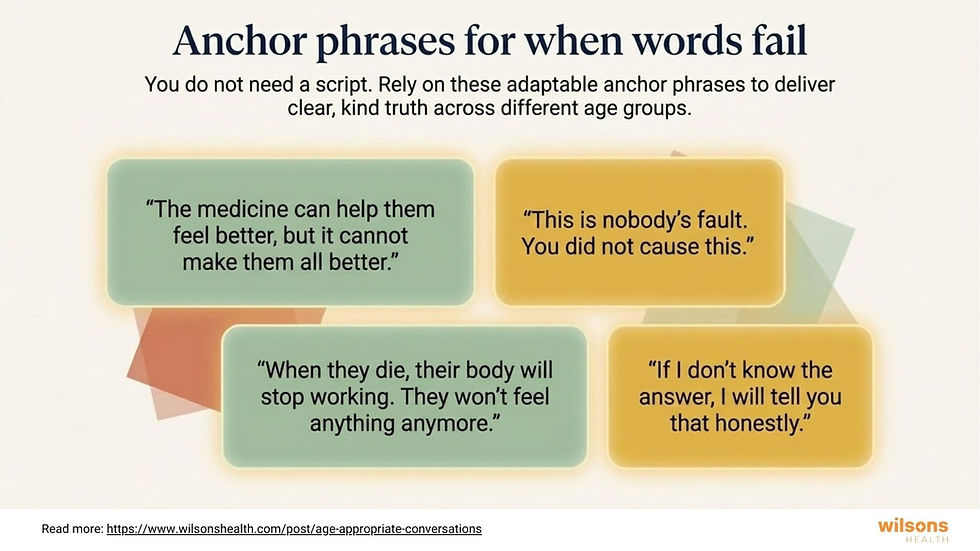
When you’re not sure what to say: a few anchor phrases
You do not need a script. But it can help to have a few anchor phrases ready—sentences that are both honest and gentle, and that fit many ages with slight tweaks.
“The vet found out that [dog’s name] is very sick on the inside.”
“The medicine can help [him/her/them] feel better, but it cannot make [him/her/them] all better.”
“This is nobody’s fault. You did not cause this.”
“We don’t know exactly how long [dog’s name] will live, but we know [he/she/they] will not live as long as we hoped.”
“When [dog’s name] dies, [his/her/their] body will stop working. [He/She/They] won’t feel anything anymore. We will be very sad, and we can talk and remember [him/her/them] together.”
“You can ask me any questions, now or later. If I don’t know the answer, I will tell you that honestly.”
“It’s okay to feel sad, or angry, or nothing at all. All of those feelings are allowed.”
You can adjust the complexity of what comes before and after these phrases depending on whether you’re talking to a 5‑year‑old, a teen, or an older adult. The core stays the same: clear, kind truth.

Living with the conversation, not just having it once
One of the quieter findings across studies is that illness conversations are not single events.
They are ongoing, shifting with:
The progression of the illness
The listener’s age and understanding
The family’s emotional state
Children and teens revisit what they’ve been told as they grow. A 6‑year‑old who accepted “Max was very sick and died” may, at 10, ask, “What kind of sickness? Could the vet have done more?” At 15, they may ask, “Did we wait too long? Or not long enough?”
This isn’t reopening a wound; it’s part of how they integrate loss into their understanding of the world.
You are allowed, each time, to say:
“Here’s what we knew then.”
“Here’s what we decided, and why.”
“If we had known more, we might have done things differently—and we made the best decisions we could with the information we had.”

That, in the end, is what age‑appropriate conversation really is: not a perfect explanation at a single moment, but a series of honest, human attempts to make sense of something hard, together, in language that fits the person in front of you.
Your dog’s illness is real. So is your child’s mind, your teenager’s questions, your parent’s changing memory, and your own grief. You do not have to choose between truth and kindness. With a little care, and a willingness to say “I don’t know” out loud, you can offer both.
References
Wright HH, Capilouto GJ, Koutsoftas AD, Fergadiotis G. Age-related differences in conversational discourse abilities. American Journal of Speech-Language Pathology. 2019;28(1):222–238. Available from: https://pmc.ncbi.nlm.nih.gov/articles/PMC6497023/
Ouchi K, George N, Schuur JD, et al. Interventions to promote serious illness conversations in the emergency department: ED GOAL. JAMA Network Open. 2021;4(3):e213113. Available from: https://jamanetwork.com/journals/jamanetworkopen/fullarticle/2835420
Pinquart M, Shen Y. Illness conversations: Self-disclosure among children and youth with chronic illness. Children. 2023;10(7):1190. Available from: https://pmc.ncbi.nlm.nih.gov/articles/PMC10515452/
Hanna JR, McCaughan E, Semple CJ. Challenges and support needs of parents and children when an important adult is at end of life: A qualitative study. Palliative Medicine. 2022;36(6):946–955. Available from: https://pmc.ncbi.nlm.nih.gov/articles/PMC9210112/
University of Oxford, Department of Psychiatry. Talking to children about serious illness. COVID-19 communication support resources. Available from: https://www.psych.ox.ac.uk/research/research-groups/covid_comms_support
Hanna JR, McCaughan E, Semple CJ. Healthcare professionals’ perspectives on conversations about children when an important adult is at end of life. American Journal of Hospice and Palliative Medicine. 2022;39(4):396–404. Available from: https://journals.sagepub.com/doi/abs/10.1177/10499091211046241"



Comments