
Managing a Child’s Fear About a Dog’s Illness

By age 10, more than half of children in some communities live with a dog, and across multiple studies those children tend to show lower anxiety than their peers without dogs.[1][3][7] So when that same dog becomes sick, the emotional ground can suddenly tilt: the creature that helped keep your child calm is now the very source of their fear.
You may see it in sideways questions —“Is she hurting?”“Will he die?”“Did I make her sick?”
None of this is random or a sign that you’re “handling it badly.” It’s what happens when a child’s attachment, developing brain, and sense of safety all collide with real uncertainty.

This article is about that collision — and how to walk your child through it without pretending the road is smooth.
Why a dog’s illness hits children so hard
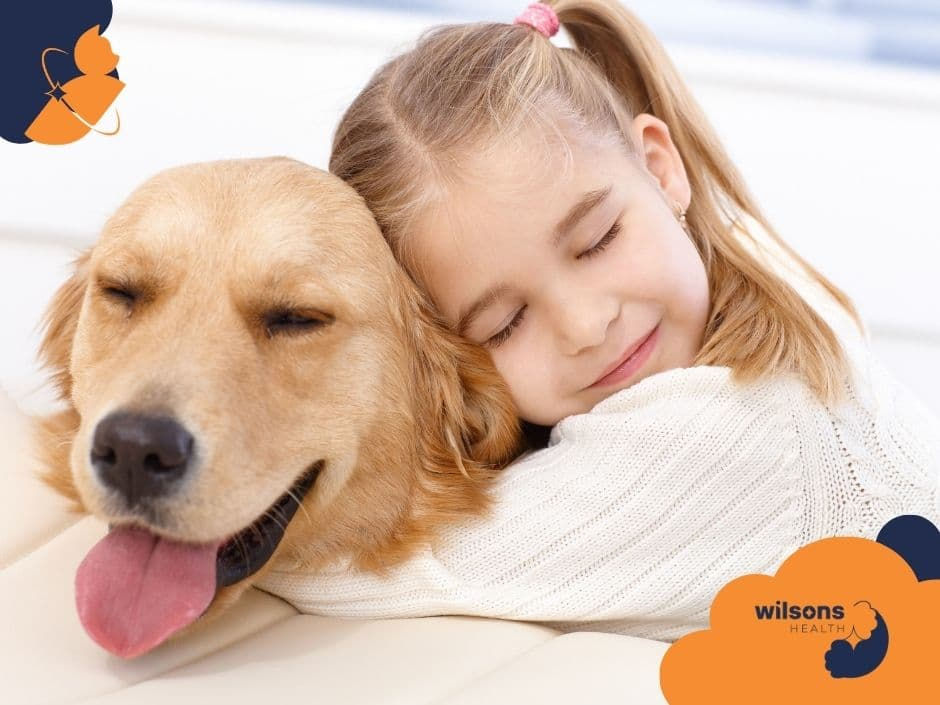
Children don’t just “like” their dogs. Research suggests many kids rank pets above humans as sources of comfort and emotional support.[3] Dogs are confidants, co-regulators, and sometimes the one reliably non-judgmental presence in a child’s day.
So when a dog becomes ill, a few things happen at once:
Attachment is threatened. That secure, comforting bond (often called pet attachment) is suddenly unstable. Attachment systems don’t like instability — they respond with anxiety, clinginess, or withdrawal.
Routine changes. Walks stop. Play becomes gentler or disappears. Vet visits interrupt evenings. For children, routine is a major part of feeling safe; when the dog’s routine changes, the child’s nervous system notices.
Uncertainty explodes. Kids are exquisitely sensitive to “something is wrong” even when adults say nothing. They pick up on whispered conversations, tense car rides to the vet, and your own micro-pauses before you answer questions.
Big questions arrive early. Illness in a beloved dog can be a child’s first real encounter with pain, aging, and death. Their brain is still building the tools to handle those concepts.
The result is often fear and anxiety: trouble sleeping, clinginess, stomachaches, irritability, or suddenly not wanting to leave the dog’s side.
This doesn’t mean something is “wrong” with your child. It means something important is happening inside them — and you have a real chance to shape how they learn to face loss and uncertainty.
A quick vocabulary for what you’re seeing
You don’t need clinical language to care for your child — but a few terms can help you make sense of what’s going on (and talk more clearly with professionals, if needed).
Pet attachment The emotional bond between child and dog. Stronger attachment usually means:
more comfort and security in daily life
and more intense distress when the dog is ill or dying[1][3]
Separation anxiety Fear of being away from someone important. Around a sick dog this may look like:
refusing sleepovers or school because “what if something happens?”
insisting the dog sleep in their room
panic when the dog goes to the vet without them
Social anxiety Worry about social situations or being judged. A dog often softens this — kids with dogs tend to have lower overall anxiety and better emotional regulation.[1][3][7] When the dog is sick, that “social buffer” may feel like it’s crumbling.
Internalizing problems Feelings turned inward: anxiety, sadness, guilt, withdrawal. These kids might look “quiet” or “good,” but they’re carrying a lot internally.
Externalizing problems Feelings turned outward: tantrums, defiance, aggression, attention problems. A child who screams at you about homework may actually be terrified about the dog.
Knowing these patterns can reduce one quiet fear many parents carry:“Is this just misbehavior?”Often, it’s distress in disguise.
What research actually tells us about kids, dogs, and anxiety
Before we talk about conversations and daily life, it helps to know the broader landscape.
Dogs are often protective for children’s mental health
Across several studies:
In a group of 643 children aged 4–11, 58% had a pet dog. Those with dogs had significantly lower anxiety scores than those without.[1]
In another study, 12% of children with pet dogs screened positive for clinical anxiety compared with 21% of children without dogs.[3][5]
Exposure to and attachment with dogs in childhood has been associated with a reduced risk of adolescent mental health disorders, including anxiety.[1]
In other words, the bond your child has with your dog is not just sweet — it’s part of how many children learn to self-soothe, feel competent, and build emotional resilience.
That’s part of why illness is so destabilizing: it shakes a pillar that was quietly holding a lot of weight.
Therapy dogs and acute anxiety
In high-stress medical situations, therapy dogs have been shown to:
Reduce acute anxiety in nearly half of children exposed to them in emergency departments, compared to about a quarter in control groups.[4][6]
Lower the need for anxiety medications in those settings.[4][6]
This matters for you not because you need a therapy dog, but because it confirms something you already suspect: dogs can be powerful emotional regulators for kids. When that regulator is sick, children can feel as if their “calm button” is broken.
The messy part: cause and effect is not clear
Researchers are careful to point out:
We don’t know if dogs cause lower anxiety, or if families with lower anxiety and more stability are simply more likely to have dogs.[3][5]
Factors like socioeconomic status, family stress, and parenting style may influence both pet ownership and child mental health.[3]
For your situation, the takeaway is simple: Your child’s distress about the dog’s illness is not proof you “shouldn’t have gotten a dog” or that the dog has somehow damaged their mental health. The relationship is far more complex — and often beneficial.
When the comforter is the patient: how children experience a sick dog
Children often can’t articulate what’s going on inside them, but research and clinical experience point to several common emotional threads when a dog is ill:
Fear “Is she hurting?”“What if he dies while I’m at school?”“Will it happen to me too?”
Helplessness They see you giving medication, scheduling appointments, making decisions. Their role is fuzzy: they love deeply but can’t fix anything.
Guilt and magical thinking “Did I step on her paw too hard?”“I wished he would stop barking — did that make him sick?”
Anticipatory grief A kind of grief that starts before the loss is official. Kids may:
cry “for no reason”
avoid the dog because it hurts too much
cling even more tightly
Echoes of other stress If your child is already dealing with school struggles, bullying, or family tension, the dog’s illness can amplify those existing anxieties.
This is not overreaction. For many children, a dog is their safest relationship. Threaten that, and everything else can wobble.

The communication tightrope: honest, but not overwhelming
One of the hardest parts is talking about what’s happening without either:
flooding your child with graphic or adult-level detail, or
smoothing everything over so much that they feel misled or shut out
There’s no perfect script, but a few principles help.
1. Match the explanation to your child’s developmental stage
You don’t need to be a developmental psychologist. A rough guide:
Preschool (3–5) Think concrete, present-focused.
“Her leg is hurt inside, so she needs medicine and more rest.”
“The doctor is helping her feel comfortable.”
Avoid: timelines, “forever” language, or metaphors like “put to sleep” that can confuse and frighten.
Early school age (6–8) They can understand simple cause and effect, and they notice inconsistencies.
“His heart isn’t working the way it used to. The medicine helps, but it can’t make it like new.”
“He isn’t in pain all the time. When he looks like this [show calm body language], he feels okay. When he does [describe signs], we help him.”
Later school age and tweens (9–12) They can handle more nuance and are often silently Googling.
“The vet says this is a chronic illness. That means it won’t fully go away, but we can treat it and keep her comfortable.”
“We don’t know exactly how long she has. That uncertainty is hard, and it’s okay to feel worried about it.”
The rule of thumb: answer the question they actually asked, not the scariest version you’re afraid they’re thinking.
If they say, “Is she hurting?” you might respond:
“Right now, the medicine is working and she’s comfortable. When dogs hurt, they do things like [name signs: limping, whining, not wanting to move]. If we see those, we help her right away.”
You’ve been honest, specific, and you’ve given them a way to read the situation themselves.
2. Use the vet as a partner in communication
Veterinarians are not just medical experts; they can also be allies in shaping how your child understands the illness.
You might say to your vet:
“My child is really anxious about whether our dog is in pain. Could you explain in kid-friendly language what you’re doing to keep her comfortable?”
“Can we involve him in a small part of the exam or care so he feels helpful rather than helpless?”
Many vets are willing to:
Show kids X-rays or models in simple terms
Point out body language that shows comfort vs. pain
Reassure both of you when your dog is not currently suffering
Transparent, empathetic communication from your vet doesn’t just calm you — it trickles down to your child.
Practical ways to ease your child’s anxiety day to day
You can’t remove the illness. But you can change the experience your child has of living through it.
1. Keep (modified) routines with the dog
Routine is a stabilizer for anxious brains — child and dog alike.
Depending on your dog’s condition and your vet’s guidance, consider:
A short, slow “special walk” each day with your child and dog, even if it’s just to the corner and back.
A predictable “snuggle time” on the couch after dinner.
A simple care task your child can own, such as:
refilling the water bowl
bringing the soft blanket
placing the pill in a treat (with your supervision)
These are not chores; they’re roles. Having a role can transform helplessness into gentle pride.
2. Create a safe space for feelings — and questions
Children often test the waters before asking what they really want to know. You can open that door without pushing them through it.
“You’ve noticed she’s going to the vet a lot. What have you been wondering about?”
“Some kids feel scared or sad when their dog is sick. Have you felt anything like that?”
If they say “no,” you don’t need to pry. You’ve signaled that the topic is allowed.
When feelings do show up, you can:
Name them: “You look really worried right now.”
Normalize them: “Lots of kids feel scared when their dog is sick. It makes sense.”
Anchor them: “We can’t control everything, but here’s what we are doing to help her.”
3. Model calm without faking perfection
Children are highly sensitive to caregiver emotional cues. They don’t need you to be endlessly serene; they need you to be legible.
Instead of:
Snapping, “It’s fine, stop worrying.”
Or dissolving in front of them with, “I can’t handle this either.”
Try:
“I feel sad and worried too sometimes. When I feel that way, I [walk, talk to a friend, sit with the dog]. We can figure out what helps you when you feel that way.”
You’re teaching emotional regulation in real time.
4. Use concrete tools for anxious moments
Some children benefit from small, repeatable rituals:
“Check-in” routine with the dog Once or twice a day, you and your child gently look for:
Is she eating or drinking?
Is she willing to move a little?
Is she relaxing in her favorite spot?
You can quietly note any concerns for the vet, while your child learns that not every quiet moment equals suffering.
Worry time Set aside 10 minutes at a predictable time (“after homework, before TV”) as “worry time.” During that window, your child can ask any dog questions or talk about fears. Outside that time, if worries pop up, you can say:
“Let’s save that for worry time so we can really focus on it.”
This doesn’t trivialize their fear; it gives it a container.
Comfort objects and routines Some kids want a photo of the dog at school, or a small token (a collar tag on a necklace, a charm). These can serve as quiet reassurance when they’re away.
5. Watch for when anxiety is getting too big
Concern and sadness are appropriate. But sometimes anxiety around a pet’s illness becomes part of a wider pattern that may benefit from professional support.
Red flags to discuss with a pediatrician or child psychologist:
Persistent trouble sleeping or nightmares about the dog
Refusal to go to school or leave the house “in case something happens”
Ongoing stomachaches or headaches without medical explanation
Intense guilt (“It’s my fault he’s sick”) that doesn’t ease with reassurance
Loss of interest in friends or activities beyond what you’d expect from sadness
Professionals can help differentiate between a natural grief response and anxiety that’s getting stuck, and can offer child-friendly strategies to help.

The ethical knot: how much do you tell them about prognosis and pain?
This is one of the hardest questions families face, and there is no universal “right” answer. Research is clear that:
Too little information can breed mistrust, confusion, and self-blame.
Too much, too vividly can overwhelm and increase fear.
Some orienting questions for yourself:
What is my child already sensing? Children often know when things are serious. If you say, “She’s fine!” while also crying in the kitchen, the mismatch itself can be frightening.
What decisions will they see us make? If euthanasia may be considered, it can help older children to know ahead of time, in gentle terms, that:
“One day, if her pain can’t be helped anymore, the vet has a way to let her die peacefully. That will be a very loving, very hard decision.”
What do I want them to remember about this time? Many parents want their child to remember:
that the dog was loved and cared for
that their own feelings were allowed
that the adults took responsibility for the hardest choices
You don’t have to map all of this out alone. Your vet and, if involved, a child therapist can help you calibrate how and when to share information.
A brief word about cats, other pets, and confusing research
You might stumble across headlines saying that cats are linked to higher rates of child mental health problems.[2][5] Some studies do show:
Children with cats were nearly three times more likely to have a diagnosed mental health problem in one dataset.[5]
Cat ownership has been associated with more “internalizing” (anxiety, depression) and “externalizing” (behavior) problems in some groups.[2]
But — and it’s a big “but” — researchers emphasize that:
We don’t know if cats contribute to those problems, or if families already facing more challenges are more likely to have cats, or if other environmental factors are at play.[2][5]
The paradox that dogs seem broadly protective while cats sometimes correlate with more problems is unresolved and likely reflects a tangle of underlying differences.
If your family has multiple pets, including cats, it’s easy to worry you’ve accidentally made things worse. The current evidence does not support that conclusion. The key drivers of how your child copes are:
the quality of their relationships (with pets and humans)
the stability and supportiveness of the home
how big emotions are handled and modeled
In other words: your day-to-day presence matters far more than the species breakdown in your living room.
When the illness is long-term: living with chronic uncertainty
If your dog has a chronic condition — heart disease, cancer in remission, epilepsy, severe arthritis — your family may be living in a long, uneven middle rather than a clear “before and after.”
Research is thin on how children’s anxiety evolves over these longer journeys. We know:
Strong emotional bonds persist, and sometimes deepen, during chronic illness.[3]
The trajectory of anxiety over time in these situations hasn’t been well studied; we’re missing good long-term data.
In practice, that means you’re navigating without a detailed map. Some families find:
Anxiety spikes around flares or crises, then settles into a new baseline.
Children become experts in their dog’s condition, which can be empowering.
Over time, kids can integrate the reality that someone they love can be both fragile and okay in this moment — a subtle but powerful life lesson.
You can support that integration by:
Marking good days out loud: “Today was a comfortable day for her. I’m glad we had that.”
Allowing bad days to be named without spiraling into catastrophe: “Today was a hard day for his body. The vet and I are watching closely.”
Keeping small, consistent rituals that don’t depend on health: bedtime stories that always include the dog, even if he’s just snoring nearby.
Caring for yourself while caring for them
One quiet driver of child anxiety is adult burnout. When you’re stretched thin — emotionally, financially, logistically — it’s harder to be the calm harbor your child needs.
You don’t need a spa day (though if you can get one, enjoy it). You might need:
One friend or relative who knows the full story and can:
sit with your child while you go to the vet
be the person you cry to so your child doesn’t have to carry your entire grief
Clear, honest boundaries:
“I can answer two questions about the dog right now, and then I need a break. We’ll talk more after dinner.”
Permission to feel ambivalent:
You can love your dog and also feel exhausted by caregiving.
You can ache for your child and also feel frustrated by their clinginess.
Children don’t need you to be invulnerable. They need you to be real, and to show that real people can feel a lot and still function, still love, still make decisions.
When this becomes part of their story
At some point — whether your dog recovers, lives for years with a chronic condition, or dies — this experience will become part of your child’s internal story about love, bodies, and loss.
We don’t have long-term data to tell us exactly how that story shapes their future anxiety. But we do know that:
Children with strong, supportive relationships — human and animal — are generally more resilient.
Having space to grieve openly, ask questions, and feel included in care decisions can transform trauma into tenderness.
Years from now, your child might not remember every vet visit or medication schedule. They may remember:
The time you let them sleep on the floor next to the dog’s bed.
The way the vet knelt down and talked to them as well as to you.
The moment you answered, “Is she hurting?” with something true, and kind, and just detailed enough.
You’re not just managing anxiety. You’re helping them learn that they can face hard things without looking away — and without facing them alone.
References
Browne, D. T., et al. Impact of pet dog or cat exposure during childhood on mental illness. National Institutes of Health / PubMed Central (PMC).
O’Haire, M. E., et al. Impact of pet ownership in early childhood on child mental health. National Institutes of Health / PubMed Central (PMC).
Bassett Medical Center. Kids With Pets Have Less Anxiety – study summary on child anxiety and pet dogs.
HABRI / Pet Partners. Therapy Dogs Reduce Child Anxiety and Medication Need – summary of findings published in JAMA Network.
WellBeing International Studies Repository. Do Children With Cats Have More Mental Health Problems? – review of associations between cat ownership and child mental health.
Kogan, L. R., et al. Therapy Dogs for Anxiety in Children in the Emergency Department. JAMA Network Open.
Global News. Children with pet dogs have less anxiety: study – coverage of research on dog ownership and child anxiety.
Serpell, J. A. The Puzzling Relationship Between Pets and Child Development. Psychology Today – discussion of complexities and confounding factors in pet-child research.
Nationwide Children’s Hospital. Pets and Mental Health: How Furry Friends Can Impact Your Child's Anxiety – overview of mechanisms by which pets influence child emotional well-being.


Comments