
Understanding Posture and Compensation Patterns in Dogs

About 80–90% of a dog’s body weight is carried on just four small paws, and in a sound, relaxed dog that weight is distributed with remarkable precision: force-plate studies show symmetry differences of less than 3% between left and right limbs in healthy dogs.[5]
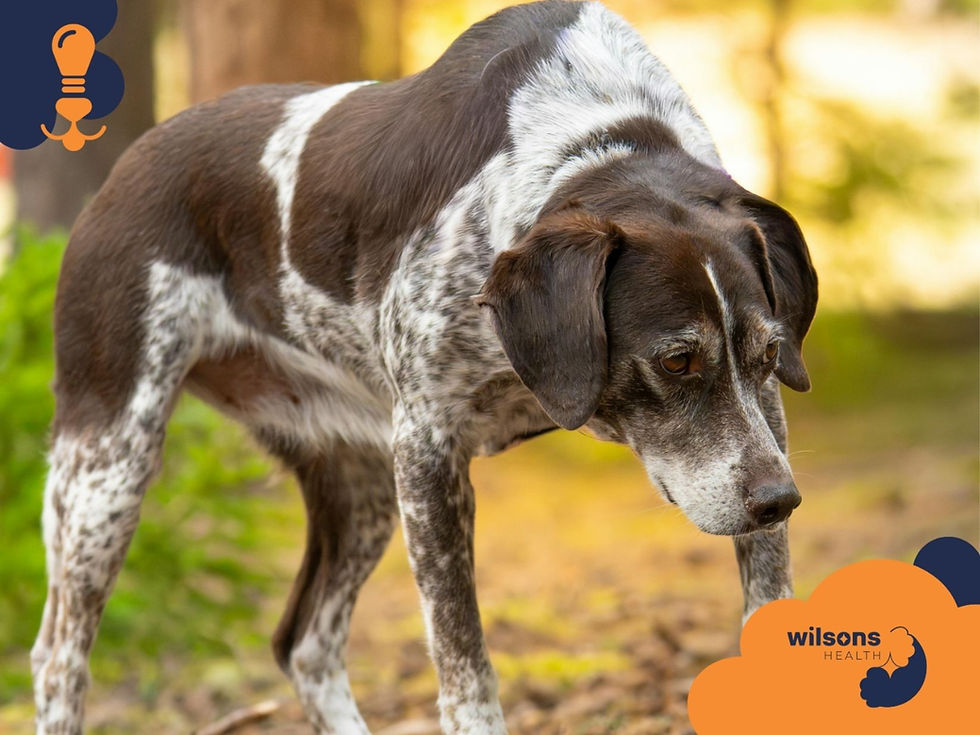
So when your dog starts sitting sideways, pacing instead of trotting, or subtly shifting weight off one leg, those small changes are not random quirks. Biomechanically, they are signals that your dog is re-organizing how their whole body works to keep moving in spite of pain, weakness, or neurological change.

Understanding these posture and compensation patterns doesn’t just satisfy curiosity. It’s one of the most reliable ways to “hear” what your dog’s body has been trying to say for a while.
What “posture” and “compensation” really mean in dogs
Before we talk about sideways sits and pacing, it helps to have a clear map of the territory.
Posture: How your dog holds their body when they’re not moving much: standing, sitting, lying down. It includes:
alignment of spine and limbs
joint angles (how bent or straight things are)
where the weight is actually going (front vs back, left vs right)
Compensation pattern: Any adjustment in posture or movement your dog uses to:
avoid pain
work around weakness or instability
cope with neurological changes
These can show up as:
asymmetric weight bearing (leaning more on one side)
altered joint angles (a permanently “tucked under” leg, for example)
changed muscle activation (some muscles overworking, others underused)
shifts in balance and gait (pacing, shorter steps, head bobbing)
Compensation is not “bad behavior.” It’s a survival strategy: your dog’s nervous system doing clever, on-the-fly problem solving. But like limping on one leg for months, these adaptations can create secondary problems over time.
The invisible orchestra: how dogs coordinate movement
Researchers build detailed 3D musculoskeletal models of dogs with:
84 degrees of freedom (ways joints can move)
134 individual muscles[1]
When these models are compared with real dogs using electromyography (EMG), the activation patterns match up well.[1] That tells us something important: movement is not random. Muscles fire in synergy groups—clusters that work together to produce smooth, efficient motion.
Key muscle groups in the forequarters, like:
M. rhomboideus (between shoulder blades and neck)
M. latissimus dorsi (big back muscle)
M. serratus (slings the trunk between the front legs)
all have specific, predictable firing sequences in a healthy walk.[1]
When a dog starts compensating—say, to protect a painful hip—those synergies shift:
some muscles fire earlier or longer than they should
others go quiet
new “helper” muscles take over jobs they weren’t designed to do
To you, this might look like:
a rounded back
a shoulder that seems bulkier on one side
a neck that’s always turned slightly
To a rehab vet, it’s a familiar pattern of overworked and underworked muscles, often accompanied by myofascial trigger points—small, painful knots in muscle that reinforce abnormal posture.[7]
Static vs dynamic: why your dog can “walk fine” but still be struggling
Clinically, posture and compensation are assessed in two broad ways:
Static analysis – the still picture
This is your dog:
standing
sitting
lying down
quietly shifting weight
Tools and observations include:
visual alignment (is one hip higher? is the spine curved?)
stance analyzers measuring how much weight each limb bears[6]
palpation for muscle tension and trigger points[7]
Static analysis often reveals:
a dog who “always sits to one side”
forelimbs doing more work than they should
one rear leg barely loading weight while standing
Dynamic analysis – the moving picture
This is your dog:
walking, trotting, turning
going up and down stairs
getting up from lying down
Techniques include:
kinematic gait analysis (joint angles, stride length, timing)[2][3][4]
kinetic analysis (ground reaction forces measured on pressure walkways)[2][3][4]
slow-motion video
Dynamic analysis picks up:
subtle head bobs
unequal stride lengths
pacing gait (same-side legs moving together)
extra time spent on certain limbs
A key finding from rehab research:Gait often improves before posture does.[6]
Dogs in therapy may look much better when walking, but still show:
uneven weight distribution when standing
persistent crooked sits
ongoing muscle trigger points
This is why focusing only on “he’s walking better now” can be misleading. The deeper, habitual compensations may still be in place, quietly loading other joints and muscles.

How conformation shapes posture (and compensation)
Not all dogs start from the same biomechanical baseline. Breed shape matters.
A study on German Shepherd Dogs with different back slopes found:[2]
dogs with a more sloped back had a greater hindlimb retraction angle (about 10°)
dogs with a level back had a smaller angle (about 6°)
This means:
sloped-back dogs naturally stand with their hind legs more “pushed back” under the body
the way they’re stacked in the show ring is not just cosmetic; it changes real joint angles and weight distribution
In daily life, that can translate to:
different stress on hips, knees, and spine
different ways of compensating when pain or instability appears
The takeaway for owners:
Some postures are “normal for the breed,” but that doesn’t mean they’re neutral for joint health.
A posture that looks typical for, say, a sloped-back Shepherd might still be a form of chronic compensation that needs support.
What compensation looks like in real dogs
Below are common patterns you might see at home, and what research suggests they often mean. None of these are diagnoses—they’re prompts to look closer and talk with your vet.
1. Shifting weight to the front
Dogs with hindlimb orthopedic problems (hips, knees, hocks) often:[4]
move weight onto their forelimbs
shorten the stance time on the painful hind leg
show smaller ground reaction forces in the affected limb[3][4]
You might notice:
front legs placed slightly wider
big, developed shoulder muscles compared to the rear
a back that slopes more forward than it used to
reluctance to jump into the car or onto furniture
In contrast, dogs with neurological hindlimb issues (spinal cord disease, nerve problems) may:[4]
not shift as much weight forward
instead increase stance time in the forelimbs (keeping them on the ground longer for balance)
show clumsiness or knuckling rather than obvious offloading
Same body region, different compensation strategy.
2. Head and pelvis movements that don’t quite match
A gait study of 27 dogs with mild pelvic limb asymmetry found:[3]
the more uneven the weight bearing in the hind limbs, the more the pelvis moved up and down
there were also compensatory vertical movements of the head
In practice, this can look like:
a slight “hip hike” on one side when the dog walks
a subtle nod of the head that doesn’t fully match the usual “head down on the good leg” pattern
a spine that swings a bit more side-to-side in the mid-back (thoraco-lumbar region)
These are often missed in real time but obvious on slow-motion video.
3. Pacing: the same-side shuffle
In a classic trot, dogs move:
left front with right rear
right front with left rear
In pacing, they move:
left front with left rear
right front with right rear
Pacing is widely recognized as a compensatory gait, not an efficient normal pattern in most dogs.[9] It can be a sign of:
core weakness
back discomfort
hip or shoulder issues
general fatigue or poor conditioning
Occasional pacing when relaxed is not necessarily alarming. But a dog who:
always paces on walks
struggles to maintain a trot
looks “stiff and side-to-side” rather than springy
is likely using pacing to reduce the twisting forces through the spine and pelvis. It’s a red flag worth discussing.
4. Sideways sits and crooked lies
The “puppy sit” or sideways sit—one hip rolled out, legs off to one side—can be:
normal in very young puppies
comfortable in certain conformations
But in adults, a consistently crooked sit often accompanies:
hip or stifle discomfort
lumbosacral (lower back) issues
uneven muscle development
Similarly, a dog who always lies:
with the same leg stretched out
curled to the same side
avoiding certain positions (like frog-legging)
may be protecting a specific joint or region of the spine.
5. Quiet signs in stillness: postural stability
Researchers test postural control by challenging dogs with mechanical perturbations—small, controlled nudges to their standing surface—while measuring the center of pressure (COP) under their paws.[5]
Findings:
as perturbation amplitude (how big the challenge is) increases, COP displacement (how much they sway) increases significantly[5]
speed of the perturbation matters less than its size[5]
young or neurologically impaired dogs show greater COP displacement—poorer stability[5]
Translated to home life:
a dog that struggles to balance on uneven ground, wobble boards, or even in the car may have compromised postural control
slipping more on smooth floors, bracing heavily, or “surfing” with wide legs are all clues
These aren’t just clumsy habits; they can be signs that the nervous system and musculoskeletal system are working harder to keep the dog upright.
The hidden cost of cleverness: when compensation helps and harms
Compensation is protective in the short term. It lets dogs:
keep walking on a sore knee
continue playing despite a stiff back
manage daily life while nerve function changes
But there’s a trade-off.
Secondary damage
When one area underperforms, others overperform. Over time, this can lead to:
overuse injuries in “helper” joints
chronic muscle tension and myofascial trigger points[7]
altered joint loading and early arthritis in previously normal limbs[1][3][4]
This is the ethical tension clinicians live with:
If we “respect” the compensation and don’t intervene, we may allow secondary damage.
If we intervene aggressively (surgery, intense rehab), we may challenge a system that has been delicately balancing itself.
There’s no universal right answer—only individual dogs, individual families, and careful weighing of benefits and burdens.

Why compensation can be emotionally confusing for owners
Living with a dog who compensates well can feel like living in a hall of mirrors.
Common emotional experiences include:
Guilt – “Did I miss this for too long?”
Doubt – “He’s walking fine now; am I overreacting?”
Frustration – “We did the surgery/meds, but he still sits funny.”
Grief – realizing that a beloved posture (that cute sideways sit) is actually a pain strategy.
The science helps explain why this feels so murky:
Dogs can normalize very asymmetric loading while still appearing “okay” at a casual walk.[3][4][6]
Gait often improves before static posture does, so early rehab “success” can mask deeper, slower-to-change patterns.[6]
Compensation can prolong function while quietly worsening underlying disease.
None of this means you’ve failed your dog. It means your dog’s body has been very, very resourceful.
How vets and rehab professionals actually assess compensation
In a thorough assessment, your veterinary team may combine:
1. Observation and handling
watching your dog:
stand, sit, lie down, turn, back up
walk and trot in straight lines and circles
palpating muscles for:
tight bands
painful trigger points
asymmetry in bulk or tone[7]
2. Static tools
Stance analyzers: platforms that measure how much weight each leg is bearing while the dog stands.[6]
Useful for tracking change over time (e.g., after surgery or during rehab)
Visual alignment checks:
is the pelvis level?
is the spine straight or curved?
do the feet point straight ahead?
3. Dynamic tools
Pressure walkways and force plates:
measure ground reaction forces, timing, and symmetry[2][3][4]
healthy dogs usually show <3% asymmetry in peak force; higher values suggest compensation[5]
3D kinematic analysis:
tracks joint angles and limb trajectories
especially useful in research and advanced rehab settings[2][3][4]
Wearable tech (e.g., Tendiboots):
can help monitor limb use and loading over time in real-world environments[6]
These tools don’t replace clinical judgment; they refine it. They also give you, as the owner, something concrete to see—graphs, numbers, videos—that can make the invisible visible.
Myofascial trigger points: the body’s “sticky notes” for compensation
When a muscle is overworked or held in a shortened position for too long, it can develop myofascial trigger points (MTrPs)—small, hyperirritable spots within a tight band of muscle.[7]
In dogs, these often:
form in muscles that are compensating for painful joints or weak regions
contribute to:
restricted range of motion
altered posture
ongoing pain even after the original injury is treated[7]
Clinically, identifying and treating MTrPs through:
manual therapy
targeted stretching
specific strengthening exercises
can:
reduce pain
improve posture
help “reset” abnormal muscle activation patterns[7]
For owners, this explains why:
your dog may still move oddly even after joint pain is controlled
gentle, precise exercises recommended by rehab professionals are not just “extra”—they’re addressing the software (muscle patterns), not just the hardware (joints).
Pacing, posture quirks, and when to worry
Here’s a practical way to think about common signs.
Often benign (but worth watching)
Occasional pacing when:
very relaxed on a loose leash
walking slowly next to a human
A sideways sit that:
alternates sides
is not the only way your dog can sit
Brief slips on smooth floors without fear or avoidance
More concerning patterns
Consider a vet or rehab consult if you notice:
Persistent pacing
your dog rarely trots normally
pacing appears even when excited or moving briskly[9]
One-way postures
always sitting to the same side
always lying curled the same direction
avoiding certain positions they used to enjoy
Subtle lameness or asymmetry
shorter steps on one leg
a hip that hikes or drops more on one side
a head that dips more on one forelimb than the other[3][4]
Balance changes
difficulty on uneven ground
wider stance than before
reluctance to stand still; constant small adjustments
Behavioral shifts
reluctance to be touched in certain areas
irritability when groomed or lifted
reduced enthusiasm for play that involves jumping, twisting, or sprinting
None of these prove a diagnosis. They are simply the body’s version of a quiet “something isn’t right.”
Talking with your vet: questions that can deepen the conversation
You don’t need to become a gait analyst to be a good advocate. But a few well-aimed questions can open up more nuanced care:
“Can we look at both how he stands and how he moves? I’ve noticed he [pacing / sitting sideways / shifting weight].”
“Does this pattern look more like an orthopedic issue or something neurological?”[4]
“Would static tools like a stance analyzer or dynamic tools like a pressure walkway add useful information in his case?”[2][3][4][6]
“If we treat the main problem, how will we address the compensations he’s developed over time?”
“What realistic timeline should I expect for:
gait improvement
posture changes
muscle balance?”[6]
“Are there specific exercises or activities I can do at home to support his posture without overloading him?”[7]
These questions signal that you understand:
compensation is complex
improvement is layered
“better” doesn’t always mean “back to baseline”
That shared understanding can make treatment decisions feel less like guesswork and more like collaboration.
Managing expectations: why change takes time
Rehabilitation research and clinical experience both suggest:[6][7]
Gait changes (how your dog moves) often respond relatively quickly:
pain control
joint stabilization
early strengthening
Posture and muscle patterns (how your dog habitually holds themselves) change more slowly:
the nervous system has to “unlearn” old synergies
trigger points need to be released and kept from reforming
weak, underused muscles must be reconditioned
This can feel like:
“He walks much better, but he still stands funny.”
“She’s more active, but that one leg still looks off when she’s resting.”
Knowing this in advance can:
reduce frustration
make you more patient with slow, targeted exercises
help you celebrate real progress, even when the picture isn’t yet perfect
How to watch your dog differently (without becoming obsessed)
There’s a fine line between helpful observation and anxious monitoring. A balanced approach might look like:
Pick a few “check-in” moments
first steps after resting
standing calmly for a treat
a short, straight-line trot on a leash
Record, don’t ruminate
take short videos from the side, front, and behind every few weeks
note any changes in a simple journal (date, what you see, what they did that day)
Share patterns, not panic
bring those videos and notes to your vet or rehab professional
ask what matters and what doesn’t in your dog’s specific context
Anchor on function and comfort
Can your dog do the things that matter to them (and you) with reasonable ease?
Are they recovering well after activity?
Does their behavior suggest comfort or distress?
The goal isn’t to catch every tiny asymmetry. It’s to notice meaningful changes early enough that your dog can be helped before secondary problems pile up.
A quieter way to listen
Posture and compensation patterns are, in a sense, your dog’s long-form body language. They’re not dramatic like a sudden limp or a yelp. They’re more like the way someone slowly starts favoring one side when they sit, or always rubs the same shoulder at the end of the day.
Science gives us the vocabulary—center of pressure, muscle synergies, kinematic asymmetry. Daily life gives us the examples—pacing on walks, sideways sits, weight shifted just a little too far forward.
When you put those together, you gain something powerful: not the ability to diagnose, but the ability to notice with context. To say, calmly, “This change has a real explanation,” and to bring that observation into the room with your vet as part of a shared effort to keep your dog comfortable.
You don’t have to fix your dog’s posture on your own. But seeing it clearly—without panic, without dismissal—is often the first, most compassionate step.
References
Fischer MS, Lilje KE, Andrada E, et al. “A three-dimensional musculoskeletal model of the dog.” Scientific Reports (Nature Publishing Group).
Andrada E, Weigele J, et al. “The effect of back slope on hindlimb kinematics in German Shepherd Dogs.” Scientific Reports (Nature Publishing Group).
University of Tennessee. “Kinematic compensatory movement evaluation in dogs with mild pelvic limb asymmetry.”
Bertram JE, et al. “Gait variables in dogs with orthopedic versus neurologic pelvic limb lameness.” PMC NCBI.
Kim J, Jones S, et al. “Postural stability under mechanical perturbations in dogs: center of pressure analysis.” PMC NCBI.
Ekico. “Dog gait analysis – static and dynamic data: Stance Analyzer and Tendiboots applications.”
Lewis T. “Myofascial Trigger Points in Veterinary Patients.” Today’s Veterinary Nurse.
Physio-pedia. “Canine Patient Assessment: Gait and Posture.”
Canine Conditioning Coach. “Pacing as a compensation pattern in dogs.”
Additional background sources on spinal injuries and soft tissue artifacts in canine gait analysis (not directly cited in text but used for contextual understanding).


Comments