
How Sleep and Temperature Regulation Change With Age in Dogs

Updated: May 19
An older dog can sleep 14 hours a day and still wake you at 3 a.m. with restless pacing or loud panting. In one study of dogs aged 9–16, those who napped more during the day actually performed worse on memory tests – and had lower afternoon body temperatures than their sharper peers.[1] In other words: the way an old dog sleeps, and the way their body handles temperature, is not random “old age weirdness.” It’s biology shifting gears.

Understanding those shifts won’t stop the 3 a.m. panting by itself. But it can turn confusion (“Is she in pain? Is this dementia? Am I doing something wrong?”) into a clearer map of what might be going on – and what to watch for with your vet.
How dogs’ internal clocks and body temperature work – at any age
Before we talk about aging, it helps to know what “normal” looks like.
Circadian rhythms: the 24‑hour pattern underneath everything
Dogs, like humans, run on circadian rhythms – roughly 24‑hour cycles controlled by internal “clocks” in the brain. These rhythms influence:
Sleep and wakefulness
Hormones like melatonin
Core body temperature (CBT) – the temperature deep inside the body, not just the nose or paws
In healthy adult dogs, CBT usually:
Is lowest in the early morning hours
Gradually rises through the day
Peaks in the early evening (around 19:00 in one aging-dog study)[1]
That rise and fall is tied to activity, metabolism, and sleep timing. When this rhythm gets flatter, weaker, or out of sync, sleep often becomes more fragmented or oddly timed.
Polyphasic sleep: why dogs nap so much
Dogs are polyphasic sleepers. Instead of one long sleep at night, they:
Sleep in multiple chunks over 24 hours
Spend a lot of time in light sleep, ready to wake
Cycle through REM and non‑REM sleep, though we know less about the fine details than we do in humans
Most adult dogs sleep 10–14 hours per day in total.[7] Seniors tend to drift toward the upper end of that range – or beyond – because their bodies need more recovery time.[6][7]
What actually changes with age?
Not every older dog will have dramatic sleep issues. But there are consistent patterns that show up across studies and owner reports.
1. More daytime napping – and what it may mean
Older dogs:
Nap more often during the day
Take longer naps[6][7]
Often still sleep a lot at night – so total daily sleep increases
In the study of 9–16‑year‑old dogs, researchers found:[1]
More daytime napping was linked to worse spatial working memory (r = -0.39, p < 0.05).
Dogs who napped more had lower afternoon body temperatures (r = -0.51, p < 0.01).
That doesn’t mean “naps cause dementia.” Correlation isn’t causation. But it supports a broader picture:
Aging brains may struggle to maintain sharp circadian rhythms.
As thermoregulation (temperature control) weakens, dogs may feel more tired, nap more, and show subtle cognitive changes.
This is one reason vets sometimes ask detailed questions about your senior dog’s sleep when they’re checking for Canine Cognitive Dysfunction Syndrome (CCDS) – the canine version of age-related cognitive decline.
2. Night‑time: fewer awakenings… but not necessarily better rest
Interestingly, that same study found that aging dogs had:
More daytime sleep
Fewer awakenings at night than younger dogs[1]
On paper, that sounds great. In practice, “fewer awakenings” doesn’t tell us whether the sleep they’re getting is deep and restorative or light and restless. We still lack detailed data on how REM and deep sleep stages change in older dogs.
Owners often describe a different picture:
A dog who seems “out cold” but startles easily
More dreaming or twitching
Restlessness on some nights, especially if pain or anxiety is brewing underneath
So we know older dogs sleep more and differently. We just don’t yet fully understand the quality of that sleep.
3. Activity may look “normal” even when sleep is changing
Another subtle but important finding: in that aging-dog study, daytime locomotor activity (moving around) did not differ significantly between cognitively impaired and unimpaired older dogs.[1]
So you can have:
A dog who still walks, eats, and plays much like before
But who naps more, sleeps at odd times, or seems “mentally foggier”
This can be disorienting for owners: “He still loves his walks – how can he have cognitive issues?” Sleep and circadian changes can show up before obvious changes in movement or enthusiasm.
Temperature regulation: the quiet system that shapes everything
Sleep and temperature are tightly linked. In humans, even small shifts in core temperature can change how easily we fall asleep and how deeply we rest. Dogs are no different – but they regulate temperature in dog-specific ways.
How dogs cool and warm themselves
Dogs don’t sweat over most of their body. They rely on:
Panting – evaporative cooling from the tongue and respiratory tract
Vasodilation – sending more blood to the skin and extremities
Behavioral changes – moving to shade, cool floors, or warm spots
Posture – changing sleep positions to conserve or release heat
Sleep positions are surprisingly efficient thermoregulation tools:[2][7]
Stretched out / on their side
Increases surface area
Helps dissipate heat
Common in warm weather or overheated dogs
Curled up (nose to tail)
Conserves heat
Protects vital organs
Typical in colder environments or drafty spots
On their back, belly exposed
Puts thinner-furred areas in contact with cool air or surfaces
Very effective at cooling down
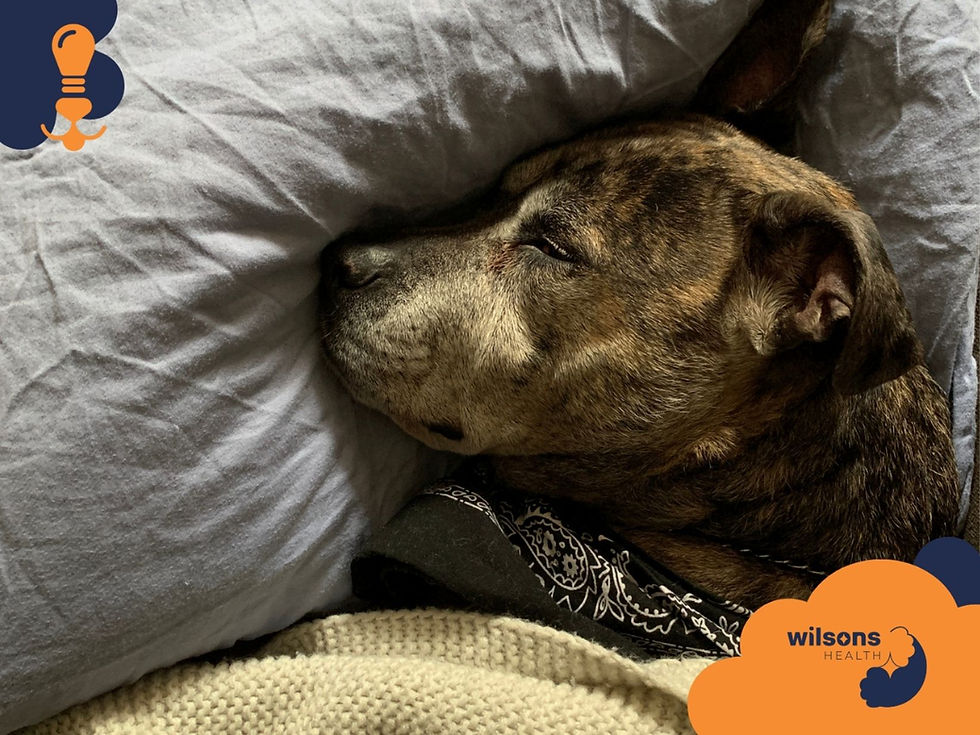
Senior dogs still use these strategies – but they’re also navigating aching joints, stiffness, and reduced flexibility. So the position that’s best for temperature may not be best for comfort. That trade-off shows up a lot in older dogs’ sleep.
Aging and thermoregulation: what changes?
We don’t have a perfect map of exactly how thermoregulation degrades with age in dogs. But we do know:
Older dogs in the study still had a diurnal temperature rhythm – their CBT still rose toward evening – but
Dogs with poorer memory had a lower peak temperature in the afternoon/evening.[1]
This suggests:
The internal systems that maintain a strong temperature rhythm may weaken with cognitive decline.
A “flatter” temperature curve could be one piece of the CCDS puzzle – though we don’t know if it’s cause, effect, or both.
In daily life, you might see:
A senior dog who seems cold more easily, seeking heat sources
Or one who overheats faster on walks, especially in summer
A dog who pants at night in a room that feels fine to you
All of these can be influenced by age-related changes in hormones, circulation, muscle mass, fat distribution, and brain regulation of temperature.

Seasons, light, and the aging dog’s internal clock
Dogs don’t live in a laboratory; they live in real weather. Seasons quietly reshape sleep and temperature regulation, especially in seniors.
In colder months
What tends to happen:[3][5]
Dogs sleep more overall in cold seasons
They may be less active outdoors, both from the cold and from joint discomfort
Older dogs with arthritis or stiffness may particularly seek warmth and long rest
On the hormonal side:
Shorter daylight in fall and winter can increase melatonin, the hormone that signals “nighttime” to the brain.[4][5]
This can shift sleep timing, making some dogs drowsier earlier or more inclined to nap.
For a senior dog, this can blur into:
“He’s sleeping all the time – is he depressed?”
“She doesn’t want to go out when it’s cold and just wants the heated bed.”
Sometimes, that’s simply an interaction of age, joints, and season – not a crisis. But it’s still worth mentioning to your vet, especially if it’s a sharp change from your dog’s usual winter pattern.
In warmer months
Heat introduces a different set of behaviors:[3]
Dogs often reduce intense activity in the hottest parts of the day
They choose cooler sleeping spots – tile floors, shaded areas, near fans
Sleep positions become more “stretched out” or belly-up to release heat
Older dogs may struggle more with:
Heat intolerance
Night‑time panting in warm rooms
Restlessness when the house is stuffy
Here, thermoregulation and sleep collide: if a dog can’t cool down efficiently, their sleep gets lighter and more broken.
Pain, cognition, and mood: sleep as a mirror, not just a symptom
It’s tempting to see sleep changes as a separate “sleep problem.” In aging dogs, sleep is more like a mirror reflecting other systems.
Pain and joint disease
Many older dogs live with some degree of arthritis or joint discomfort. This can:
Limit comfortable sleep positions
Cause frequent repositioning at night
Make them seek orthopedic bedding or soft surfaces for pressure relief[2]
Lead to irritability, grumpiness, or clinginess from chronic poor rest
Owners sometimes describe:
A dog who circles and circles, lies down, then pops back up
A dog who used to sprawl, now only curls tightly or avoids certain positions
More vocalization or sighing when settling
Addressing joint pain – medically and environmentally – can dramatically improve sleep quality, even without touching the sleep system directly.
Cognitive changes (CCDS and beyond)
Sleep changes are woven into the typical CCDS picture, which may include:
Night‑time restlessness or “sundowning” behaviors
Changes in circadian rhythm – awake at night, sleepy in the day
Increased anxiety or confusion after dark
The research we have suggests:
More daytime napping and flatter temperature rhythms are associated with poorer memory in seniors.[1]
Sleep and temperature patterns might eventually serve as non‑invasive markers of brain aging – but we’re not there yet.
For now, what matters practically is this:
Sleep changes can be an early, subtle sign that your dog’s brain is aging differently.
Not every sleepy old dog has CCDS – but persistent, disruptive pattern changes are worth discussing with your vet.
Mood and emotional wellbeing
The emotional side is less directly studied in dogs, but we can reasonably infer:
Fragmented or uncomfortable sleep makes most mammals more irritable, anxious, or “off.”
Older dogs with chronic discomfort or cognitive confusion may feel less secure at night.
Owners often internalize this as guilt: “He’s pacing at night; I must be failing him.” In reality, you’re watching complex biology unfold. Your job is not to fix aging; it’s to notice patterns and advocate for comfort.
What’s clearly known vs. what’s still murky
It can be calming to see where science is solid – and where it’s still squinting at the data.
Better established | Still uncertain / under study |
Older dogs sleep more overall and nap more during the day.[6][7] | The exact changes in sleep architecture (REM vs deep sleep) with age in dogs. |
Dogs change sleeping positions to regulate temperature and comfort.[2][7] | How specific thermoregulation changes directly cause cognitive decline, if they do.[1] |
Seasonal shifts (light, temperature) influence dog sleep and activity.[3][4] | The precise emotional impact of sleep changes on dogs’ mood and anxiety. |
Temperature regulation and sleep quality are linked in older dogs.[1][8] | Ideal environmental temperature ranges for every senior dog – this varies by breed, size, and health. |
Living with an older dog means living in that uncertain column a lot of the time. You’re not missing a secret manual; the manual doesn’t fully exist yet.

What this means for daily life with a senior dog
This is the part you live with at 2 a.m., on winter mornings, and in hot July bedrooms.
These aren’t medical instructions, but ways of thinking and observing that can support conversations with your vet and make daily care gentler on both of you.
1. Watch patterns, not single nights
Almost every dog – young or old – has weird nights. What matters more is trend:
Things to quietly track (even just in your phone notes):
Total hours asleep in 24 hours (roughly)
Daytime vs nighttime sleep – is the balance shifting?
New or worsening night‑time panting, pacing, or vocalizing
Changes in preferred sleep spots (warmer, cooler, softer, harder)
Seasonal shifts – is winter sleep different from summer in predictable ways?
These observations give your vet much more to work with than “He’s sleeping more.”
2. Think in terms of “comfort plus temperature”
For senior dogs, comfort and thermoregulation are intertwined:
Bedding:
Orthopedic or memory‑foam beds can ease pressure on joints.[2]
In cold months, a warmer or more insulated bed can reduce shivering and stiffness.[5]
In hot months, a cooler pad or tile floor access helps prevent overheating.[3]
Room environment:
Avoid extremes; seniors often tolerate a narrower comfort range.
Watch for drafts on older, thin-coated dogs in winter.
Use fans or good airflow in summer, especially at night.
Position freedom:
Give them space to choose their own position – stretched, curled, belly‑up.
If they’re suddenly avoiding a once-favorite position, that can be a pain clue.
3. Respect seasonal biology
Rather than fighting it:
In winter, expect more sleep and slower starts.
Gentle, shorter, more frequent walks may be kinder for stiff joints.
More light exposure during the day (open blinds, time outdoors when safe) may help keep the circadian rhythm anchored.[4][5]
In summer, expect heat‑avoidant behavior.
Time walks for cooler hours.
Let them sleep where the floor is cool, even if it’s not the coziest-looking spot.
If a change feels seasonal and gradual, it’s often less concerning than a sudden, dramatic shift that doesn’t fit the weather.
4. Use sleep as a conversation starter with your vet
Sleep and temperature changes are rarely “just sleep.” They can point toward:
Pain (arthritis, spinal issues)
Endocrine issues (like hypothyroidism or Cushing’s, which affect energy and temperature tolerance)
Cardiovascular or respiratory changes (contributing to night‑time panting)
Cognitive decline (CCDS)
Bringing specific examples helps:
“Over the last two months, he naps a lot more in the afternoon and seems disoriented if we wake him.”
“She pants heavily at night even when the room is cool, and lies on the tile instead of her bed.”
“In winter he used to still want long walks; this year he mostly wants to sleep by the heater.”
You’re not expected to sort “normal aging” from “disease” alone. Your role is to notice and describe.
5. Let go of the “lazy” story
Older dogs who sleep a lot are often labeled:
“Lazy”
“Depressed”
“Giving up”
Sometimes, yes, depression or illness is involved. But very often, you’re seeing:
A body that needs more recovery
A brain whose rhythms are softer and slower
Joints that feel better after long, warm rests
Reframing “He’s so lazy now” as “His biology is reallocating energy” doesn’t change the behavior. It changes the story you tell yourself – and usually, it’s a kinder one.
The ethical balancing act: comfort, activity, and “doing enough”
Caring for an old dog often means holding two truths at once:
They benefit from movement, for weight, joints, and mood.
They also genuinely need more rest and may be less heat- or cold-tolerant.
There’s no perfect formula for:
How warm the bed should be vs. whether that discourages exercise
How much to encourage walks vs. how much to let them sleep
When to invest in heated beds or cooling mats vs. when to adjust the house environment
These are shared decisions with your vet, guided by your dog’s specific conditions. And they’re ethical decisions too: how you weigh comfort, longevity, and daily joy.
What science can offer here is not a rulebook, but a quiet reassurance:
The fact that you’re asking these questions means you are already engaged and caring.
There is no single “right” balance point for every dog.
Aging changes in sleep and temperature regulation are expected, not a sign you failed.
Living alongside an aging body clock
When your dog was young, sleep probably felt invisible – something that just happened in the background. In old age, it moves into the foreground:
You notice the deeper sighs, the longer naps.
You feel the warmth of their body by your feet on winter nights.
You hear the panting in the dark and wonder what it means.
Biology is doing what biology does: circadian rhythms softening, thermoregulation getting less precise, brains and joints quietly accumulating years. Your job is not to stop that clock. It’s to keep your dog as comfortable, oriented, and secure as possible while it turns.
Understanding how sleep and temperature regulation change with age doesn’t take away the poignancy of those 3 a.m. moments. But it can replace some of the fear with recognition:
This is not random. This is not your fault. This is your dog’s body telling its age – and inviting you, as always, to keep listening.
References
Zanghi, B. M., & Kerr, W. (2014). Diurnal changes in core body temperature, day/night locomotor activity and spatial working memory in aged dogs. Available at: PMC.ncbi.nlm.nih.gov.
PetsCare.com. Decoding Dog Sleep Positions: Understand Your Pet.
Stamford Dog Trainer. Weather and Naps: How Seasons Affect Dog Sleep.
Snowy River Doodle. Seasonal Behavior Changes Dogs: Fall Psychology Guide.
Hometown Veterinary Hospital & Clinic (HVHCT.com). Seasonal Changes and Their Impact on Senior Pets.
Orvis.com. How Older Dogs' Sleep Habits Change.
MasterClass.com. How Dogs Sleep: 5 Common Dog Sleeping Positions Explained.
The Hungry Puppy. Understanding Your Pet’s Sleep Patterns and Creating the Perfect Rest Environment.

Comments